
Executive Summary
A fast-growing B2B SaaS company that powers advocacy-led marketing campaigns for enterprise clients needed to strengthen its AWS cloud security posture and prepare for ISO 27001 and SOC 2 compliance assessments. The company’s platform helps brands turn employees, customers, partners, and communities into a measurable distribution engine for campaigns, product launches, and events.
Teleglobal International partnered with the company to design and implement a full AWS security and governance framework. The project covered multi-account architecture, centralized security monitoring, continuous compliance management, backup and disaster recovery controls, and automated audit evidence collection using Scrut Automation. This engagement falls under Teleglobal’s Cloud Security services, built to help SaaS companies meet enterprise compliance requirements without slowing down product delivery.
| 5 Dedicated AWS Accounts | ISO 27001 Compliance Aligned | SOC 2 Audit-Ready | Scrut Compliance Platform | 3-Layer Security Controls |
Background
The client operates a SaaS-based advocacy-led growth platform. Enterprise marketing teams use it to run coordinated campaigns, launch viral contests and gamified promotions, track every share, comment, and conversion, and identify their most influential advocates. The platform combines automation, analytics, campaign orchestration, and AI-driven insights to support large-scale advocacy programs across digital channels.
As the company moved upmarket and started onboarding larger enterprise clients, the conversation around security changed. Prospective customers wanted proof of mature security controls, operational governance, and data protection before signing contracts. Compliance was no longer a future plan. It became a sales requirement.
The company needed an audit-ready AWS environment that could demonstrate the controls, monitoring capabilities, and governance processes required for ISO 27001 certification and SOC 2 attestation.
The Challenge
The company faced a set of interconnected security and governance gaps that stood in the way of compliance readiness and enterprise customer trust.
- Compliance Readiness
The organization was preparing for ISO 27001 and SOC 2 assessments but lacked a cloud environment that could demonstrate security controls, audit trails, and governance processes to external auditors.
- No Centralized Security Visibility
Security events and compliance findings were scattered across services and accounts. There was no single view of the security posture, which made risk management harder and auditor reviews more time-consuming.
- Manual Audit Evidence and Compliance Gaps
Generating audit evidence was manual and repetitive. AWS resources were not continuously evaluated against security baselines, so configuration drift went undetected between assessment cycles.
- Business Continuity and Governance
No structured backup or disaster recovery strategy existed. The cloud environment also lacked account segregation, centralized access management, and the governance controls needed to pass an external audit. The company needed a model that could scale alongside future compliance requirements without a rebuild.
The Solution
Teleglobal designed and implemented a comprehensive AWS security and governance framework tailored to the company’s compliance goals. The project was delivered as part of Teleglobal’s AWS Well-Architected review and Cloud Managed Services offerings.
Multi-Account AWS Architecture
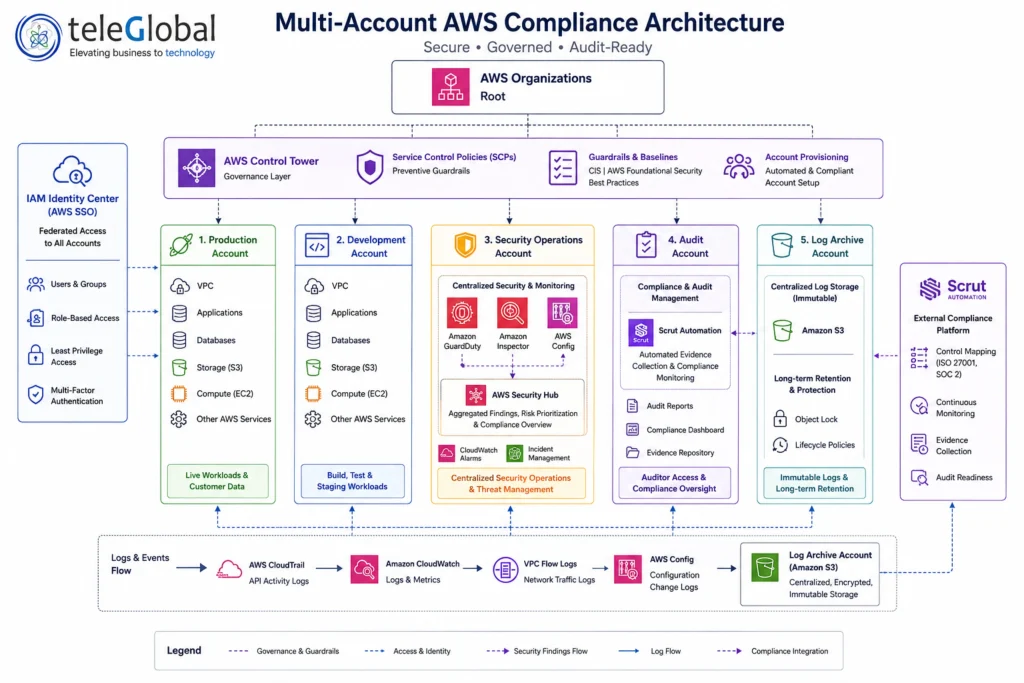
A multi-account governance strategy was implemented to create clear security boundaries and operational isolation. Five dedicated AWS accounts were provisioned:
- Production: Live customer-facing platform and data processing
- Development: Testing, staging, and feature builds
- Security Operations: Centralized security tooling and threat management
- Audit: Compliance findings, security assessments, and auditor access
- Log Archive: Immutable, long-term storage of all operational and security logs
This structure reduced the blast radius of any security incident, simplified access management, and aligned the environment with AWS security best practices and CIS AWS Foundations Benchmark recommendations.
Centralized Security Monitoring
AWS-native security services were deployed across all accounts to create a unified security monitoring layer:
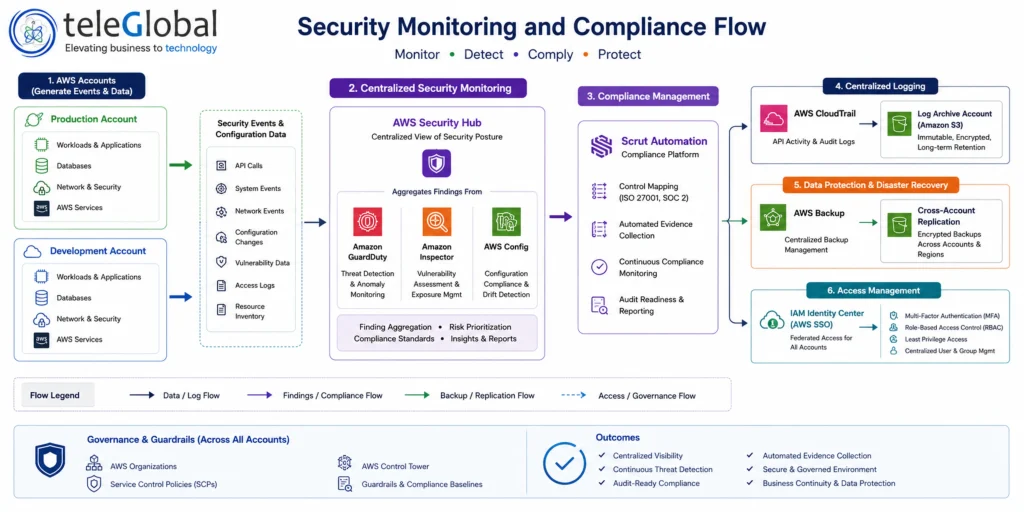
- AWS Security Hub as the centralized dashboard for aggregating findings, risk prioritization, and compliance reporting
- Amazon GuardDuty for continuous threat detection, anomaly monitoring, and account compromise identification
- Amazon Inspector for automated vulnerability assessments and exposure management across workloads
- AWS Config for continuous configuration evaluation against compliance policies and drift detection
- Amazon CloudWatch for operational monitoring, log management, automated alerting, and incident response
Compliance Management with Scrut Automation
Scrut Automation was integrated as the compliance management platform to address the manual audit evidence problem. The integration gave the company:
- Automated evidence collection tied directly to AWS controls and configurations
- Continuous compliance tracking against ISO 27001 and SOC 2 control requirements
- Control mapping between AWS services and compliance framework controls
- Risk management workflows and auditor collaboration features
This cut the time spent on audit preparation significantly and gave the compliance team real-time visibility into readiness posture.
Centralized Logging and Audit Trails
Dedicated Audit and Log Archive accounts were configured to centralize all logs across AWS accounts. AWS CloudTrail, CloudWatch Logs, and Amazon S3 were integrated to provide immutable audit trails, long-term log retention, simplified security investigations, and regulatory reporting support. Every action across every account is now traceable.
Backup and Disaster Recovery
A structured backup and disaster recovery framework was implemented using AWS Backup with defined RPO and RTO targets. The framework includes automated backup policies, cross-account backup protection, retention governance, and documented disaster recovery planning.
Identity and Access Security
Access governance was strengthened using AWS IAM best practices. The implementation included role-based access control (RBAC), least privilege enforcement, MFA across all accounts, segregation of duties, and privileged access management. These controls directly map to both ISO 27001 and SOC 2 access control requirements.
Security Governance Framework Alignment
The full environment was aligned with multiple industry-recognized frameworks:
- ISO 27001 information security management controls
- SOC 2 Trust Services Criteria for security, availability, and confidentiality
- AWS Well-Architected Framework security pillar
- CIS AWS Foundations Benchmark
- AWS Security Best Practices
AWS Services Used
| Category | AWS Services |
| Security & Compliance | AWS Security Hub, Amazon GuardDuty, Amazon Inspector, AWS IAM, AWS KMS |
| Monitoring & Logging | Amazon CloudWatch, AWS CloudTrail, Amazon S3 |
| Governance | AWS Organizations, AWS Control Tower, Service Control Policies (SCPs), AWS IAM Identity Center |
| Backup & Disaster Recovery | AWS Backup, Amazon S3 Versioning, Cross-Region Backup Strategy |
| Compliance Platform | Scrut Automation |
Results
| Area | Before | After |
| Compliance Readiness | No formal compliance controls or audit trails | Audit-ready AWS environment aligned with ISO 27001 and SOC 2 |
| Security Visibility | Fragmented security events across services | Centralized monitoring via Security Hub, GuardDuty, Inspector, Config, CloudWatch |
| Audit Evidence | Manual, time-consuming evidence collection | Automated evidence collection and compliance tracking through Scrut |
| Account Structure | Single account, no environment separation | Five dedicated accounts: Production, Development, Security Ops, Audit, Log Archive |
| Backup & DR | No structured backup or DR strategy | AWS Backup with defined RPO/RTO, cross-account protection, retention governance |
| Access Controls | Weak access governance, no MFA enforcement | RBAC, least privilege, MFA, segregation of duties via IAM Identity Center |
| Governance | No standardized cloud operating model | Multi-account governance with Control Tower, SCPs, and framework alignment |
What’s Next
With the audit-ready AWS environment in place, the company is positioned to move forward on several fronts.
- Complete ISO 27001 certification using the implemented controls and governance framework
- Finalize SOC 2 attestation through continued evidence collection and control monitoring via Scrut
- Implement automated security remediation using AWS Lambda, Systems Manager, and EventBridge
- Adopt Terraform-based Infrastructure as Code for consistent, auditable deployments
- Establish an ongoing continuous compliance program covering ISO 27001, SOC 2, CIS Benchmarks, and internal security policies
- Conduct regular disaster recovery testing and business continuity exercises
- Build toward Security Operations Center (SOC) readiness with dashboards, runbooks, and incident response procedures