| Author: Kamlesh Kumar | Published: 20-Mar-2026 |
Cloud migration is one of the biggest technology investments a business can make. And yet, many organizations go into it without an understanding of what it will actually cost. Budgets get stretched, timelines slip, and unexpected charges show up mid-project.
Working with professional cloud migration services ensures costs are scoped accurately from the start. This guide walks you through the cloud migration process and breaks down every cost involved in cloud migration, so you can plan accurately. Whether you are moving to AWS, Azure, or Google Cloud, the principles here apply.
What Does Cloud Migration Actually Cost in 2026?
Cloud migration costs vary widely based on the size and complexity of your environment. According to published 2026 pricing research, costs typically range from:
For a large enterprise migrating its entire infrastructure, the average project cost is around $1.2 million. The wide range exists because no two migrations are the same. The number of applications, how modern or outdated your current systems are, and how much refactoring is needed all drive the final number.
The 5 Main Cost Components of Cloud Migration
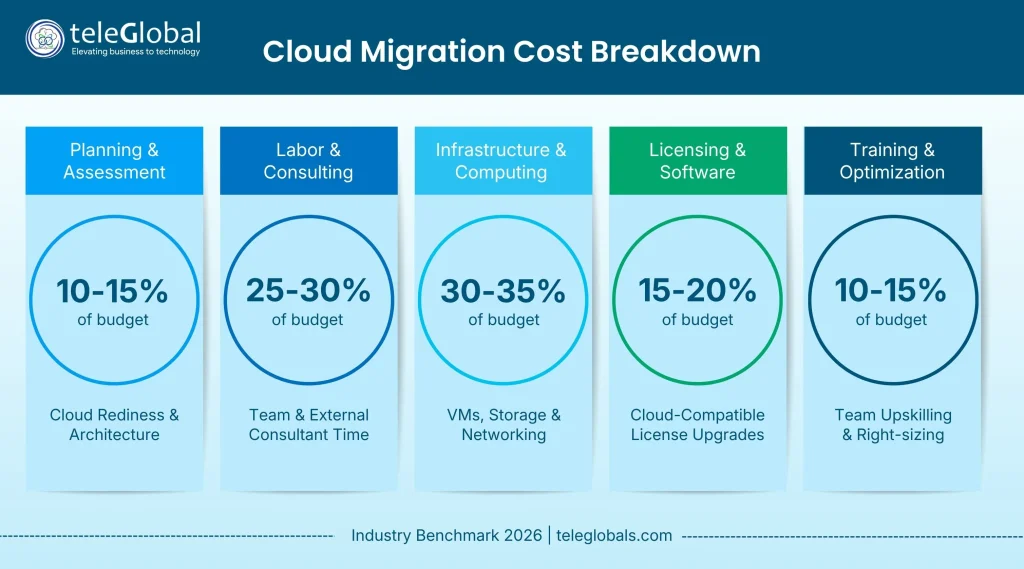
Before you can calculate your cloud migration cost, you need to understand what you are paying for. Here are the five areas that make up the total:
- Planning and Assessment (10-15% of Total Budget)
Before a single workload moves, you need to assess your current infrastructure. Understanding the cloud migration steps before you begin helps avoid costly corrections later. This phase covers cloud readiness assessments, architecture design, dependency mapping, and proof-of-concept testing. Skipping this phase is one of the most common budgeting mistakes because it leads to costly corrections later.
- Labor and Consulting (25-30% of Total Budget)
This is often the largest single line item. Internal teams diverted from their regular work, external consultants, cloud architects, and migration specialists all come at a cost. According to AWS documentation, software licensing costs alone can run 300% of the total compute cost if not planned carefully.
- Infrastructure and Compute (30-35% of Total Budget)
Once workloads land in the cloud, you start paying for virtual machines, containers, storage, and networking. One cost that frequently catches organizations off-guard is data egress: charges applied when data leaves the cloud environment. In AWS, data transfer into the cloud is typically free, but transfers out accumulate quickly at enterprise scale.
- Software Licensing (15-20% of Total Budget)
Not all your existing licenses carry over to the cloud. Some on-premise software requires a fresh subscription for cloud use. Organizations that assume existing licenses are transferable often discover mid-project that they need new agreements, which adds both cost and delay.
- Training and Post-Migration Optimization (10-15% of Total Budget)
Getting your team ready to manage a cloud environment takes time and investment. Post-migration, there is also a period of optimization, right-sizing resources, adjusting configurations, and clearing up costs from parallel infrastructure that ran during the transition. Industry data shows that indirect costs like these regularly add 20-30% to initial estimates.
Is Your Migration Budget at Risk of Escalating?
Get Your Free Cost Audit Now →Typical cloud migration cost breakdown by category
Cloud Migration Cost by Company Size and Cloud Migration Strategies
The cloud migration strategy you choose has a direct impact on cost and timeline. Here is how the main approaches compare:
| Strategy | Typical Cost Range | Timeline |
| Rehost (Lift & Shift) | $5,000-$50,000 per app | 1-4 weeks per app |
| Replatform | $50,000-$200,000 per app | 2-8 weeks per app |
| Refactor / Re-architect | $200,000-$1M+ per app | 2-6 months per app |
| Repurchase (SaaS) | $10,000-$100,000 | 2-6 weeks |
| Full Data Center Exit | $500,000-$5M+ | 9-24 months |
Rehosting is the fastest and most affordable approach but offers limited optimization. Refactoring delivers the most cloud-native benefits but requires the highest investment. Most mid-size organizations use a mix of strategies. Teleglobal International’s Cloud Consulting Services help you identify the right combination for your workloads and budget.
Cloud Migration Challenges and Hidden Costs Most Companies Miss
These are the costs that do not appear in vendor pricing calculators but regularly blow budgets:
- Parallel infrastructure costs: Running both on-premise and cloud environments simultaneously during transition, often for 2-4 months.
- Data egress fees: Charges for transferring data out of the cloud. These scale fast at enterprise data volumes.
- Downtime costs: Unplanned outages during cutover carry real revenue impact. Cloud downtime can cost between $300,000 and $5.6 million per incident.
- License renegotiation: New cloud-compatible licenses for tools that do not transfer automatically.
- Security and compliance setup: Configuring access controls, audit logging, and compliance frameworks in the new environment.
- Cloud to Cloud Migration fees: For organizations considering moving between providers, data transfer costs are especially significant and often underestimated.
Teleglobal International’s Cloud Security Services ensure that compliance and security costs are scoped accurately from day one, rather than discovered as surprises after go-live.
How to Reduce Your Cloud Migration Costs
Smart planning before you start can significantly lower your total cost:
- Use a cloud readiness assessment to understand your current environment before scoping migration work.
- Choose Reserved Instances or Savings Plans instead of on-demand pricing once your workloads are stable. Reserved Instances can reduce compute costs by up to 72% compared to on-demand rates.
- Consolidate workloads where possible. Running multiple workloads in a single virtual machine is more cost-effective than one VM per workload.
- Phase your migration in waves. Starting with lower-complexity workloads builds team experience and reduces overall cost for subsequent phases.
- Use the right cloud migration tools for assessment and workload analysis to significantly reduce manual effort and cost. Use a multi-cloud pricing comparison tool to ensure you are on the right platform for each workload. Teleglobal International’s Multi-Cloud Pricing Calculator gives you a clear cost comparison across AWS, Azure, and Google Cloud for free.
For organizations moving larger workloads, Teleglobal International’s Cloud Migration and Modernization Services cover the full migration lifecycle from assessment through post-migration optimization.
Frequently Asked Questions
Q. 1 What is the average cost of cloud migration in 2026?
Costs range from $40,000 for small businesses to over $5 million for large enterprises with complex infrastructure. The average enterprise project costs around $1.2 million. Mid-size companies typically spend $100,000 to $500,000 over a 12 to 24-month migration project.
Q. 2 What is the cheapest way to migrate to the cloud?
Rehosting, also called lift-and-shift, is the fastest and most affordable approach. It moves your existing applications to the cloud without significant changes, starting at around $5,000 per application. It does not unlock all cloud-native benefits but gets you into the cloud quickly and at lower upfront cost.
Q. 3 How long does cloud migration take?
A small workload with 1-10 applications typically takes 1-3 months. A mid-size project with 10-50 applications takes 3-9 months. Large enterprise migrations with 50 or more applications and complex legacy systems can take 9-24 months. The timeline depends heavily on how modern your current systems are and how much refactoring is needed.
Q. 4 What are the most common hidden costs in cloud migration?
Parallel infrastructure costs, data egress fees, software license renegotiation, security and compliance configuration, and post-migration optimization are the most frequently overlooked expenses. These hidden costs typically add 20-30% to initial estimates.