| Author: Ashish Kumar | Published: 16-Mar-2026 |
Two of the most common ways businesses fill technology skill gaps today are staff augmentation and managed services. Both give you access to skilled professionals without building a full in-house team. But they work very differently, and choosing the wrong one can cost you time, money, and control.
The combined IT staff augmentation and managed services market was valued at $339.96 billion in 2024 and is expected to reach $1,218.86 billion by 2033. With that level of growth, more businesses are asking the same question: which model is the right fit for what we need to do? This guide explains both models, so you can make the right call for your business.
| $339.96B Combined market size in 2024 (IT Staff Aug + Managed Services) | $1,218.86B Projected market size by 2033 (CAGR 13.7%) | 30-50% Cost saving with staff augmentation vs full-time employee hiring |
What Is IT Staff Augmentation?
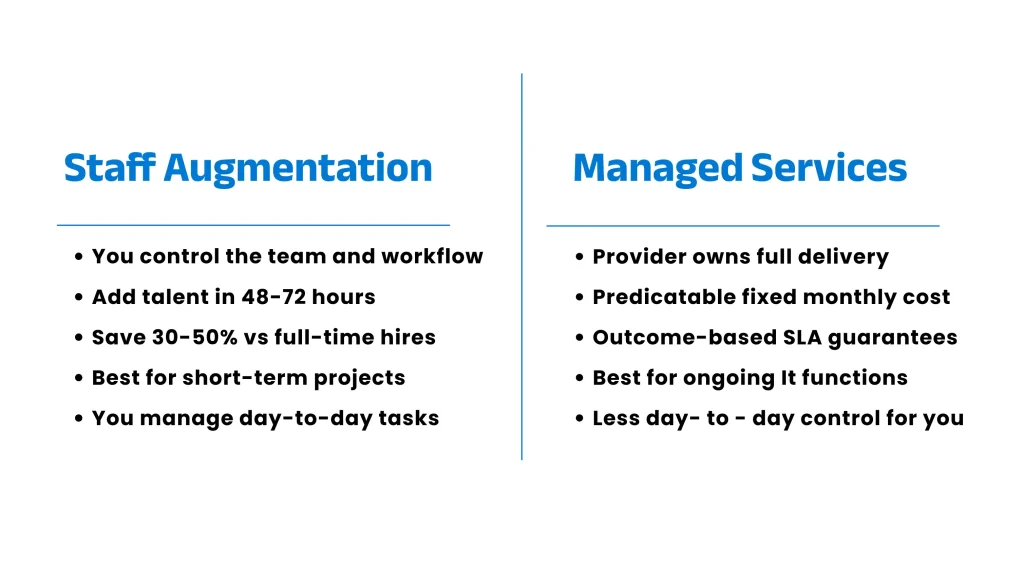
Staff augmentation is an IT outsourcing model where you bring in external professionals to work directly within your existing team. You keep full control. You set the tasks, manage the workflow, and direct the people. The staff augmentation provider handles recruitment, payroll, and administration.
According to industry research, most staff augmentation providers can build and place a team within 48 to 72 hours, compared to 3 to 6 months for traditional hiring. Companies using this model typically save 30 to 50% on staffing costs compared to hiring full-time employees, since there are no benefits, equipment, or long-term salary commitments.
When Staff Augmentation Works Best
- You have a short-term project with a defined end date
- You need a specific technical skill your team does not have, such as cloud engineers, AI specialists, or DevOps experts
- You want to keep direct control over how work is done and how people are managed
- You need to scale a team fast without committing to permanent headcount
- You are testing a specialist before deciding on a full-time hire
What Are Managed Services?
Managed services means handing over an entire IT function to a third-party provider. Instead of managing people, you agree on outcomes. The provider takes full responsibility for delivery, performance, maintenance, and reporting, all governed by a Service Level Agreement (SLA).
The global managed services market, valued at USD 365.33 billion in 2024, is projected to reach USD 511.03 billion by 2029, growing at a CAGR of 6.9%, according to MarketsandMarkets. You pay a fixed monthly or subscription fee, which makes costs predictable. The provider carries the operational risk. If something breaks or performance drops below the SLA threshold, it is their responsibility to fix it.
When Managed Services Work Best
- You need ongoing management of an IT function, such as cloud infrastructure, cybersecurity, or IT support
- You want a predictable monthly cost with no budget surprises
- You do not have the in-house expertise to manage a complex technical function day to day
- You want a provider to take full accountability for outcomes, not just provide people
- You are scaling operations and need a reliable partner who can grow with you
Staff Augmentation vs Managed Services: Head-to-Head Comparison
| Factor | Staff Augmentation | Managed Services |
| Control | You manage the team fully | Provider manages delivery |
| Best for | Short-term, project-based needs | Ongoing IT functions & operations |
| Pricing | Pay per hour / resource used | Fixed monthly or subscription fee |
| Speed to start | New talent in 48-72 hours | Onboarding takes 2-4 weeks |
| Scalability | Scale up or down quickly | Smoother long-term scalability |
| Risk ownership | You carry the execution risk | Provider carries delivery risk |
| Team control | Full visibility and oversight | Less day-to-day involvement |
| Cost saving | 30-50% less than full-time hires | Predictable, no surprise costs |
Staff Augmentation vs Managed Services: Cost Comparison
Cost is usually the first question businesses ask. Here is how the two models compare in real terms:
Staff augmentation: You pay for hours worked or resources deployed. Typical rates for IT professionals range from $25 to $150 per hour depending on skill level and geography. Saves 30-50% vs full-time equivalent hiring costs. Managed services: You pay a fixed monthly fee based on scope, typically ranging from $1,000 to $10,000+ per month for SMBs and significantly more for enterprise environments. Costs are fully predictable, with no hidden charges for overtime or additional headcount.
For short-term or flexible needs, staff augmentation is usually more cost-effective. For long-term, stable functions, managed services offer better value because the provider absorbs operational risk and inefficiencies.
Use Teleglobal International’s Multi-Cloud Pricing Calculator to estimate cloud infrastructure costs alongside your staffing model, so your total technology budget is accurate from day one.
How to Decide Which Model Is Right for Your Business
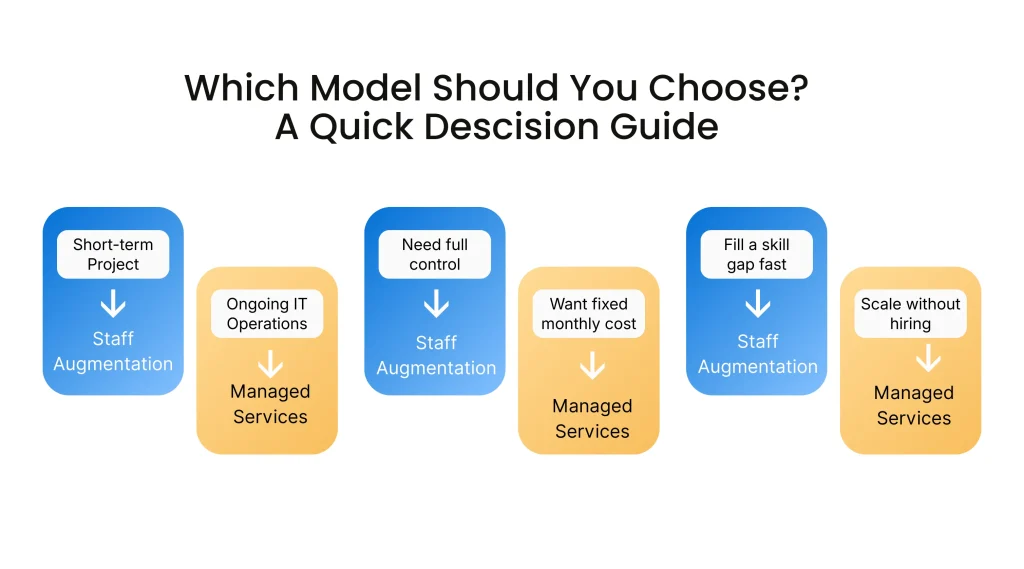
The right model depends on four things: how long you need support, how much control you want, how specialized the work is, and whether your need is a project or an ongoing function.
Choose staff augmentation if: your need is specific, short-term, and requires you to stay in control of the team. Examples include a product launch, a cloud migration project, or a six-month development sprint.
Choose managed services if: you need a function running reliably over the long term and you want a provider to own the outcome. Examples include managed cloud operations, 24/7 IT support, or ongoing cybersecurity monitoring.
Many businesses use both. Industry experts note that in 2026 the strongest teams combine staff augmentation for flexibility with managed services for operational stability. The advantage comes from knowing when to keep control and when to hand it off.
Teleglobal International offers both Staff Augmentation Services and Cloud Managed Services. Whether you need to plug a specific skill gap or hand over an entire cloud function, our team helps you find the right model for where your business is right now.
Why Getting This Decision Right Matters More Than Ever in 2026
IDC forecasts that over 90% of companies will face a significant IT skills gap by 2026, leading to a potential $5.5 trillion in lost productivity worldwide. At the same time, global IT outsourcing spending is set to reach $806.55 billion by 2030. The businesses that come out ahead will not be the ones that spend the most. They will be the ones that chose the right model for the right job.
Whether you need IT consulting support to evaluate your current setup or IT infrastructure management on an ongoing basis, Teleglobal International has teams ready to support both models.
Frequently Asked Questions
1. What is the main difference between staff augmentation and managed services?
With staff augmentation, you hire external professionals who work inside your team under your management. With managed services, you hand over an entire IT function to a provider who takes full ownership of delivery, performance, and outcomes. The core difference is control: you keep it with staff augmentation and delegate it with managed services.
2. Is staff augmentation cheaper than managed services?
For short-term or project-based needs, staff augmentation is usually more affordable because you only pay for the hours or resources you use. Managed services cost more upfront but offer predictable fixed pricing and include the provider absorbing operational risk. For long-term functions, managed services often deliver better total value.
3. How fast can you get staff augmentation resources in place?
Most IT staff augmentation providers can source and place professionals within 48 to 72 hours, with work beginning within a week. This is significantly faster than traditional hiring, which typically takes 3 to 6 months from job posting to start date.
4. Can a business use both staff augmentation and managed services at the same time?
Yes, and many do. A common approach is to use staff augmentation for specific project-based or short-term needs where you want direct control, while using managed services for ongoing functions like cloud operations, IT support, or cybersecurity where you want the provider to own the outcome.
5.How can Teleglobal International help with staff augmentation or managed services?
Teleglobal International offers IT staffing and staff augmentation services as well as cloud managed services, IT infrastructure management, and IT consulting. The team works with businesses to find the right model based on their goals, timeline, and budget. Visit teleglobals.com to connect with an expert.