Business leaders are under pressure to move faster and deliver more with fewer resources. Traditional automation helps, but it only goes so far. What companies need today are systems that can think, plan, and act on their own. That is where agentic AI for business comes in.
In 2026, agentic AI has crossed from experimentation to enterprise infrastructure. The global agentic AI market was valued at USD 9.89 billion in 2026 and is projected to reach USD 57.42 billion by 2031, growing at a CAGR of 42.14%. Across industries, 79% of enterprises have adopted AI agents in some form, though only 11% have moved them into production, which defines the primary challenge of this moment.
A Gartner study predicts that by 2027, more than 40% of agentic AI projects will fail if they lack clear outcomes. But those that succeed, backed by the right architecture, governance, and implementation partner, are fundamentally changing how companies operate.
This article explains what agentic AI is, how it differs from generative AI, how it works, real use cases by industry, ROI data, risks, and a practical implementation framework. We also look at how TeleGlobal International helps businesses adopt agentic AI safely and at scale.
What is an agent in AI?
An agent in AI is a system that can take action toward a goal without step-by-step human guidance. Unlike simple bots, agents can:
Perceive their environment.
Decide the best course of action.
Carry out tasks.
Learn and adapt over time.
Think of it as a digital co-worker that not only answers questions but can also plan, execute, and finish tasks on its own.
What is agentic AI?
Agentic AI is a framework where multiple agents collaborate, plan, and act to complete complex tasks. Instead of waiting for instructions, these agents break down large goals into smaller steps, handle them, and report results back.
For businesses, this means systems that not only assist but actively drive outcomes. They can connect across software, make decisions using live data, and keep improving with experience.
Agentic AI vs. Generative AI: What’s the Difference?
Generative AI (such as GPT-4, Claude, and Gemini) creates content, answers questions, and responds to prompts. It requires human input for every task.
Agentic AI goes beyond content generation. It can plan, make decisions, and execute multi-step workflows to achieve a specific goal with minimal human intervention.
Generative AI
Agentic AI
What it does
Responds to prompts, generates content
Pursues goals, executes workflows
Human input
Required at each step
Required only for goal-setting and oversight
Task scope
Single task per prompt
Multi-step, multi-system workflows
Learning
Fixed at training time
Adapts based on real-time outcomes
Example
“Draft this email”
Identifies who to email, drafts it, sends it, logs the response in CRM, schedules follow-up
Most enterprise Agentic AI solutions use Generative AI as their reasoning engine, adding memory, tools, and workflow automation to turn insights into actions.
In simple terms: Generative AI helps people work faster. Agentic AI helps businesses automate entire processes.
Agentic AI Market Growth and Enterprise Adoption in 2026
Agentic AI is rapidly evolving from an emerging technology to a strategic business investment.
Market Growth
The global Agentic AI market is expected to reach USD 9.89 billion in 2026 and grow to USD 57.42 billion by 2031, with a CAGR of 42.14%.
New Agentic AI deployments increased 3.2 times year-over-year between 2025 and 2026.
By 2026, 40% of enterprise systems are expected to include task-specific AI agents, compared to less than 5% in 2025.
Enterprise Adoption by Industry
Industry
Adoption Rate
Financial Services
91%
Technology
88%
Healthcare
74%
Retail & eCommerce
72%
Manufacturing
68%
Professional Services
65%
The Real Challenge: Moving from Pilot to Production
While 79% of organizations have adopted AI agents in some capacity, only 11% have successfully deployed them in production environments.
The most common barriers include:
Infrastructure limitations (41%)
Governance and security concerns (38%)
Difficulty measuring ROI (33%)
Organizations that overcome these challenges and successfully scale Agentic AI are seeing significant business impact, with an average 171% return on investment (ROI) and some implementations delivering 5x to 10x returns.
The opportunity in 2026 is no longer adopting Agentic AI; it’s operationalizing it at scale.
Why businesses need agentic AI in 2026
Companies in every industry face a mix of challenges: rising costs, growing customer demands, and skill shortages. Agentic AI for businesses answers these challenges by:
Speeding up decision-making.
Reducing repetitive manual work.
Improving customer response time.
Lowering errors in finance, IT, and operations.
Agentic AI use cases in 2026
The real strength of agentic AI use cases in enterprise lies in how it is applied. Here are some of the most impactful agentic AI use cases 2026:
Finance and risk management
Fraud detection across millions of transactions in real time.
Credit scoring that adapts to new patterns.
Automated compliance checks.
Financial services leads all industries in agentic AI adoption, with a 91% adoption rate among institutions surveyed in 2026. PayPal’s agentic fraud detection system analyses hundreds of millions of transactions daily, identifying anomalies that no human team could monitor at that scale. Banks implementing agentic AI for KYC and AML workflows are reporting 200% to 2,000% productivity gains on those specific processes. By early 2026, 21% of firms have deployed AI agents that autonomously route transactions to optimised payment networks in under 200 milliseconds.
Customer service
Virtual agents that handle returns and refunds.
Smart support systems that resolve queries before they reach human teams.
Customer support is the highest-deployment agentic AI use case across industries, with a 43% current deployment rate among enterprises surveyed (Digital Applied). Gartner forecasts that by 2029, agentic AI will autonomously resolve 80% of common customer service issues without human intervention.
Sales and marketing
Automated data entry in CRM systems.
Smart lead scoring and follow-up.
Personalized outreach that improves conversion.
Sweep, which raised $22.5 million to automate sales workflows on Salesforce and HubSpot, is one of the clearest examples of agentic AI creating enterprise value in the sales function.
IT and operations
Predictive monitoring of servers and networks.
Automated resolution of common support tickets.
Self-healing systems that act before failures occur.
SuperOps launched an agent marketplace for IT service providers that demonstrates the operational impact at scale. Enterprises deploying agentic AI in IT operations are reporting up to a 40% reduction in manual workloads for routine monitoring and support tasks.
Security and compliance
Threat detection and response across systems.
Continuous audits for compliance with regulations.
Consumer services
Voice-enabled assistants like Ola’s Kruti in India, which books rides and food deliveries while understanding 13 languages.
Top business use cases of agentic AI in 2026
USE Case Area
Example in 2025
Business Impact
Finance
PayPal fraud detection workflows
Safer transactions, lower risk
Customer Service
Retail return handing systems
Faster response, improved customer trust
Sales & Marketing
Sweep automating Salesforce tasks
Higher Sales efficiency
IT Management
SuperOps agent marketplace for MSPs
Up to 40% drop in Manual workloads
Security
Microsoft Security Copilot and CrowdStrike
Faster detection, stronger protection
Consumer Services
Ola Kruti digital assistant
Convenience for millions of Users
Real examples of agentic AI
PayPal uses agentic workflows to monitor orders and stop fraud.
Microsoft Security Copilot integrates with CrowdStrike to improve cyber defense.
Sweep raised $22.5M to automate sales on Salesforce and HubSpot.
SuperOps launched an agent marketplace for IT service providers.
Ola’s Kruti helps millions in India with ride bookings and food orders.
These are not pilots or tests. They are examples of agentic AI driving real change in 2026.
Benefits of agentic AI for businesses
The benefits of agentic AI go beyond cost savings — though the cost savings alone justify the investment for most organisations.
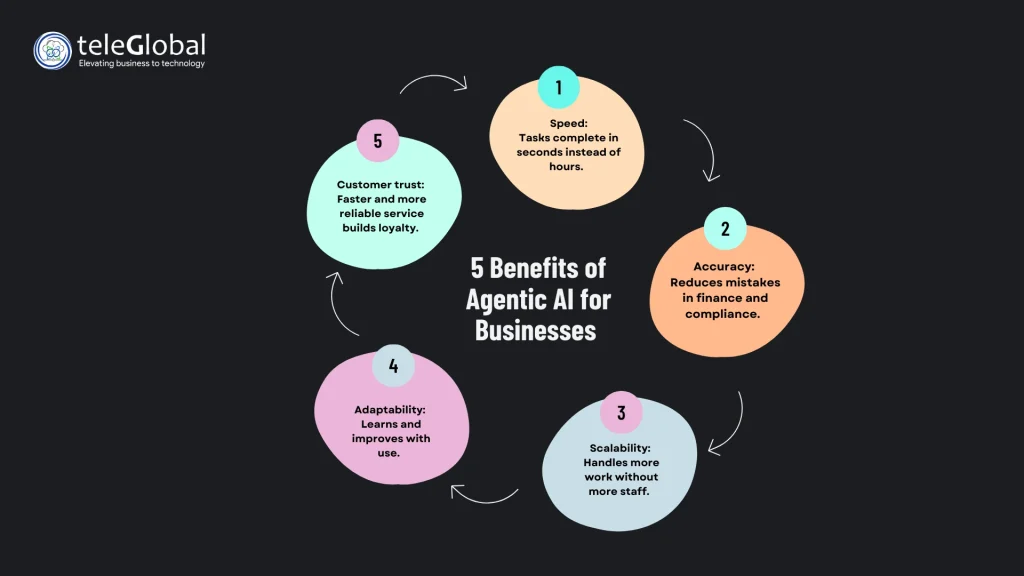
Speed: Tasks complete in seconds instead of hours.
Accuracy: Reduces mistakes in finance and compliance.
Scalability: Handles more work without more staff.
Adaptability: Learns and improves with use.
Customer trust: Faster and more reliable service builds loyalty.
Risks and challenges
Adoption is not without risks. Gartner predicts 40% of projects may be dropped by 2027 due to unclear outcomes.
Key risks include:
High cost of poor design.
Security concerns like data leaks.
Weak governance leading to bad decisions.
False claims from vendors selling basic bots as “agents.”
How to Implement Agentic AI: A 5-Step Framework
Organizations successfully deploying Agentic AI at scale tend to follow a structured approach. Here’s a practical framework to guide implementation.
Step 1: Start with High-Impact Use Cases
Avoid beginning with your most complex AI initiative. Instead, focus on repetitive, high-volume processes where outcomes are measurable and risks are manageable.
Common starting points include:
Customer service automation
IT ticket resolution
Invoice processing
Employee support workflows
Prioritize use cases that deliver high business value with lower implementation complexity.
Step 2: Evaluate Data and Infrastructure Readiness
Before deploying Agentic AI, assess whether your organization is prepared to support it.
Key areas to review:
Data quality and accessibility
API integrations with existing systems
Security and access controls
Cloud and infrastructure capacity
A strong foundation is essential for reliable AI performance.
Step 3: Design the Right Architecture
Choose an architecture that aligns with your business goals, security requirements, and scalability needs.
Key decisions include:
Single-agent vs. multi-agent systems
Cloud-native vs. on-premises deployment
AI model selection
Integration and orchestration strategy
These choices will directly impact future scalability, governance, and operational costs.
Step 4: Build with Governance from Day One
Governance should be part of the implementation process—not an afterthought.
Establish:
Approval workflows
Escalation procedures
Security controls
Audit and compliance requirements
Human oversight mechanisms
This helps ensure AI operates safely, transparently, and responsibly.
Step 5: Monitor, Optimize, and Scale
Agentic AI requires continuous improvement after deployment.
Track:
Response accuracy
Workflow success rates
System performance
Business outcomes and ROI
Regular monitoring and optimization help maintain performance and support long-term scalability.
The most successful organizations treat Agentic AI as an ongoing business capability, not a one-time technology project.
Future of enterprise AI in 2026 and beyond
Agentic AI is quickly becoming a core part of enterprise technology strategies.
According to Gartner, 40% of enterprise systems will include task-specific AI agents by 2026, up from less than 5% in 2025. This marks a shift from AI experimentation to real-world business adoption.
The Stanford Human-Centered AI Institute (HAI) describes 2026 as the year Agentic AI moves into the mainstream. Looking ahead, multi-agent ecosystems are expected to transform how users interact with software, enabling AI agents to collaborate across applications and business functions to achieve outcomes, not just complete tasks.
By 2026, most large firms are testing enterprise AI 2026 projects. The next wave will focus on:
Smarter cross-system automation.
Deeper personalization in customer journeys.
Stronger compliance with global data rules.
Growth in AI business automation across every industry.
The companies that succeed will redesign workflows around agents, not just add them to existing systems.
Benefits vs Challenges of agentic AI
Benefits
Challenges
Faster results
High upfront costs
Lower manual Work
Complex integration
Better decisions with live data
Security and compliance risks
Grater scalability
Slow ROI if poorly managed
Improved customer trust
Vendor over-promise
Conclusion
Agentic AI is no longer a future initiative; it’s becoming a competitive advantage. With most enterprises already exploring AI agents, the real challenge is moving from pilots to production and delivering measurable business results.
Success depends on four key factors:
Choosing the right business use cases
Building scalable AI infrastructure
Establishing governance and security from day one
Partnering with experts who understand enterprise AI deployment
At TeleGlobal International, we help organizations assess readiness, design AI architectures, deploy production-grade agentic AI solutions, and manage them at scale.