Summary: An AI readiness assessment checklist confirms that your strategy, data, infrastructure, governance, people, and operations can support AI in production. In 2026, 89% of organizations use AI in at least one business function, yet only 37% report any EBIT impact (McKinsey). The gap is rarely the model. It is the foundation. This guide covers the six areas to assess, a five-step process, a scoring model, the most common gaps, and the extra controls AI agents require.
| Author: Ashish Kumar | Published Date: 19-Nov-2026 |
What Is an AI Readiness Assessment?
An AI readiness assessment is a structured review of whether an organization can build, deploy, and operate AI safely and at scale. It identifies the gaps that will block production use cases and produces a prioritized roadmap with owners and timelines.
Unlike an AI maturity model, which benchmarks overall capability against an industry curve, a readiness assessment is tied to specific use cases.
Why an AI Readiness Assessment Matters in 2027
Adoption is no longer the challenge. The real challenge is translating it into measurable business value.
- Value is stalling: AI high performers, those attributing at least 5% of EBIT to AI, remain flat at about 6% of organizations, and 20% say AI operating costs have constrained use (McKinsey).
- Data is the main blocker: Gartner predicts that through 2026, organizations will abandon 60% of AI projects unsupported by AI-ready data (Gartner).
- Readiness pays off: Only 13% of organizations are fully AI-ready, and they are 4x more likely to move pilots into production and 50% more likely to see measurable value (Cisco).
- Regulation has fixed dates: Under the amended EU AI Act, stand-alone high-risk AI rules apply from December 2, 2027, and embedded high-risk AI rules from August 2, 2028 (European Parliament).
The AI Readiness Assessment Checklist: Six Areas to Review
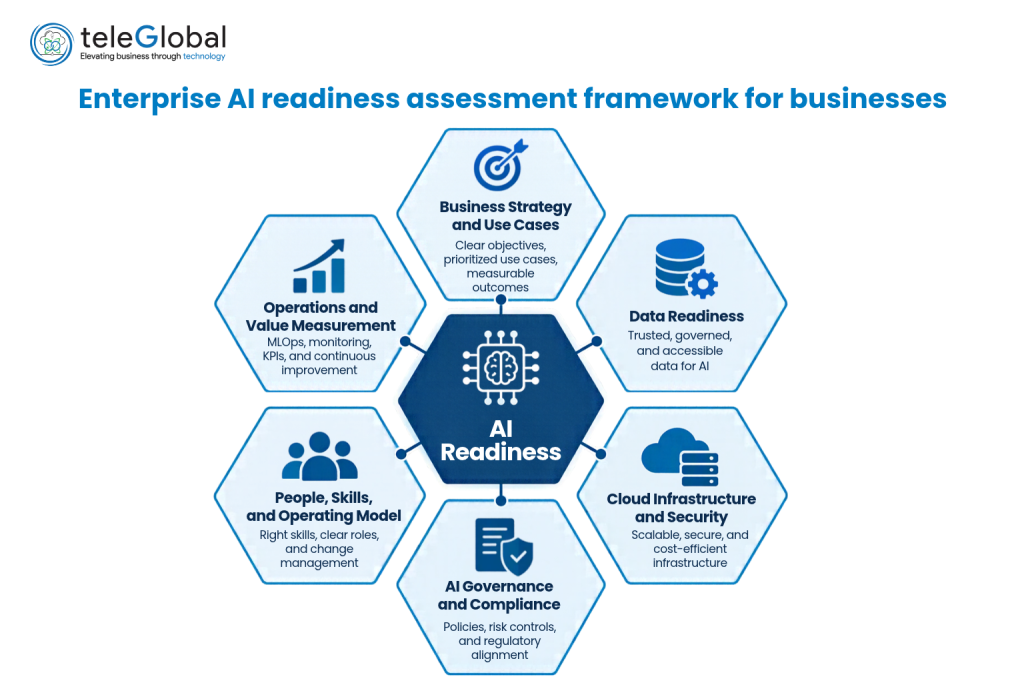
Mark an item complete only when evidence exists: an approved policy, a running system, a named owner, or a tracked metric.
1. Business Strategy and Use Cases
- AI objectives linked to specific business outcomes and KPIs
- Use cases ranked by value, feasibility, and risk
- Executive sponsor and approved budget for each priority use case
- Baseline metrics recorded before any pilot starts
99% of AI leaders have a well-defined AI strategy, compared with 58% of organizations overall (Cisco).
2. Data Readiness: Building AI-Ready Data
- Data sources mapped to each use case, with named data owners
- Data quality, lineage, and metadata documented
- Classification and access controls for sensitive and personal data
- Pipelines for both training data and live production feeds
- Documents and knowledge content indexed for retrieval-augmented generation (RAG)
Only 19% of organizations have fully centralized data. AI-ready data is judged per use case and maintained continuously, not cleaned once. See Teleglobal’s data analytics services.
3. Cloud Infrastructure and Security
- Scalable compute, such as GPU capacity, Amazon Bedrock, or Amazon SageMaker
- Network capacity and latency tested for AI workloads
- Encryption at rest and in transit, private connectivity, and least-privilege IAM
- Logging and monitoring for model endpoints and data access
- Cost guardrails for inference and token usage
Only 15% of organizations have networks fully ready for AI. Meanwhile, 86% of organizations reported an AI-related security incident in the past 12 months. Validate your cloud security baseline before rollout.
4. AI Governance and Compliance
- Approved AI usage policy, including generative AI tools and shadow AI
- AI system inventory with a risk classification for each system
- Controls aligned to the NIST AI Risk Management Framework or ISO/IEC 42001
- Regulatory mapping for the EU AI Act, India’s DPDP Act, and sector rules
- Human review and escalation paths for high-impact decisions
60% of organizations do not know the specific requests employees make to generative AI tools. Gartner also predicts that by 2027, 60% of organizations that ignore data governance culture challenges will fail to govern AI successfully (Gartner).
5. People, Skills, and Operating Model
- Defined roles for data engineering, ML engineering, MLOps, and security
- AI literacy training for business users
- Change management plan for redesigned workflows
- Clear ownership after the implementation team exits
91% of AI leaders have a change management plan, compared with 35% overall.
6. Operations and Value Measurement
- MLOps for deployment, versioning, and rollback
- Monitoring for model drift, accuracy, latency, and cost
- KPI dashboard linking each use case to financial outcomes
- Scheduled review to retire, retrain, or scale each use case
How to Run an AI Readiness Assessment in Five Steps
- Define scope: Select two to five priority use cases.
- Assemble stakeholders: Include business sponsors, data owners, IT, security, legal, and end users.
- Collect evidence: Review architecture, data catalogs, policies, access controls, and cost reports.
- Score each area: Apply the scoring model below and record the evidence behind every score.
- Build the roadmap: Rank fixes by impact on the priority use cases, assign owners, and define success metrics for the first pilot.
How to Score Enterprise AI Readiness
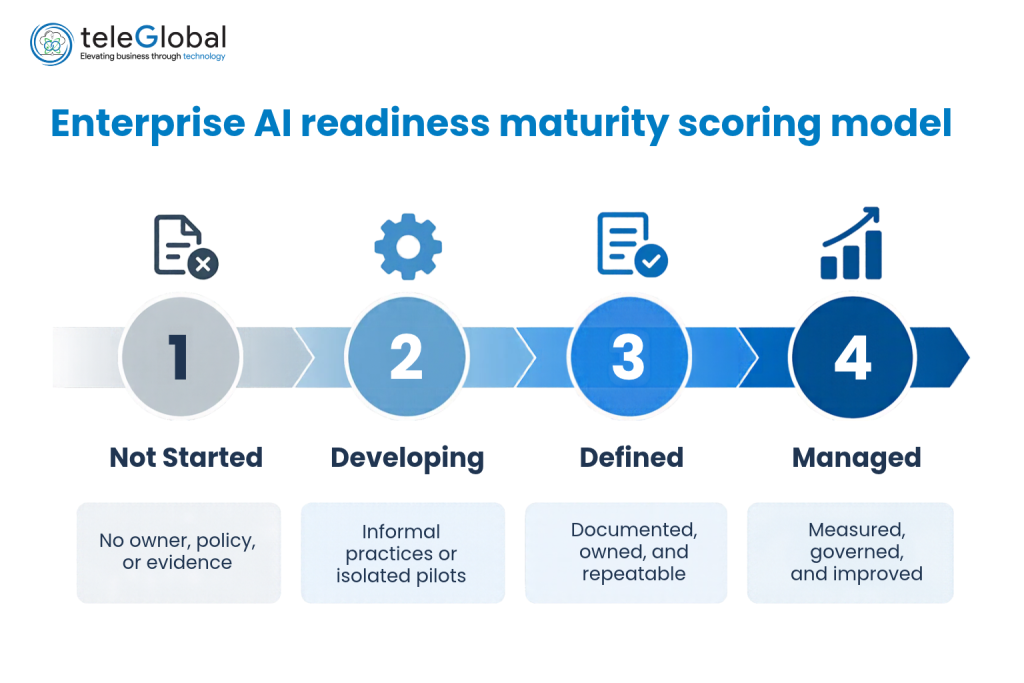
Rate each checklist item from 1 to 4, then average the scores for each area
| Score | Level | What It Means |
|---|---|---|
| 1 | Not started | No owner, policy, or evidence |
| 2 | Developing | Informal practices or isolated pilots |
| 3 | Defined | Documented, owned, and repeatable |
| 4 | Managed | Measured, governed, and improved |
Below 2, fix foundations first. Between 2 and 3, run controlled pilots with defined success metrics. Above 3, standardize and scale. Your lowest-scoring area sets the pace.
Common Enterprise AI Readiness Gaps
- No baseline metrics: Without a pre-pilot baseline, value cannot be proven to finance.
- Ownerless data: Quality issues surface mid-pilot because no one owns the source.
- Late security review: Security and compliance join after the build, forcing rework.
- Uncontrolled costs: Inference spend grows faster than value.
- No post-launch owner: Models drift once the project team moves on.
AI Agents Raise the Readiness Bar
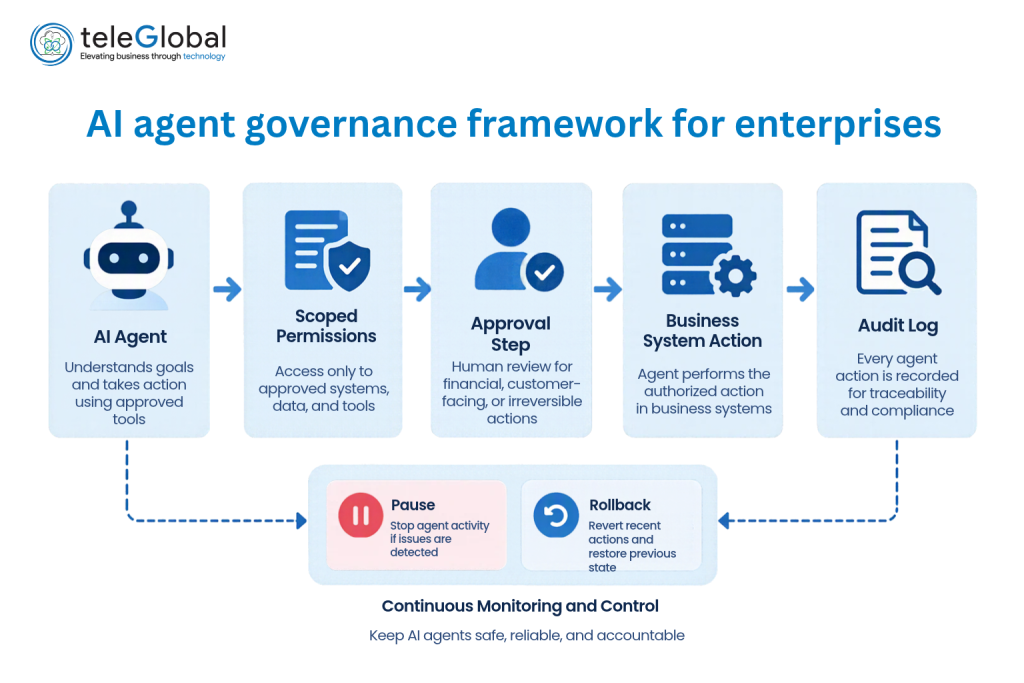
AI agents take actions inside business systems. Among large organizations, 40% now report scaling AI agents, up from 27% a year earlier (McKinsey). Add these checks before deployment:
- Scoped permissions and tool access for each agent
- Approval steps for financial, customer-facing, or irreversible actions
- Audit logs that record every agent action
- A tested way to pause or roll back agent activity
How Teleglobal Runs an AI Readiness Assessment
Teleglobal is an AWS Advanced Tier Services Partner with the AWS AI Services Competency. Its assessment covers use case discovery, data readiness across Amazon S3, data lakes, and existing pipelines, architecture recommendations, and cost modeling, following the AWS Well-Architected Framework and AWS Cloud Adoption Framework.
The output is a prioritized roadmap, followed by proof of concept, deployment, and AWS managed services. See our AI analytics platform case study, or explore Teleglobal’s AI services and AWS AI services.
Planning an AI initiative? Talk to Teleglobal about an AI readiness assessment for your enterprise.
Frequently Asked Questions
What does an AI readiness assessment checklist include?
Strategy and use cases, data readiness, infrastructure and security, AI governance, people and operating model, and value measurement.
What is AI-ready data?
Data aligned to a specific use case, documented, governed, and continuously checked for quality.
What is the difference between AI readiness and AI maturity?
AI readiness checks whether you can deliver specific use cases now. AI maturity benchmarks your overall AI capability against an industry model.
Who should take part in an enterprise AI readiness assessment?
Business sponsors, data owners, IT and cloud leads, security, legal, and the teams that will use the AI system.
How often should an enterprise reassess AI readiness?
Before each major AI initiative, and whenever data platforms, AI tools, or regulations change significantly.