Project Overview
A cab services business migrated from Microsoft Azure to AWS to support growing booking demand and establish a consistent way to manage its cloud environment. The project brought together migration, separate cloud accounts, central security monitoring and storage optimization.
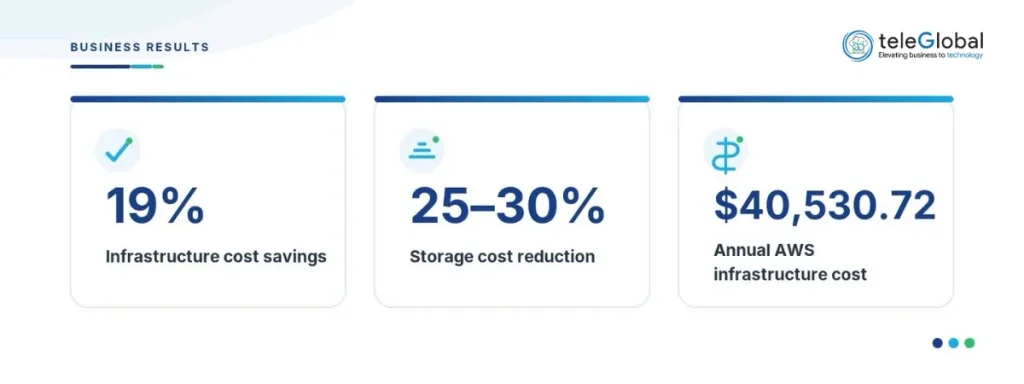
Teleglobal set up a landing zone using AWS Control Tower in the Asia Pacific (Mumbai) Region. The completed project delivered 19% infrastructure cost savings and a 25–30% reduction in storage costs.
Results at a glance
| Metric | Project Result |
|---|---|
| Infrastructure Cost Savings | 19% |
| Annual AWS Infrastructure Cost | $40,530.72 |
| Storage Cost Reduction | 25–30% through S3 Intelligent-Tiering and lifecycle policies |
| Automation | 70% automation via AWS Control Tower, as reported in the project brief |
The Client and Business Need
The organization needed a cloud platform that could support increasing booking volumes, customer demand and future expansion. Protecting business continuity during migration was a priority.
It also needed clear separation between live and development environments, consistent security rules, central access management and better visibility into cloud resources and costs.
Project Details
| Detail | Description |
|---|---|
| Industry | Cab services and transportation |
| Migration | Microsoft Azure to Amazon Web Services |
| AWS Region | Asia Pacific (Mumbai) |
| Core Implementation | Landing zone setup and multi-account governance using AWS Control Tower |
| Account Roles | Production, Development, Audit and Log Archive |
The Challenges
- Move Applications With a Structured Plan
The migration required a review of the existing Azure environment and the services connected to each application. Testing was needed to check the migrated workloads and support business continuity.
- Separate Production and Development
Live applications and development work needed distinct account boundaries, with access and policies suited to each environment.
- Improve Security Visibility
The business needed a central view of security findings, configuration changes and activity logs across its AWS accounts.
- Control Costs and Standardize Operations
The team needed a consistent approach to cloud administration, resource management and storage costs as the environment grew.
The AWS Solution
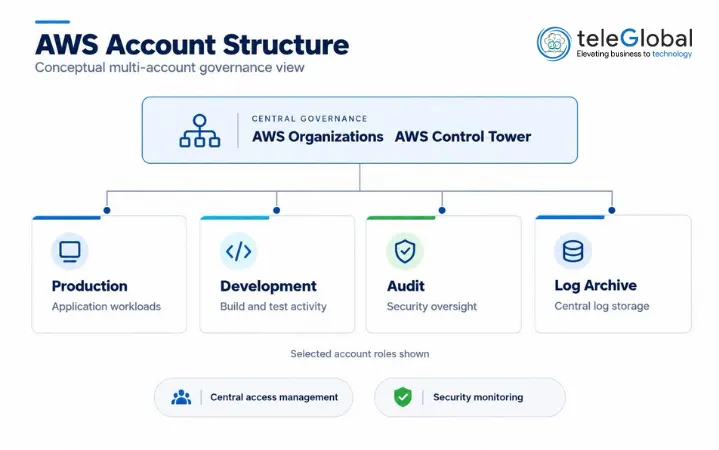
A landing zone was implemented using AWS Control Tower and AWS Organizations. A landing zone is a structured cloud environment with accounts, access settings and shared controls in place.
- Separate Cloud Accounts
Dedicated Production, Development, Audit and Log Archive accounts separated application environments, security oversight and log storage. This gave each account a clear purpose within the wider AWS organization.
- Central Access and Security Rules
AWS IAM Identity Center supported central workforce access management. Service Control Policies set limits on permitted actions in member accounts. Preventive controls restricted selected actions, while detective controls identified settings that did not meet configured requirements.
- Security Monitoring and Central Logs
AWS Config, AWS Security Hub and centralized logging supported configuration checks, security review and investigation. These capabilities improved visibility and supported compliance reviews without implying a specific regulatory certification.
- Storage Optimization
Amazon S3 Intelligent-Tiering and lifecycle policies supported more efficient storage management. Intelligent-Tiering adjusts storage tiers based on access patterns, while lifecycle rules manage configured storage transitions and expiration actions.
How the Migration Was Delivered
- Review the Existing Environment
- Discovery established the scope of the Azure environment and the workloads involved in the move.
- Map Application Connections
- Dependency mapping identified the services and connections that needed to work together during and after migration.
- Establish the AWS Environment
- The landing zone provided the account structure, access settings, security controls and logging needed to manage the target environment.
- Migrate and Test
- The workloads moved from Azure to AWS, with testing included in the migration process. Control Tower supported account setup and governance; it was not the tool that transferred application workloads.
- Strengthen Security and Optimize
- Security hardening and resource optimization supported ongoing operation of the new environment, including the storage cost measures described in the brief.
Business Results
- Lower Infrastructure and Storage Costs
The project recorded 19% infrastructure cost savings, with annual AWS infrastructure costs of $40,530.72. Storage costs were reduced by 25–30% through S3 Intelligent-Tiering and lifecycle policies.
- More Automated Cloud Administration
The project brief reports 70% automation via AWS Control Tower. Its role in the solution focused on account setup and governance, helping standardize how the AWS environment was managed.
- Clearer Security Oversight
Central logging, auditing and configuration checks gave the team a more organized way to review cloud activity and security findings. Preventive and detective controls supported consistent rules across governed accounts.
- A Foundation for Growth
The completed migration and multi-account structure established a framework for supporting the expansion of booking operations and customer services.
Technology Stack
| Service or Feature | Role in the Project |
|---|---|
| AWS Control Tower | Landing zone setup and governance |
| AWS Organizations | Multi-account management |
| AWS IAM Identity Center | Central workforce access |
| AWS Config | Configuration tracking and checks |
| AWS Security Hub | Central security findings |
| Service Control Policies | Limits on actions in member accounts |
| Amazon S3 Intelligent-Tiering | Storage tier management based on access patterns |
| Amazon S3 Lifecycle | Rule-based storage transitions and expiration |
Plan Your Azure to AWS Migration
Discuss your applications, cloud costs and security requirements with Teleglobal. Build a migration plan and an AWS foundation that fit your business needs.
Frequently Asked Questions
1. Why did the business migrate from Azure to AWS?
The business needed a platform to support growing booking demand, with clearer account separation, centralized security oversight and better cost management.
2. What did the AWS landing zone provide?
It provided a structured environment for managing accounts, access, security controls and logs. Dedicated accounts separated production, development, auditing and log storage.
3. What cost savings did the project report?
The brief reports 19% infrastructure cost savings and a 25–30% reduction in storage costs. These describe different cost measures and are not additive.
4. Does AWS Control Tower migrate applications?
Control Tower establishes and governs the AWS account environment. Moving the applications is a separate process, which in this project included discovery, dependency mapping, migration and testing.