This guide explains what serverless computing is, how it works in practice, and why enterprises are moving production workloads to serverless architectures. It covers the full AWS serverless ecosystem, enterprise use cases across six industries, architecture best practices, and a direct comparison of serverless versus containers versus virtual machines. Written for CIOs, CTOs, Cloud Architects, and Digital Transformation leaders, it gives technical and business readers a shared vocabulary and a clear framework for evaluating whether serverless fits their next project.
| Author: Ashish Kumar | Published: 23-July-2026 |
Serverless computing is a cloud model where developers deploy code without managing any infrastructure. The cloud provider handles provisioning, scaling, and availability automatically. For enterprises still spending engineering hours on server maintenance, patch cycles, and capacity planning, serverless directly eliminates that overhead. This guide covers how serverless architecture works, the AWS services that power it, where it delivers the most business value, and where it falls short, so technology leaders can make an informed decision before the next project kicks off.
Cloud computing infrastructure costs are a persistent pressure point. Organizations often over-provision to cover peak demand, then pay for idle capacity the rest of the year. Serverless architecture changes the economic model: resources are allocated per event, billed per execution, and released the moment a function finishes. For workloads with variable or unpredictable traffic, that shift has a direct impact on the cloud bill.
Teleglobal’s cloud consulting services team works with enterprises across India, the US, UAE, and Europe on exactly this transition, assessing which workloads are serverless-ready and which need refactoring first.
What Is Serverless Computing?
Serverless computing is a cloud execution model where code runs in response to events, and the cloud provider automatically manages all the underlying infrastructure. Developers write individual functions, deploy them, and the platform handles provisioning, scaling, availability, and billing, charging only for the actual time the code runs.
The “serverless” label is slightly misleading: servers still exist. What changes is that no one on your team is responsible for them. The cloud provider owns every layer below your application code, including operating systems, hardware, network configuration, patching, and capacity management.
The core building block is the serverless function (also called FaaS, or Function as a Service). A function is a small, focused unit of code that runs in response to a trigger: an HTTP request, a file upload, a database change, a scheduled timer, or a message from a queue. It runs, does its job, and terminates. Nothing sits idle between invocations.
This event-driven execution model is what separates serverless from conventional cloud approaches, and it’s what drives most of the cost and scalability advantages the technology is known for.
How Serverless Architecture Works: Step by Step
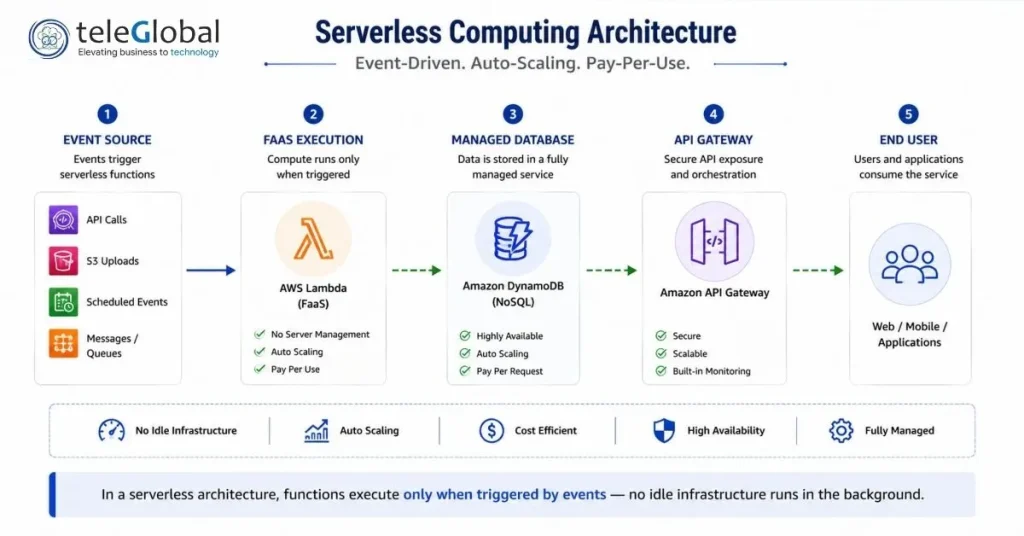
A serverless architecture chains together multiple event-driven components. Here is how a typical file-processing workflow runs:
1. A user uploads a document to cloud storage (Amazon S3).
2. S3 fires an event automatically when the upload completes.
3. The event triggers an AWS Lambda function.
4. Lambda validates the file format and extracts metadata.
5. Metadata is written to a managed database (Amazon DynamoDB).
6. A second function sends a confirmation notification through Amazon SNS.
7. If the file requires multi-step approval, AWS Step Functions orchestrate the remaining workflow.
8. The entire sequence runs without a single server being provisioned or managed by your team.
Each function handles one responsibility. They are independently deployable, independently scalable, and independently testable, which is why serverless pairs naturally with microservices design.
Traditional Infrastructure vs. Serverless Computing
| Capability | Traditional Infrastructure | Serverless Computing |
|---|---|---|
| Server provisioning | Manual – your team provisions VMs | Automatic – cloud provider handles it |
| Infrastructure costs | Fixed – pay for allocated capacity 24/7 | Variable – pay only for execution time |
| Scaling | Manual or scripted auto-scaling | Automatic and near-instant |
| OS and runtime patching | Your team’s responsibility | Cloud provider’s responsibility |
| High availability | Requires design and additional cost | Built-in across availability zones |
| Time to deploy | Hours to days (provisioning + config) | Minutes (code only) |
| Idle resource cost | High – servers run even with zero traffic | None – no execution means no charge |
| Operational overhead | High | Very low |
Benefits of Serverless Computing
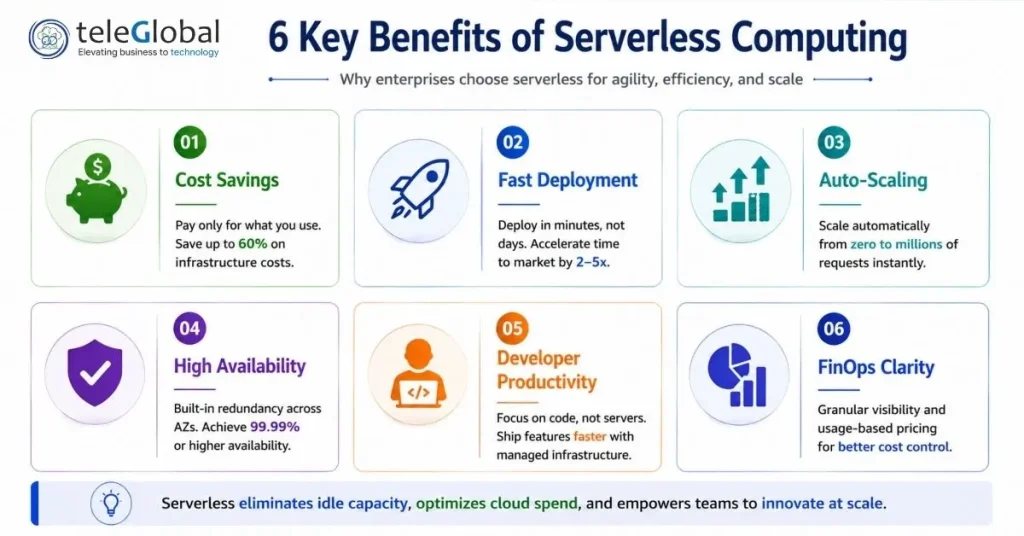
Serverless architecture delivers measurable improvements across four operational dimensions that matter most to enterprise technology leaders: cost, speed, reliability, and developer efficiency.
1. Reduced Infrastructure Costs
The consumption-based pricing model bills organizations only for the compute time their code actually uses. For a workload that processes 50,000 transactions one day and 500 the next, this directly matches spending to demand. There is no idle server cost, no hardware refresh cycle, and no capacity buffer to maintain.
The global serverless architecture market was valued at approximately USD 18.2 billion in 2025 and is projected to grow at a CAGR of 24.1% through 2035, according to GM Insights, a signal of how broadly enterprises are validating the cost model with real production workloads.
2. Faster Time to Market
Development teams skip infrastructure procurement, OS configuration, and environment setup entirely. They write code and deploy. Organizations that make this shift consistently report shorter deployment cycles, measured in days or hours rather than the weeks that traditional provisioning often requires.
3. Automatic Scaling at Any Volume
Whether a serverless application handles 100 requests or 10 million, the platform allocates resources in real time with no manual intervention. This is particularly valuable for retail, media, and financial services companies where traffic spikes are predictable in timing but unpredictable in magnitude, such as Black Friday, earnings reports, and live events.
4. Built-in High Availability
AWS Lambda, for example, runs functions across multiple availability zones by default. Redundancy, fault tolerance, and recovery are part of the platform, not something your team designs and maintains separately. Organizations get enterprise-grade availability without the engineering overhead of building it themselves.
5. Improved Developer Productivity
When engineers are not managing servers, they are building features. For enterprises where engineering talent is both expensive and scarce, redirecting those hours from infrastructure maintenance to product development has a compounding business effect.
6. Predictable Cloud Cost Optimization
Because organizations pay per execution, cloud spending becomes directly tied to business activity, not to infrastructure commitments. Finance teams can correlate cloud costs to transaction volumes. FinOps programs become more tractable when the unit economics are this clear.
Teleglobal’s DevOps services include CI/CD pipeline automation that accelerates serverless deployment cycles, so teams can release faster without adding risk.
Core Components of Serverless Architecture
A production-grade serverless architecture combines four categories of managed services:
Function as a Service (FaaS)
The execution layer. Developers deploy individual business functions that run on demand. AWS Lambda is the most widely used FaaS platform; Azure Functions and Google Cloud Functions are the main alternatives. According to Datadog’s 2025 serverless report, more than half of AWS users now run Lambda in some capacity.
Event Sources
Functions execute when triggered by an event. Event sources include HTTP requests via API Gateway, file uploads to S3, database change streams from DynamoDB, IoT sensor data, messages from SQS queues, or scheduled jobs via EventBridge.
Managed Databases
Serverless functions pair with fully managed database services that scale independently. Amazon DynamoDB (NoSQL) and Amazon Aurora Serverless (relational) are the primary AWS options. Both scale automatically and charge based on usage rather than provisioned capacity.
API Gateway and Orchestration
Amazon API Gateway exposes serverless functions securely through REST or GraphQL APIs. AWS Step Functions orchestrate multi-step workflows, chaining functions together with branching logic, parallel execution, error handling, and retry policies, without writing that plumbing logic inside individual functions.
Serverless Services in AWS: The Complete Enterprise Toolkit
AWS offers the most mature serverless ecosystem among major cloud providers, with services covering compute, storage, messaging, database, API management, workflow, and container workloads. Here is the core toolkit for enterprise serverless development:
| AWS Service | What It Does | Primary Enterprise Use Case |
|---|---|---|
| AWS Lambda | Execute code without provisioning servers – billed per 100ms of execution time | APIs, backend processing, automation, event processing |
| Amazon API Gateway | Publish and secure REST and WebSocket APIs at scale | Web and mobile application backends, microservices exposure |
| Amazon DynamoDB | Fully managed NoSQL database with single-digit millisecond latency | Real-time applications, user profiles, IoT data stores |
| Amazon EventBridge | Route events between applications, AWS services, and SaaS platforms | Enterprise application integration, event-driven workflows |
| Amazon SQS | Managed message queue that decouples microservices | Async workloads, order processing, task queues |
| Amazon SNS | Pub/sub messaging and push notifications | Alerts, customer notifications, fan-out workflows |
| AWS Step Functions | Visual workflow orchestration for multi-step processes | Business process automation, approval workflows, ETL pipelines |
| Amazon S3 | Object storage with native event trigger support | File processing, media workflows, data lake ingestion |
| AWS AppSync | Managed GraphQL API service | Mobile and web backends requiring real-time data sync |
| AWS Fargate | Serverless container execution – no cluster management | Containerized workloads that need longer runtimes than Lambda |
| Amazon Aurora Serverless | Relational database that scales compute automatically | Applications with variable query loads, dev/test databases |
| AWS Secrets Manager | Secure storage and rotation of API keys and credentials | Security best practice for any serverless application |
For organizations building AI-powered applications, AWS AI services, including Amazon Bedrock for foundation model inference, integrate directly with Lambda, enabling serverless AI workflows without dedicated GPU infrastructure.
Enterprise Use Cases for Serverless Computing
Serverless architectures are already running in production across every major industry. These are the most validated enterprise patterns:
Financial Services: Fraud Detection and Payment Processing
Banks and payment processors use serverless computing to analyze transactions in real time, flag anomalies, and trigger compliance checks, all without provisioning dedicated fraud-detection servers. Event-driven processing means the system reacts within milliseconds of a transaction occurring, at whatever transaction volume the business generates. The FaaS model holds 65% of the serverless computing market share, driven heavily by financial services workloads.
Healthcare: Patient Data Processing and IoT Medical Devices
Healthcare organizations use serverless architecture to process patient records, analyze diagnostic imaging metadata, and manage data streams from connected medical devices, all under HIPAA-compliant configurations. The shared responsibility model is important here: AWS secures the infrastructure, but the organization is responsible for IAM policies, encryption, and data governance.
Retail and E-Commerce: Scaling Through Demand Peaks
A retailer running a serverless architecture during a flash sale does not pre-provision servers for peak load. The platform scales to match demand in real time, then scales back to zero when the promotion ends. This pattern is consistent across e-commerce: automatic scaling during traffic spikes, zero idle cost the rest of the year.
Manufacturing: Real-Time IoT and Predictive Maintenance
Manufacturers deploy serverless functions to process sensor data from production equipment at scale. When a sensor reading deviates from acceptable parameters, a function fires, logs the anomaly, and triggers a maintenance alert, all within seconds, and without a dedicated server sitting idle between readings.
Media and Entertainment: Video Processing and Personalization
Streaming platforms use serverless services in AWS to encode video at upload, generate thumbnails, and deliver personalized content recommendations. Workloads scale instantly when a new title launches or a live event airs, and scale back to baseline the moment demand normalizes.
Customer Support: AI-Powered Automation
Enterprises integrate serverless functions with AI models to automate ticket routing, knowledge base search, and sentiment analysis. Each customer interaction triggers a function chain that classifies the request, retrieves relevant content, and escalates to a human agent only when the model is not confident. The serverless model means the system handles 500 simultaneous sessions just as easily as five.
When Should Your Business Choose Serverless?
Serverless is a strong fit for workloads that are event-driven, variable in traffic, and focused on discrete tasks. The list below covers the validated patterns where serverless consistently outperforms alternatives on cost and operational simplicity:
- REST and GraphQL APIs
- Microservices backends
- Real-time data processing and stream analytics
- Background job processing (image resizing, document conversion, report generation)
- AI/ML inference triggered by events
- IoT data ingestion and processing
- Workflow automation with conditional branching
- Scheduled batch jobs (nightly reports, cleanup tasks)
- Mobile application backends
- Webhook receivers and third-party integrations
When Serverless May Not Be the Right Choice
Serverless is not universally optimal. Four workload types consistently perform better on alternative infrastructure:
Long-running processes. AWS Lambda functions time out after 15 minutes. Applications that require continuous processing for hours, such as batch analytics jobs, complex simulations, and video encoding pipelines at large scale, are better suited to containers (ECS/Fargate) or EC2.
GPU-dependent workloads. Model training and high-throughput GPU inference require dedicated GPU instances. Serverless is appropriate for lightweight inference triggered by events, not for sustained compute-intensive AI training.
Legacy monolithic applications. Older applications built as single deployable units typically require significant architectural refactoring before they can run as serverless functions. A phased modernization approach, extracting individual capabilities as functions while the monolith continues to run, is usually more practical than a direct lift-and-shift.
Ultra-low-latency user-facing requests. Cold starts, the initialization delay when a function has been idle, can add noticeable latency to the first request after a quiet period. AWS Lambda’s Provisioned Concurrency eliminates this by keeping functions warm, but it adds cost. For applications requiring sub-50ms response times consistently, this trade-off needs deliberate architecture planning.
Serverless vs. Containers vs. Virtual Machines
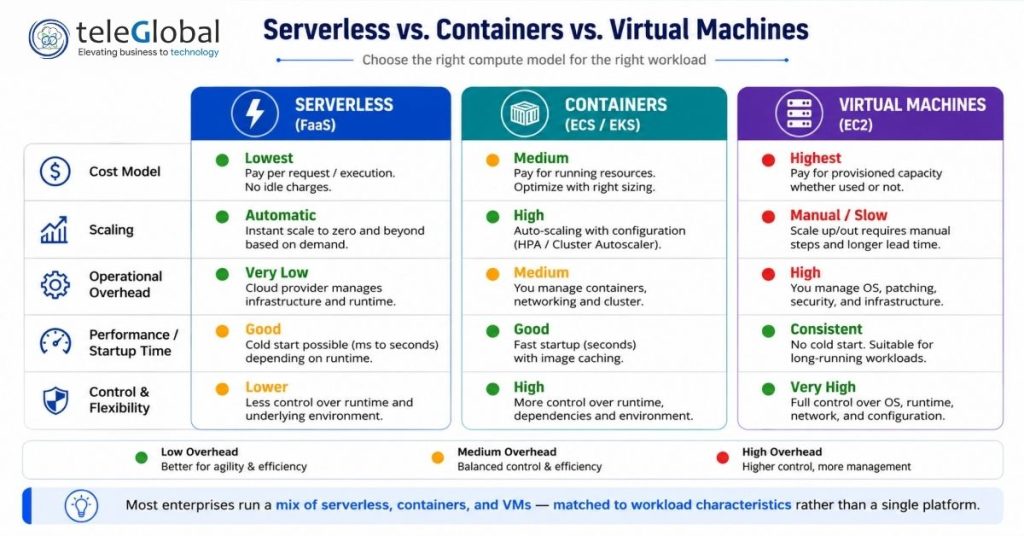
| Factor | Serverless | Containers | Virtual Machines |
|---|---|---|---|
| Infrastructure management | None – fully managed | Minimal – manage the cluster | High – manage OS, network, storage |
| Auto-scaling | Automatic, per-request | Configurable (HPA in Kubernetes) | Manual or scripted |
| Pricing model | Pay per execution | Pay for running containers | Pay for allocated resources |
| Cold start latency | Under 200ms (Node/Python) | Seconds (image pull) | Minutes (OS boot) |
| Best fit | Event-driven, bursty, API workloads | Microservices, long-running services | Legacy apps, specialized hardware |
| Operational overhead | Very low | Medium | High |
| Maintenance responsibility | Cloud provider | Shared | Customer managed |
| Max execution duration | 15 minutes (Lambda) | Unlimited | Unlimited |
| Cost at sustained high load | Can exceed containers | Cost-effective at scale | Predictable at steady load |
For most enterprises, the answer is not one model or another. It is the right model for each workload. Event-driven APIs and background jobs go serverless. Long-running services go to containers. Legacy workloads waiting for modernization stay on VMs. A mixed strategy is the norm in mature cloud environments..
Common Challenges of Serverless Computing
Serverless is not a zero-effort architecture. These are the challenges enterprises consistently encounter, along with the practical steps to address them:
Vendor Lock-In
AWS Lambda functions use AWS-specific event formats, IAM permission models, and integrations. Migrating a mature serverless application to Azure or Google Cloud is not straightforward. It requires rewriting event handlers, re-mapping services, and retesting the entire application. Organizations with multi-cloud strategies should use abstraction layers (Serverless Framework, AWS SAM) and design functions around business logic rather than cloud-specific APIs wherever possible.
Cold Starts
A cold start occurs when a Lambda function that has been idle must initialize a new execution environment before processing a request. In 2026, cold start times for Node.js and Python functions are typically under 200 milliseconds, which is not perceptible to most users. Java runtimes with Spring context can still exceed 3 seconds without optimization, though AWS Lambda SnapStart brings Java cold starts below 200ms for most configurations. Provisioned Concurrency eliminates cold starts entirely for latency-critical paths, at an additional cost.
Security in a Shared Responsibility Model
AWS secures the infrastructure. Your team secures everything running on it. For serverless, that means IAM roles with least-privilege permissions for every function, encryption at rest and in transit, credential management through AWS Secrets Manager, and API authentication at the Gateway layer. A misconfigured IAM policy in a serverless application can expose far more than a misconfigured EC2 instance, because functions often have access to multiple services simultaneously.
Applying a Zero Trust security model, where no function is trusted by default and every cross-service call is authenticated, is the recommended baseline for enterprise serverless deployments.
Observability and Debugging
A serverless application can involve dozens of functions, multiple queues, and several managed services, all executing asynchronously. Traditional log-based debugging does not scale to this complexity. Enterprise teams should adopt distributed tracing from day one. AWS X-Ray traces requests across Lambda, API Gateway, DynamoDB, and other services. AWS CloudTrail provides audit logs for every API call. Third-party tools like Datadog and Grafana give teams a consolidated view across the full execution chain.
Serverless Best Practices for Enterprise Adoption
Architecture decisions made at the start of a serverless project determine how manageable, secure, and cost-efficient the system is at scale. These five practices are non-negotiable:
Design around events, not servers. Build functions that respond to API requests, file uploads, database changes, message queue arrivals, and scheduled timers. This event-driven mindset is fundamental. Applications that are designed as continuous processes first and then “serverless-ified” rarely achieve the cost or scalability benefits.
Keep functions small and focused. Each function should perform one operation: validate input, resize an image, send a notification, write to a database. Functions that try to do too much become difficult to test, troubleshoot, and independently scale. The single responsibility principle is not just a software engineering preference in serverless. It has direct operational consequences.
Implement least-privilege IAM from the start. Every Lambda function should have an IAM role that grants access only to the specific resources it needs. A function that reads from one DynamoDB table should not have write access to another. Review permissions at every deployment. This is where most serverless security incidents begin.
Instrument everything. Enable AWS X-Ray tracing on all functions from day one. Set CloudWatch alarms on error rates, timeout rates, and throttle counts. Define what “healthy” looks like before launch so anomalies are detectable immediately, not after a user reports an issue.
Optimize function packaging. Smaller deployment packages mean faster cold starts. Remove unused dependencies, use Lambda Layers for shared code, and choose lightweight runtimes (Node.js or Python) for latency-sensitive functions. Right-size memory allocation using AWS Lambda Power Tuning to balance cost and performance.
Enterprise Decision Framework: Should You Go Serverless?
Use this framework to evaluate whether a specific workload is a serverless candidate:
| Question | If YES → Serverless fits | If NO → Consider alternatives |
|---|---|---|
| Is the workload event-driven? | Triggered by HTTP, file upload, DB change, queue message, or schedule | Needs continuous processing → containers or VMs |
| Is traffic variable or unpredictable? | Traffic spikes significantly during certain periods | Steady, high-throughput load → containers more cost-effective |
| Are individual tasks short-lived? | Each operation completes in under 15 minutes | Long-running jobs → ECS Fargate or EC2 |
| Is the team avoiding infrastructure management? | Team wants to focus on code, not servers | Team needs full infrastructure control → VMs or containers |
| Is the workload latency-tolerant? | Sub-second response acceptable (or Provisioned Concurrency will be used) | Sub-50ms required at all times → evaluate cold start impact carefully |
| Is the codebase modular? | Application can be decomposed into discrete functions | Monolithic architecture → refactoring required first |
Future of Serverless Computing
The serverless computing market is projected to grow from USD $32.27 billion in 2026 to USD $170.8 billion by 2034, at a CAGR of 23.16%, according to Straits Research. That growth reflects four emerging patterns that enterprise technology leaders are already evaluating:
AI-native serverless pipelines. Lambda and Amazon Bedrock are becoming the default architecture for enterprise AI inference at scale. Events trigger functions; functions call foundation models; results flow back to the application. No GPU cluster to manage, no idle inference server running overnight.
Edge serverless. AWS Lambda@Edge and Cloudflare Workers push function execution closer to end users, reducing latency for personalization, A/B testing, security checks, and IoT data processing. Cold start times at the edge are now under 50ms in most configurations.
Multi-cloud serverless. Enterprise adoption of multiple cloud providers is accelerating. Open-source frameworks like OpenFaaS and the Serverless Framework are making function-level portability more practical, reducing the vendor dependency that has historically slowed serverless adoption in regulated industries.
Serverless containers (AWS Fargate). Fargate blurs the line between serverless and containers. Teams define container specifications, and AWS manages the underlying compute. This pattern is growing among enterprises that need longer execution times than Lambda allows but still want to avoid cluster management.
Why Enterprises Choose Teleglobal for Serverless Adoption
Implementing serverless architecture successfully requires more than deploying Lambda functions. It requires architectural judgment about which workloads to move, a governance model for IAM and security, observability tooling from the first deployment, and operational experience managing cloud costs at scale.
Teleglobal has delivered cloud modernization projects for 900+ clients across India, the US, UAE, and Europe over 10+ years.
Serverless Architecture Design: Assessing your workload portfolio, identifying serverless-ready candidates, designing event-driven architectures aligned with your business goals, and flagging workloads that need refactoring before they can benefit from serverless.
AWS Serverless Implementation: Building and deploying production-grade applications using Lambda, API Gateway, DynamoDB, Step Functions, EventBridge, SQS, and SNS, with CI/CD pipelines, IAM governance, and observability configured from day one.
Cloud Migration and Modernization: Assessing legacy applications and migrating them to serverless environments in phases, minimizing disruption to running systems throughout the transition.
Cloud Cost Optimization (FinOps): Monitoring function invocation patterns, right-sizing memory allocation, removing unused resources, and building cost reporting that ties cloud spending directly to business activity.
Security and Compliance: Implementing least-privilege IAM, encryption, secrets management, and regulatory compliance frameworks appropriate to your industry, including HIPAA, SOC 2, and GDPR requirements.
Managed Cloud Services: 24×7 monitoring, alerting, incident response, and continuous optimization for your serverless workloads.
Learn more about Teleglobal’s cloud consulting services, DevOps services, and cloud security services.
Conclusion
Serverless computing has moved well past the experimental stage. Enterprises in financial services, healthcare, retail, manufacturing, and media are running production workloads on serverless infrastructure today, and the economics continue to improve as cloud providers mature their platforms.
For CIOs and CTOs evaluating their next cloud modernization initiative, the decision is rarely serverless versus something else. It is which workloads go serverless first, which need containers, and which stay on VMs while the modernization roadmap advances. The frameworks and best practices in this guide are designed to make that evaluation concrete.
The teams that get the most value from serverless share one characteristic: they design for events from the start, instrument everything from day one, and treat IAM governance as a first-class requirement rather than an afterthought. The architecture is forgiving of many things, but security policy gaps are not among them.
Ready to modernize your applications with serverless computing? Contact Teleglobal to discuss your cloud architecture, evaluate serverless fit, and build a migration roadmap tailored to your workload profile.
Frequently Asked Questions
1. What is serverless computing?
Serverless computing is a cloud model where developers deploy and run application code without managing servers. The cloud provider automatically handles provisioning, scaling, patching, and availability. Organizations are billed only for the compute time their code actually uses, with no charge for idle capacity.
2. What is serverless architecture?
Serverless architecture is an event-driven application design pattern built on managed cloud services. Functions execute in response to specific triggers, including HTTP requests, file uploads, database events, or scheduled jobs, rather than running continuously on dedicated servers. AWS Lambda-based architectures are the most common enterprise implementation.
3. What are serverless functions?
Serverless functions are small, independent units of code that execute in response to a trigger event and terminate when complete. Each function performs one operation, such as processing a payment, resizing an image, or sending a notification. AWS Lambda is the leading serverless function platform, running more than half of all AWS Lambda invocations for production workloads.
4. What are the main benefits of serverless computing?
The primary benefits are: no infrastructure management, automatic scaling from zero to millions of requests, pay-per-execution pricing that eliminates idle costs, built-in high availability across cloud availability zones, and faster deployment cycles because development teams work only on application code.
5. What are the challenges of serverless computing?
The main challenges are vendor lock-in (functions are tightly coupled to provider APIs), cold start latency on first invocation after idle periods, the complexity of debugging distributed asynchronous architectures, and the ongoing security responsibility for IAM, encryption, and API authentication that remains with the organization.
6. Which AWS services support serverless computing?
The core AWS serverless services are: AWS Lambda (compute), Amazon API Gateway (API management), Amazon DynamoDB (NoSQL database), Amazon Aurora Serverless (relational database), AWS Step Functions (workflow orchestration), Amazon EventBridge (event routing), Amazon SQS (message queuing), Amazon SNS (notifications), Amazon S3 (object storage with event triggers), and AWS Fargate (serverless containers).
7. Is serverless computing suitable for enterprise applications?
Yes. Enterprises across financial services, healthcare, retail, manufacturing, and media run production serverless workloads at scale. It is best suited for event-driven applications, APIs, microservices, and data processing pipelines. Long-running processes, GPU workloads, and legacy monolithic applications may need alternative architectures.
8. How can Teleglobal help with serverless adoption?
Teleglobal provides serverless architecture design, AWS implementation, cloud migration planning, FinOps cost optimization, security and compliance configuration, and 24×7 managed services for serverless workloads. As an AWS Advanced Consulting Partner with 900+ clients globally, Teleglobal supports the full lifecycle from initial assessment through ongoing operations.