Summary: PHP2Shell is the name given to two critical security flaws in PHP, the technology that powers many websites and web applications. The flaws may allow an attacker to run commands on an affected server without signing in. Organisations should identify every PHP runtime, install a fixed release, confirm that the live service is using it and review suspicious activity from 17 October 2026. Teleglobal International’s cloud security services can support assessment and remediation across complex cloud environments.
| Author: Ashish Kumar | Published Date: 26-Oct-2026 |
What is PHP and how is it connected to PHP2Shell?
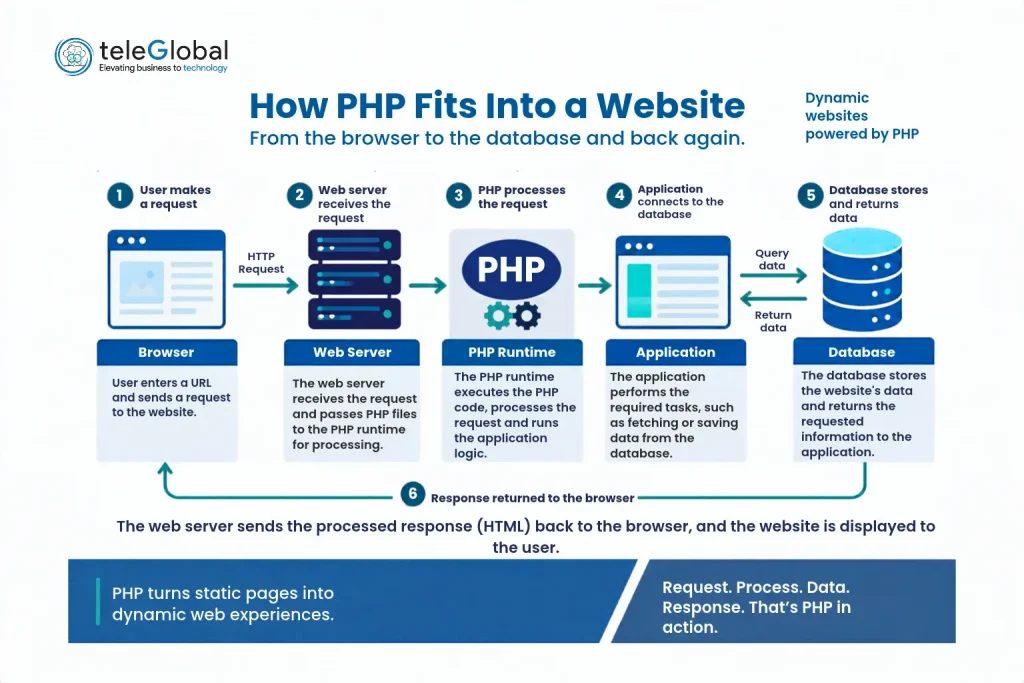
PHP is a widely used server-side programming language that processes application logic, form submissions, authentication, database queries and dynamically generated web pages. It supports platforms such as WordPress and Drupal, as well as many custom business applications.
PHP2Shell is not limited to WordPress, a plugin or a development framework. The vulnerabilities are in the PHP runtime itself. An application can therefore be fully updated and still remain exposed if its web-serving process uses a vulnerable PHP build.
What is the PHP2Shell vulnerability?
PHP2Shell is the name used for two vulnerabilities disclosed and patched by the PHP Project on 21 October 2026: CVE-2026-109618 and CVE-2026-109619. A CVE is a standard public identifier for a security vulnerability. Both flaws affect PHP memory handling while the runtime processes HTTP requests, including page requests, form submissions and API calls.
CVE-2026-109618 involves out-of-memory handling that can leave internal request data only partially initialised. CVE-2026-109619 involves request-owned state that may remain after its underlying memory has been released. Under exploitable conditions, either flaw can lead to unauthenticated remote code execution. This means an attacker may run commands with the privileges of the affected PHP or web-server process, potentially exposing application files, data, credentials and connected services.
The official PHP security advisory rates both vulnerabilities Critical and identifies the affected environments. CISA’s alert urges organisations to patch immediately and prioritise internet-facing systems.
Who is affected by the PHP2Shell vulnerability?
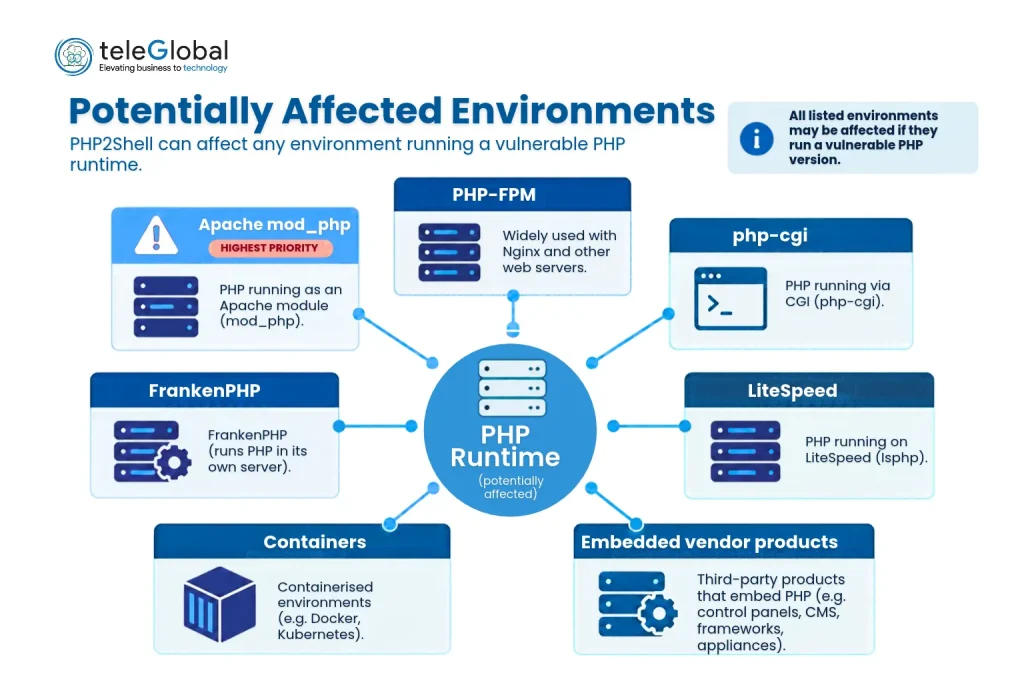
The PHP Project states that the risk applies to PHP installations serving web requests, including PHP-FPM, Apache with mod_php, php-cgi, FrankenPHP and LiteSpeed. It considers mod_php the highest-risk deployment because a demonstrated exploit can run before the website’s own code starts.
The main operational challenge is asset visibility. PHP may run inside a container, virtual machine, managed hosting service, administration interface, network appliance or third-party product. These instances may not appear in a standard website inventory, and vendor-managed products may require a supplier-provided update.
Which PHP versions contain the PHP2Shell fix?
PHP 8.1 and earlier are outside normal upstream support. Some Linux distributions and long-term-support vendors may provide backported fixes. Teams should check the vendor advisory and package build rather than relying only on the displayed PHP version.
How to respond to PHP2Shell: Five actions to take now
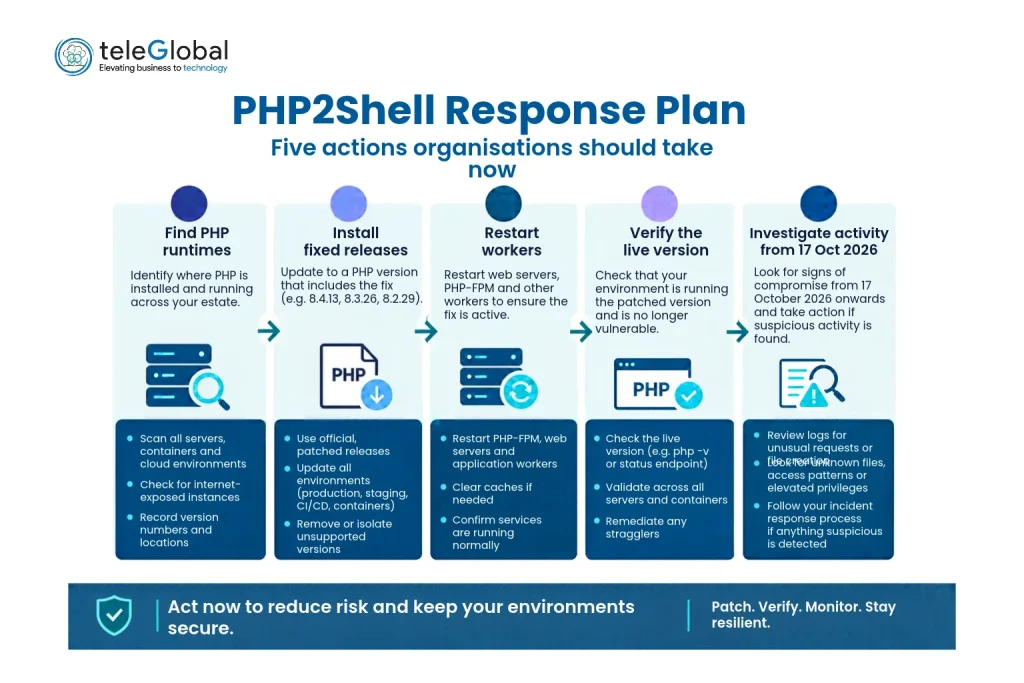
- Find every PHP runtime : Check production, testing and disaster-recovery environments, managed hosting, virtual machines, containers, appliances and vendor products. Prioritise services that are reachable from the internet. Ask hosting and software suppliers whether they bundle PHP and which patched build they provide.
- Patch the underlying runtime: Upgrade to a fixed PHP release or install a vendor package that explicitly contains both fixes. Rebuild containers from a patched base image. Updating WordPress, Laravel, Drupal, themes or plugins does not patch PHP itself.
- Restart and verify the live service: Installing a package does not by itself confirm remediation. Existing PHP workers may continue to use the previous code until they are restarted or redeployed. Verify the version used by the live web-serving process because it may differ from the command-line PHP version.
- Reduce exposure if patching is delayed: Restrict public access, isolate exposed applications and apply vendor-recommended web application firewall controls while remediation is under way. These are temporary risk-reduction measures, not substitutes for patching. CISA advises taking affected systems offline when they cannot be updated promptly.
- Investigate possible exploitation: Review available telemetry from at least 17 October 2026. Amazon Threat Intelligence reported an exploitation attempt dated 17 October, four days before the public disclosure on 21 October 2026, and stated that it was unclear whether the observed attempts would have succeeded in real-world systems. Examine PHP worker processes launching shells or downloading tools, unexpected file changes, unusual outbound connections, memory errors and repeated worker failures. A vulnerable version does not prove compromise; logs and investigation evidence are required to determine what occurred.
What PHP2Shell shows about vulnerability management
PHP2Shell highlights a common operational gap: organisations cannot patch software they cannot find. Maintain an accurate runtime inventory, assign owners, centralise security logs, limit service-account permissions and test emergency patching before the next critical advisory. Teleglobal International’s cloud managed services include monitoring, patch management and incident response, while its guide to cloud managed services for modern cybersecurity provides further context on continuous security operations.
Bottom line
PHP2Shell requires a disciplined response: identify affected runtimes, apply the appropriate update, restart or redeploy services, verify the live version and investigate the exposure period. The central risk is incomplete coverage across containers, managed platforms, appliances and long-running worker processes. Teleglobal can help organisations assess exposure, coordinate remediation and establish repeatable cloud security operations for future critical vulnerabilities.
Frequently Asked Questions
1. Does updating WordPress fix PHP2Shell?
No. WordPress maintenance remains important, but PHP2Shell is in the PHP runtime. The hosting provider or server administrator must patch PHP separately.
2. Is a web application firewall enough?
No. A WAF may reduce exposure to known request patterns during the patch window, but it is not a complete fix.
3. Does a vulnerable server mean it was compromised?
No. Vulnerability and compromise are different findings. Patch the system, preserve relevant logs and investigate the period of possible exposure.