This guide explains agentic AI in retail – what it is, how it differs from basic chatbots and rule-based automation, the five types of autonomous AI agents retailers are deploying in 2026, the highest-ROI use cases with real examples from Walmart, Amazon, and Sephora, and a step-by-step framework for getting started. It is written for retail CIOs, CTOs, digital transformation leaders, and IT directors evaluating AI agents for their organizations. This guide covers the business value, the implementation sequence, the agent frameworks in use today, and what to look for in an AI agent development partner.
| Author: Ashish Kumar | Published Date: 30-July-2026 |
Agentic AI in retail refers to autonomous AI systems that perceive data, reason about it, plan a course of action, and execute decisions without waiting for a human to approve each step. The agentic AI in retail and e-commerce market reached $60.43 billion in 2026, up from $46.74 billion in 2025, and is projected to grow at a 29.29% CAGR to $218.37 billion by 2031 (Mordor Intelligence, May 2026). With 76% of retailers increasing their investment in AI agents over the next 12 months, the question is no longer whether to adopt these systems – it is where to start and how to scale.
This guide covers the five types of AI agents deployed in retail, the highest-ROI use cases, a measurable framework for evaluating business value, and the implementation steps that separate successful production deployments from failed pilots.
For Teleglobal’s full range of AI development and integration services, visit our Artificial Intelligence services page.
What Is Agentic AI in Retail?
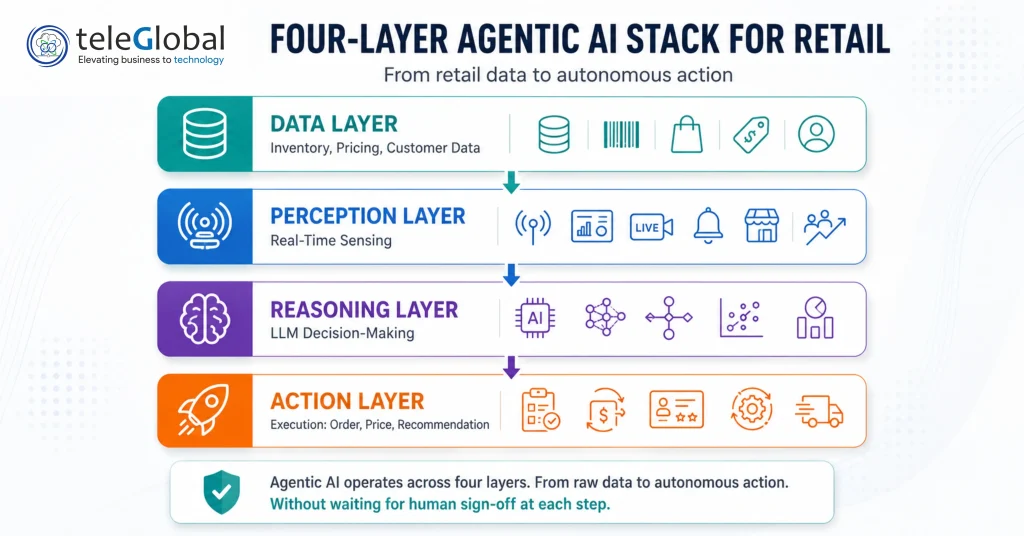
Agentic AI in retail is a class of artificial intelligence system that takes autonomous, multi-step actions to achieve a business goal – such as replenishing stock, adjusting a product price, or personalizing an offer – based on real-time data, without a human approving each decision. Unlike a chatbot that responds to a question, or a rules-based RPA bot that follows a fixed script, an autonomous AI agent reasons about its environment, selects the best action from multiple options, executes it, and learns from the outcome.
The key difference from earlier AI tools is goal-directed behavior. You give an agentic system an objective – “minimize stockouts across store 12 this week” – and it figures out the steps. Traditional automation needs a human to map every step in advance.
Three capabilities define a true autonomous AI agent:
- Perception: reads real-time inputs – inventory levels, competitor prices, weather, footfall, purchase history
- Reasoning: uses a large language model (LLM) or planning algorithm to evaluate options and select the best action
- Execution: carries out the action autonomously – updates a price, triggers a purchase order, sends a personalized message – and records the outcome for the next decision cycle
Types of AI Agents Used in Retail
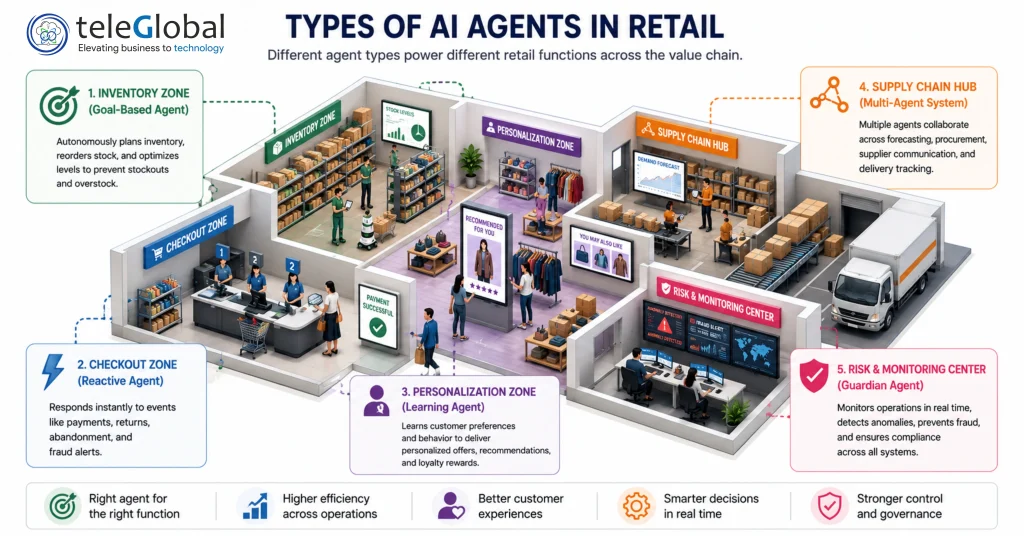
Retailers deploy five types of autonomous AI agents, each suited to a different layer of operations. Understanding the types before selecting a use case prevents mismatched architectures.
| Agent Type | What It Does | Retail Example | Autonomy Level |
| Reactive Agent | Responds to a specific trigger with a predefined action | Cart abandonment follow-up message sent within 2 hours | Low – rule-triggered, no reasoning |
| Goal-Based Agent | Works toward an objective, choosing its own steps | Inventory agent minimizing stockouts across 50 stores | Medium – plans steps autonomously |
| Learning Agent | Improves decisions over time based on outcome feedback | Pricing agent that refines margin targets after each promotion | High – adapts without reprogramming |
| Multi-Agent System | Two or more agents that coordinate to complete a workflow | Demand forecast agent hands off to procurement agent, which signals supplier agent | Very High – distributed orchestration |
| Guardian / Monitoring Agent | Watches other agents or systems for anomalies and intervenes | Fraud detection agent that flags unusual transaction patterns in real time | Medium – oversight and escalation |
Most enterprise retail deployments in 2026 start with a goal-based or learning agent for one well-defined workflow, then expand to multi-agent orchestration once data pipelines and governance are in place.
Highest-ROI Use Cases of Agentic AI in Retail
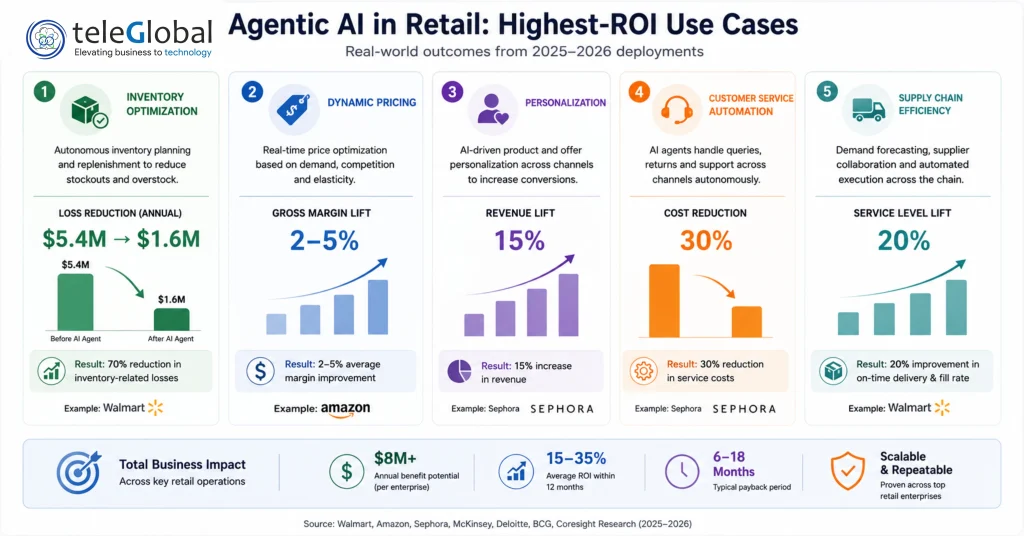
Retail AI agents deliver the most measurable returns in five operational areas. These are not future projections – they are documented 2025-2026 deployments with published outcomes.
1. Autonomous Inventory Management and Replenishment
AI agents monitor stock levels across every SKU, location, and channel in real time. They forecast demand using weather data, local events, historical patterns, and competitor activity – then trigger replenishment orders automatically before a stockout occurs.
A large North American retailer reduced quarterly inventory losses from $5.4 million to $1.6 million after deploying agents to detect demand patterns and manage stock transfers (Svitla Systems, April 2026). Inventory management accounts for 22.81 to 28.3% of all retail AI investment in 2026 – the largest single category (Mordor Intelligence).
2. Dynamic Pricing and Margin Optimization
Pricing agents continuously evaluate competitor prices, inventory position, days remaining in a season, and margin targets simultaneously. They update prices in real time across channels without waiting for a weekly pricing review.
Retailers using AI-driven dynamic pricing report 2 to 5 percent margin improvement in competitive categories within the first six months of deployment. The agent does what a human pricing team cannot: process thousands of SKUs simultaneously and respond to market changes within minutes.
3. Hyper-Personalized Customer Experience
Learning agents build individual customer profiles from purchase history, browsing behavior, return patterns, and real-time context (such as current location or device time of day). They generate personalized product recommendations, offers, and content at the moment of highest intent.
Sephora’s agentic AI system acts as a digital beauty consultant – analyzing skin tone, past purchases, and seasonal trends to recommend specific products and routines. Retailers using AI-driven personalization increase revenue by 10 to 15% on average.
4. Supply Chain and Procurement Automation
Multi-agent systems coordinate demand forecasting, procurement, logistics routing, and supplier communication as an integrated workflow. When one agent detects a predicted supply disruption, it signals the procurement agent to source alternatives before the shelf empties.
Walmart’s agentic AI investment spans demand forecasting, inventory management, workforce productivity, and fulfillment optimization – described internally as collapsing the gap between “I want it” and “I have it.”
5. Autonomous Customer Service and Return Processing
AI agents handle order tracking, return initiation, delivery queries, and product questions without human involvement. Salesforce Agentforce resolved 84% of customer service cases autonomously across 380,000 interactions, requiring human escalation for only 2% of cases.
Business Value of AI Agents: What the Numbers Show
These are verified figures from named research publishers and disclosed enterprise deployments. No projected or unverifiable numbers appear in this table.
| Metric | Result | Source | Application Area |
| Enterprise apps with AI agents by end-2026 | 40% (up from less than 5% in 2025) | Gartner, 2025 | All retail functions |
| Revenue lift from AI personalization | 10-15% | McKinsey | Customer experience |
| Average order value increase | 25% higher | Shopify Retail Report 2025 | Personalization |
| Return rate reduction | 19% lower | Shopify Retail Report 2025 | Personalization |
| Quarterly inventory loss reduction | $5.4M to $1.6M (70%) | Svitla Systems, 2026 | Inventory management |
| Customer service cases resolved autonomously | 84% of 380,000 interactions | Salesforce Agentforce data | Customer service |
| Retailer AI investment increase (2025-2026) | CIO AI funding up 36% | Kore.ai retail study, 2026 | All functions |
| Retailers increasing AI agent investment | 76% | Warmly.ai / industry survey | Customer service applications |
AI Agent Frameworks Used in Enterprise Retail
Enterprise retail AI agent deployments in 2026 are built on one of six principal frameworks. The choice of framework affects integration complexity, cost, and the team skills required.
| Framework | Best For | Retail Use Case Fit | Hosting |
| LangChain / LangGraph | Custom agent pipelines, RAG-based retrieval | Product search, customer support, inventory Q&A | Any cloud / on-premise |
| CrewAI | Multi-agent role orchestration | Supply chain coordination, procurement workflows | Any cloud |
| AutoGen (Microsoft) | Conversational multi-agent loops | Customer service escalation, internal helpdesk | Azure / any cloud |
| AWS Bedrock Agents | Managed agent hosting, action groups on AWS | Inventory, pricing, recommendations on AWS stack | AWS |
| Azure AI Agent Service | Enterprise governance, compliance, traceability | Regulated retail, finance-adjacent compliance | Azure |
| Google Vertex AI Agents | Multimodal agents (text, image, video) | Visual search, product catalog agents | Google Cloud |
Python remains the dominant development language across 52% of AI agent projects in 2026. For teams without in-house LLM expertise, partnering with a specialist AI agent development company that holds cloud certifications (AWS GenAI, Azure OpenAI Service) significantly reduces time to first production agent.
How to Implement AI Agents in Your Retail Business: Step-by-Step
The 79% adoption vs. 11% production gap – almost four in five enterprises have adopted AI agents in some form, yet only one in nine runs them in production – reflects poor sequencing, not poor technology. The steps below follow the pattern of successful 2026 deployments.
Step 1: Choose One High-Value, Well-Defined Use Case
Do not start with “we want AI agents across the business.” Start with the use case where the current pain is greatest and the data is cleanest. Inventory replenishment for a single product category, or dynamic pricing for one channel, are proven starting points. Gartner notes that successful deployments are “task-specific, targeting high-volume, well-defined workflows.”
Step 2: Audit Your Data Foundation
AI agents depend on structured, consistent, real-time data. Before selecting a framework or vendor, audit whether your inventory, pricing, and customer data is accessible via APIs, consistent across systems, and updated frequently enough for the use case. A pricing agent that reads yesterday’s data is not a pricing agent – it is a delayed report.
Step 3: Select the Right Agent Framework for Your Stack
Match the framework to your cloud environment and use case (see the table above). For retailers already on AWS, AWS Bedrock Agents reduces integration overhead significantly. For multi-agent supply chain workflows, CrewAI or LangGraph are the 2026 production standards. If your team has no in-house LLM engineers, this is the step where an AI agent development partner adds the most value.
Step 4: Define Success Metrics Before Building
Name the metric the agent will move and set a baseline before deployment. Inventory agent: stockout rate per SKU per week. Pricing agent: average margin on a defined category. Customer service agent: first-contact resolution rate. Without a baseline, there is no way to measure whether the deployment succeeded.
Step 5: Deploy with Human-in-the-Loop Oversight
Production-ready retail agents run in a supervised mode first – making recommendations that a human reviews and approves. Autonomy is expanded incrementally as the agent demonstrates consistent, safe decisions. This is not a limitation; it is how enterprises avoid the governance failures that account for most agent project cancellations.
Step 6: Test, Validate, and Set Guardrails
An agent that is not tested is not ready. Run the agent against historical data (backtesting) before live deployment. Define the boundaries: what actions is the agent allowed to take without escalation? What triggers a human review? Document these as guardrails before go-live, not after the first incident.
Step 7: Scale to Additional Use Cases After First Wins
Once the first agent demonstrates measurable results against its baseline metric, use that data to build the business case for the second use case. The fastest-scaling organizations in 2026 follow a pattern: one pilot, one production win, one internal case study, then expansion approval from leadership.
Why Retailers Choose Teleglobal for AI Agent Development
Teleglobal International builds and deploys custom AI agents for retail clients across India (Pune, Mumbai, Bengaluru), UAE (Dubai), the US, and Europe. As an AWS GenAI Partner with 10+ years in business and 900+ clients served, Teleglobal designs AI agent solutions on AWS, Azure, and Google Cloud using LangChain, CrewAI, AWS Bedrock Agents, and Azure AI Agent Service.
What makes Teleglobal’s AI agent practice different from a generic software vendor:
- Use-case-first scoping: Teleglobal starts every engagement with a structured discovery to identify the one use case where the data is ready and the ROI is clearest – not a broad platform proposal
- Framework-agnostic delivery: the team selects the agent framework (LangChain, CrewAI, Bedrock Agents) that fits the client’s existing cloud stack, not the one the vendor prefers to sell
- Production focus: Teleglobal builds agents designed for production operations, with guardrails, monitoring, and human-in-the-loop controls built into the initial deployment, not added later
- Multi-geography delivery: clients in Pune, Dubai, and the US access the same delivery team with local account management in each region
- For clients on AWS, Teleglobal connects AI agents to existing AWS data pipelines using AWS AI services, cutting integration time and accelerating deployment.
If your retail organization is evaluating AI agents for inventory, pricing, personalization, or customer service and has not yet identified a production-ready starting point, Teleglobal’s AI team can run a scoping session to map use cases to your data readiness in one working session.
Explore Teleglobal’s AI development services.
Frequently Asked Questions
1. What is agentic AI in retail?
Agentic AI in retail is a class of AI system that perceives real-time data, reasons about it, and takes autonomous action toward a business goal – such as adjusting a product price, replenishing stock, or personalizing an offer – without requiring human approval at every step. It differs from chatbots and rule-based bots by its ability to plan, decide, and act independently.
2. How do AI agents differ from chatbots in retail?
Chatbots respond to user queries within a defined script. AI agents pursue goals across multiple steps and systems without a user prompting each step. A chatbot answers “Where is my order?” An AI agent detects a likely delivery delay before the customer notices it, reschedules automatically, and sends a proactive update. Agents act; chatbots respond.
3. What are the main types of AI agents used in retail?
The five main types are: reactive agents (trigger-based, no reasoning), goal-based agents (work toward an objective autonomously), learning agents (improve from outcome feedback), multi-agent systems (multiple agents coordinating on a workflow), and guardian agents (monitoring other systems for anomalies). Most enterprise retail deployments start with goal-based or learning agents.
4. What is the ROI of AI agents in retail?
Documented ROI from 2025-2026 deployments: McKinsey reports 10-15% revenue increase from AI personalization. Shopify finds 25% higher average order values and 19% lower return rates. One North American retailer reduced quarterly inventory losses from $5.4M to $1.6M. Salesforce Agentforce resolved 84% of customer service cases autonomously, cutting escalation costs by reducing human handling to 2% of cases.
5. What AI agent frameworks are used in enterprise retail?
The leading frameworks in enterprise retail production as of 2026 are: LangChain and LangGraph for custom RAG pipelines, CrewAI for multi-agent orchestration, AutoGen for conversational loops, AWS Bedrock Agents for AWS-native stacks, Azure AI Agent Service for governance-heavy environments, and Google Vertex AI for multimodal use cases including visual product search.
6. How long does it take to implement AI agents in retail?
A single, well-scoped AI agent deployment – with clean data and a defined use case – typically reaches production in 8 to 16 weeks. Time-to-value (first measurable result) is approximately 5.1 months for enterprise deployments, per BCG and Forrester 2026 research. Complex multi-agent systems coordinating across supply chain, pricing, and customer channels require 6 to 12 months for production readiness.
7. What is custom AI agent development?
Custom AI agent development is the process of designing, building, and deploying an AI agent tailored to a specific business workflow – using the client’s own data, integrated into the client’s existing systems, and governed by rules the client defines. It differs from off-the-shelf AI tools in that the agent’s goals, guardrails, actions, and integrations are all purpose-built for the organization’s operations.
8. How do I choose an AI agent development company for my retail business?
Evaluate on five criteria: proof of production deployments (not sandbox demos), framework expertise matched to your cloud stack, a clear methodology for scoping use cases against data readiness, defined guardrails and human-in-the-loop controls built into the initial deployment, and post-launch support with SLA commitments.