Summary
An AWS managed services partner helps organizations run, protect and optimize cloud environments after deployment. The right partner should provide clear operational ownership, measurable service levels, security governance, cost visibility and a roadmap for continuous improvement. Selection should be based on verified expertise, service scope, operating processes and evidence that the provider can support workloads similar to yours.
| Author: Abhinita Singh | Published: 14-Oct-2026 |
What Is an AWS Managed Services Partner?
An AWS managed services partner, often called an AWS MSP, supports the cloud lifecycle from assessment and migration to ongoing operations and optimization. Depending on the agreed scope, services may include monitoring, incident response, patching, backup, security operations, cost management, architecture reviews and automation.
The AWS Managed Services Provider Program recognizes partners that deliver across the cloud journey and requires a third-party audit of technical skills and business health. Validation is useful evidence, but buyers should still assess how the service will work in practice.
When Does a Business Need AWS Managed Services?
AWS managed services become valuable when cloud operations consume too much engineering time, costs are difficult to explain, incidents are handled reactively, security ownership is fragmented or the environment is growing faster than internal processes.
An MSP can also support post-migration operations, multi-account growth and specialist coverage. The objective is not to hand over responsibility without oversight. It is to establish clear ownership, repeatable controls, dependable escalation and a stronger operating rhythm.
What Should AWS Managed Services Include?
- Cloud operations: Monitoring, incident handling, patching, backup, capacity management and documented escalation.
- Security operations: Identity controls, configuration review, threat monitoring and a defined remediation process.
- Cost governance: Billing visibility, tagging, rightsizing and recurring optimization reviews that consider performance risk.
- Reliability management: Architecture reviews, recovery planning, service-level measurement and tested operating procedures.
- Continuous improvement: Automation, technical roadmaps and service reviews that reduce recurring operational work.
How to Choose the Right AWS Managed Services Partner
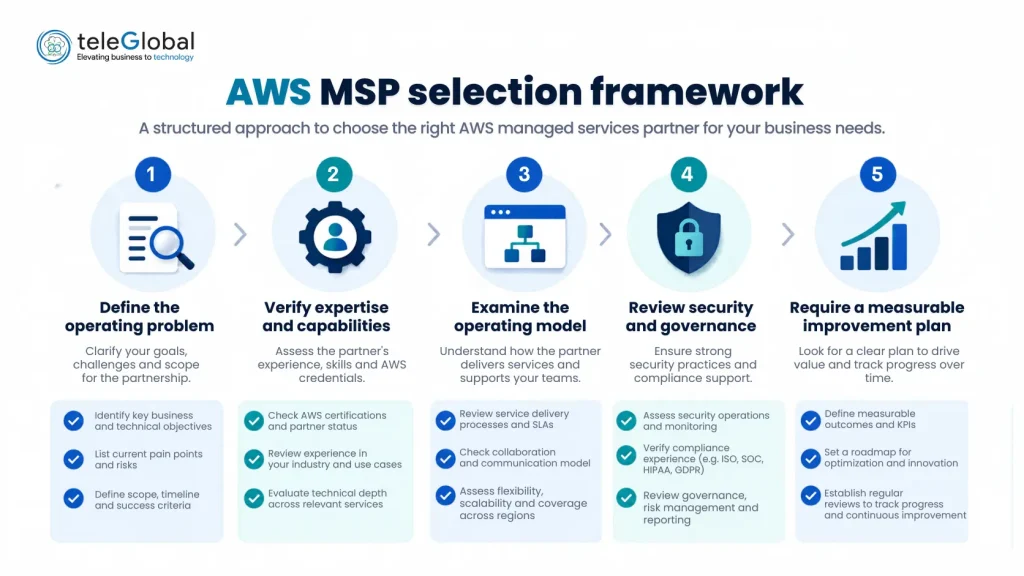
1. Define the operating problem. Document incidents, security risks, cost issues, workload dependencies and skills gaps before comparing providers.
2. Verify relevant expertise. Review program validations, certifications and customer evidence that match the workload and industry context.
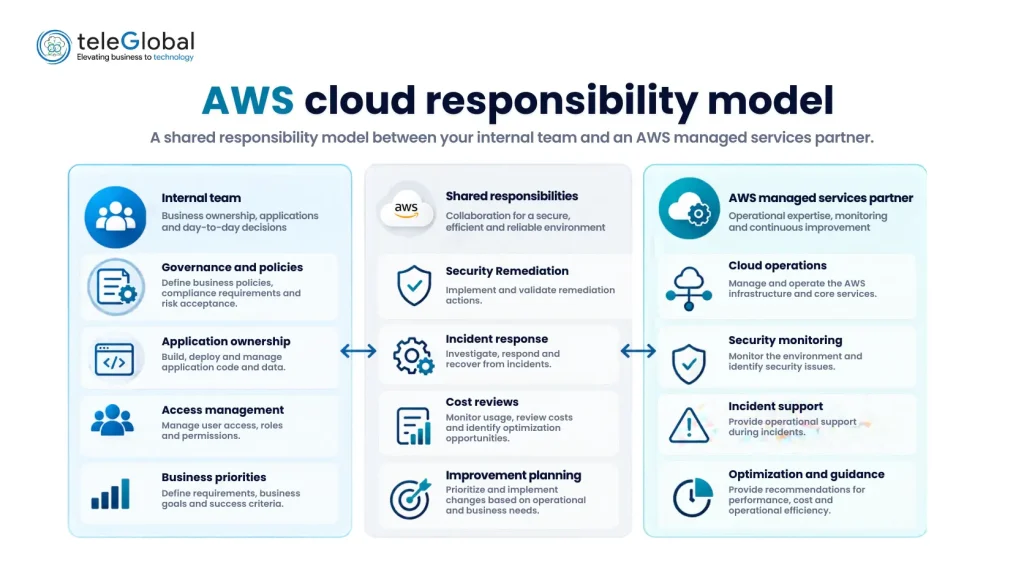
3. Examine the operating model. Ask for the responsibility matrix, escalation path, support coverage, reporting model and service-level definitions.
4. Review security and governance. Confirm access controls, change management, evidence handling and how remediation decisions are approved.
5. Require a measurable improvement plan. A capable MSP should show how automation, reviews and technical recommendations will improve the environment over time.
Warning Signs When Evaluating an AWS MSP
- A standard package offered without discovery of workload or business requirements.
- Savings, uptime or security guarantees presented without a documented baseline and scope.
- Unclear responsibility for incidents, backups, access management or third-party tools.
- Reports that list activity but do not explain risk, service health, cost drivers or next actions.
- Heavy dependence on individual engineers instead of documented processes and automation.
Why Consider Teleglobal for AWS Managed Services?
Teleglobal’s AWS managed services offering covers cloud operations, security, performance and cost optimization. Its broader cloud managed services practice includes migration, monitoring, patching, incident response, FinOps, backup and disaster recovery across cloud environments.
A useful engagement should begin with an assessment of the existing environment, operating risks and business priorities. This creates a service scope organized around the workload rather than a generic catalog.
Build a Better AWS Operating Model
AWS managed services should create greater control, not another layer of complexity. Talk to Teleglobal’s cloud team to assess your environment and define a managed-services model aligned with your operational priorities.
AWS Managed Services FAQs
What is the difference between an AWS consultant and an AWS MSP?
A consultant commonly supports a defined project. An MSP takes responsibility for agreed ongoing operations, governance and optimization after or alongside project delivery.
Does an AWS MSP replace the internal IT team?
Not necessarily. A good operating model defines which responsibilities stay internal, which move to the provider and how both teams collaborate.
How should AWS managed services be priced?
Evaluate pricing against scope, support coverage, workload complexity, tools and service levels. Compare complete operating value rather than the monthly fee alone.
What should an MSP service review cover?
A review should cover service health, incidents, security actions, cost drivers, changes, risks and agreed improvement work.