
| Author: Kamlesh Kumar | Published: 29-Jan-2026 |
Business leaders are looking for ways to improve efficiency without sacrificing quality. One rising solution is AI agentic workflows. Unlike simple automation, these workflows think, decide, and act with purpose. In this guide, we explain what agentic AI workflows are, how they work, and the Agentic AI use cases and benefits businesses should know in 2026.
What Are AI Agentic Workflows
AI agentic workflows are systems where AI agents manage business processes from start to finish. These agents don’t just follow pre-set rules. They observe, analyze, make decisions, and take action. This shift is driving a massive market growth, with the global Agentic AI market projected to hit $10.86 billion by the end of 2026.
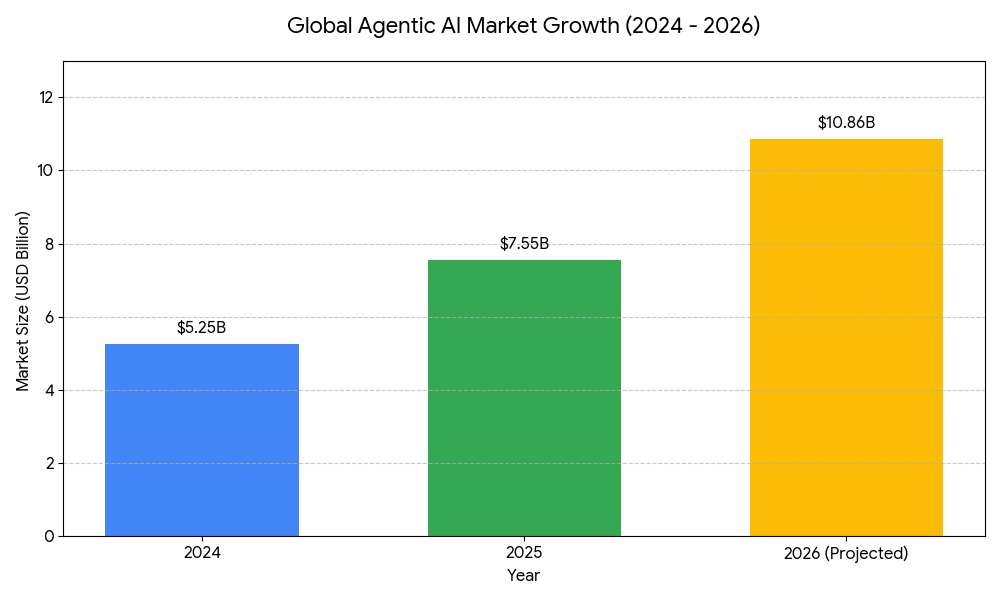
In simple terms, they act like digital employees who handle tasks independently. This makes them more flexible than traditional automation tools.
For example, instead of waiting for a human to approve an invoice, an agentic AI workflow can check records, confirm data, and process payment on its own.
How AI Agentic Workflows Differ from Traditional AI Workflows
Most traditional AI workflows are limited. They process input and give an output, but they don’t act on the result.
Agentic AI workflows, on the other hand:
- Make choices based on context.
- Adjust to new information in real time.
- Carry out actions without waiting for human approval.
- Learn and improve over time.
This makes them more suitable for dynamic business environments where speed and adaptability matter.
Key Use Cases of Agentic AI Workflows in 2026
The use cases of agentic AI workflows are expanding quickly. Gartner predicts that by 2028, 90% of all B2B buying will be intermediated by AI agents, effectively reprogramming $15 trillion in global spend. Businesses across industries are finding value in them.
- Customer Service Management
- AI agents handle customer queries. In fact, 80% of support organizations are expected to apply agentic AI.
- They escalate issues when needed.
- They provide real-time support without human delay.
- Finance and Accounting
- Automating invoice approvals.
- Detecting fraud and taking corrective action.
- Managing payroll workflows.
- Supply Chain and Logistics
- Monitoring shipments.
- Predicting delays and rerouting orders.
- Managing vendor communication automatically.
Real-world data from 2026 shows that multi-agent systems have reduced the time from over a week to less than 72 hours.
- Healthcare Operations
- Tracking patient records.
- Scheduling appointments.
- Alerting doctors to critical updates.
- Human Resources
- Screening job applications.
- Scheduling interviews.
- Managing employee onboarding.
These examples show how agentic AI workflows free human teams to focus on strategy while routine processes run themselves.
Benefits of AI Agentic Workflows
The benefits of AI agentic workflows go far beyond automation:
- Faster decisions: Tasks are completed in real time without human delays.
- Error reduction: AI agents cut down mistakes in repetitive work.
- Scalability: Businesses can manage more work without hiring more staff.
- Cost efficiency: Labor costs for routine processes decrease.
- Consistency: Workflows run smoothly without interruptions.
- Employee productivity: Teams focus on strategy instead of routine tasks.
These benefits lead to smarter operations and long-term growth.
Challenges in Deploying AI Agentic Workflows
While powerful, these workflows also bring challenges:
- Integration with legacy systems can be complex.
- Data security must be ensured before giving AI agents control.
- Governance and oversight are needed to prevent misuse.
- Training staff to work alongside AI is essential.
Leaders must plan carefully to get the most out of AI workflows 2026.
Future of Agentic AI Workflows in Business
The future of agentic AI workflows looks strong. By 2026 and beyond, businesses will rely on them for real-time decision-making.
Gartner forecasts that 40% of all enterprise applications will include integrated task-specific AI agents by the end of 2026(up from <5% in 2024). With AI business workflows becoming more advanced, we will see:
- Smarter hybrid systems combining agentic and generative AI.
- End-to-end business process management with minimal human oversight.
- Wider adoption across industries, from healthcare to retail.
Businesses that invest now will be ahead in efficiency and customer satisfaction.
How TeleGlobal International Can Help
At TeleGlobal International, we design AI agentic workflows that fit real business needs. Our solutions are safe, scalable, and built to deliver results. Whether you need agentic AI workflows for customer service, finance, or operations, we help you plan, deploy, and manage them for long-term growth.
Frequently Asked Questions
1. What are AI agentic workflows?
They are AI-driven processes where agents observe, decide, and act independently.
2. What are the main use cases of agentic AI workflows?
They include customer service, finance, supply chain, healthcare, and HR.
3. What are the benefits of agentic AI workflows?
They bring speed, cost savings, error reduction, and improved scalability.
4. How do agentic AI workflows differ from traditional workflows?
Traditional workflows need human input, while agentic workflows act autonomously.
5. What is the future of AI agentic workflows?
By 2026, they will manage more business processes, blending action and creativity.
6. How can TeleGlobal International support businesses with AI workflows?
We build and deploy AI business workflows that improve efficiency and drive growth.