Summary: AI in product development helps teams research customer needs, design features, write software and improve products after launch. This guide helps CIOs, CTOs and product leaders choose useful applications, understand implementation and plan costs. It explains how to start with one measurable workflow and evaluate quality before scaling.
| Author: Ashish Kumar | Published Date: 22-Oct-2026 |
What is artificial intelligence in product development?
Artificial intelligence in product development means using software that learns patterns or generates content to support research, design, building and testing. It also includes adding intelligent features, such as document search or recommendations, to a product.
Teleglobal’s AI integration services help businesses incorporate these capabilities into existing applications and workflows, connecting AI models with the data and systems needed to support specific business tasks.
AI product development use cases
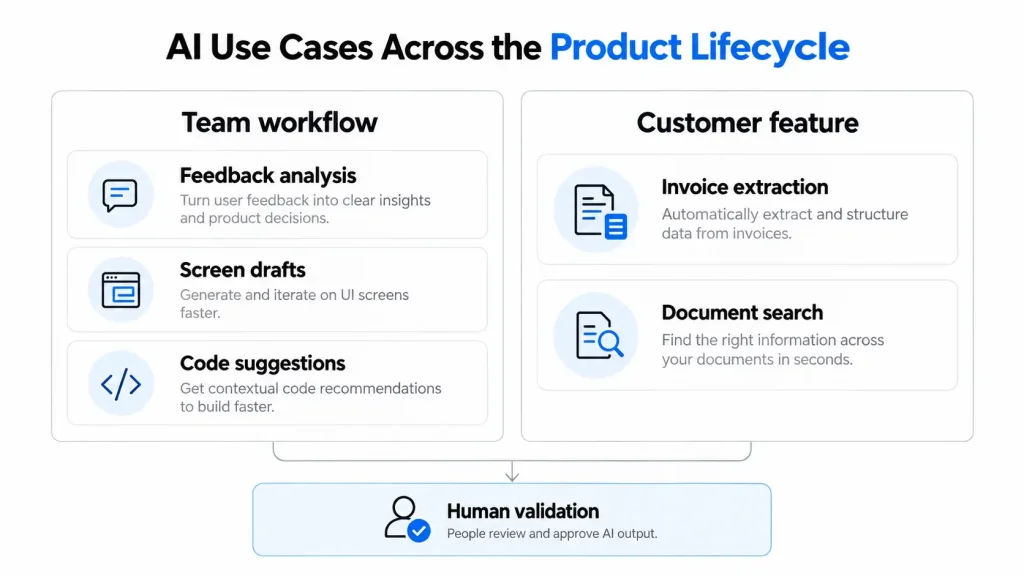
AI can support both the people building a product and the customers using it. These illustrative examples show where each approach fits.
Generative AI in product development works well for tasks involving text, images or code. Machine learning in product development can support predictions, such as identifying accounts likely to stop using a service.
For engineering applications, see our guide to generative AI in software development.
Benefits of AI in product development
The benefits are measurable only when teams compare results with an existing baseline.
- Faster discovery: measure time to a validated customer insight.
- Shorter delivery: track time from approved requirement to accepted release.
- Less rework: monitor defects and hours spent correcting outputs.
- Better adoption: measure task completion and repeat use.
McKinsey’s August 2026 survey found that 80% of respondents reported improved individual productivity, while 37% attributed some enterprise-level EBIT impact to AI. These are broad, self-reported findings, not product development benchmarks. They reinforce the need to measure business value separately from personal time savings.
Build an AI product strategy around the right use case
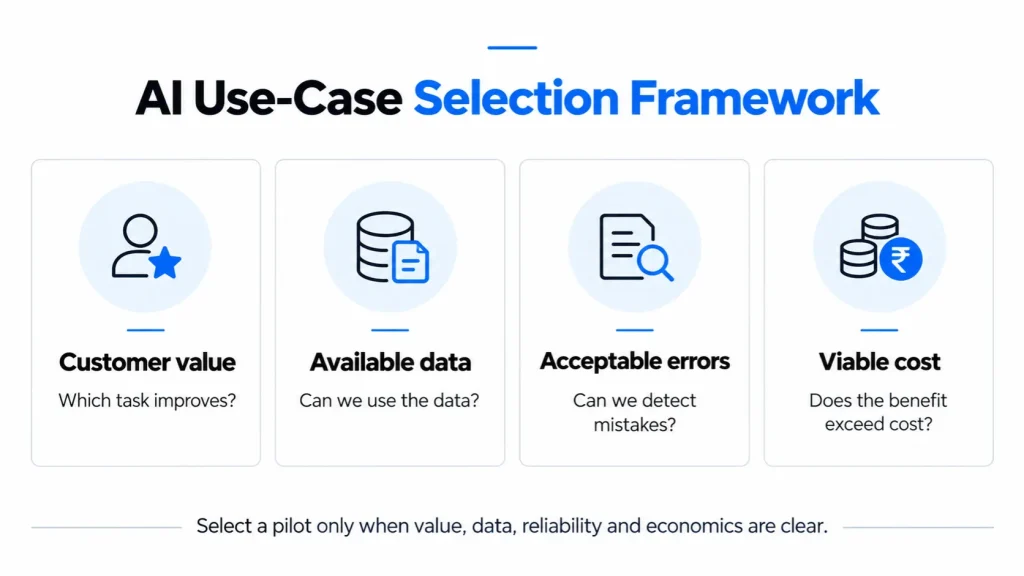
Use-case selection should consider customer value, data readiness and the consequences of failure.
AI for product innovation works best when teams can test an assumption before expanding investment. Begin with one workflow that meets these criteria.
Should you buy an AI tool or build an AI feature?
Choose the approach based on how much control the workflow needs. Buying a tool may suit an internal task; building a feature may make sense when AI is part of the customer experience.
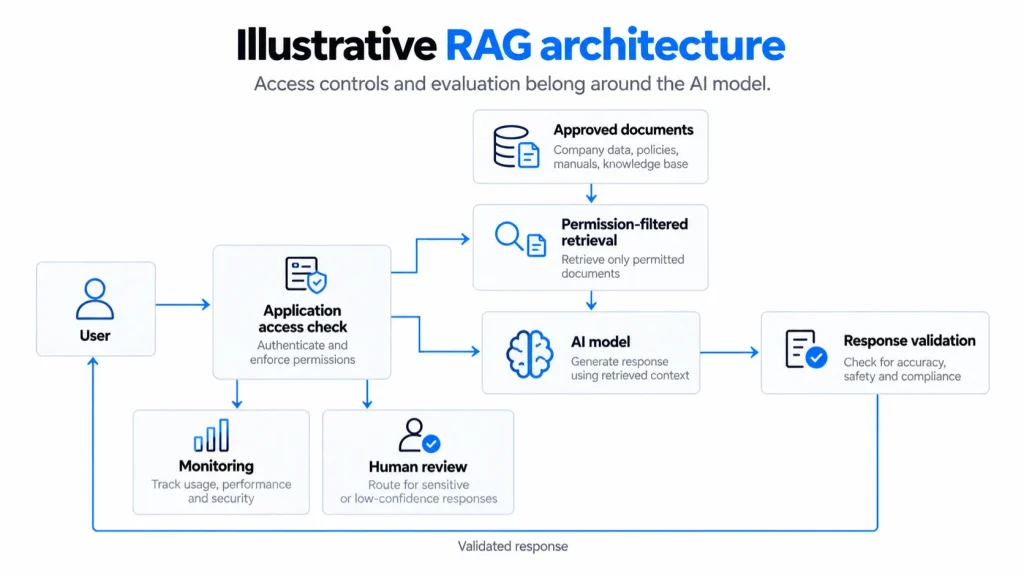
These options can work together. A custom feature can use a model API with retrieval. AWS’s RAG overview explains how external knowledge can inform responses without retraining the model. Fine-tuning changes model behaviour through additional training; it does not replace access controls or a process for keeping source documents current.
How to use AI in product development
The AI product development process needs explicit quality checks between a promising demo and a production release.
- Define the outcome– Select a task, owner and baseline. Set acceptable error rates and a business success measure.
- Prepare the data– Remove outdated records and confirm permissions. Separate each customer’s information throughout storage and retrieval.
- Choose the architecture– Compare ordinary rules, existing models and custom training. For changing company knowledge. Our RAG implementation guide explores the components.
- Build a limited pilot– Connect one workflow through APIs, which let systems exchange data. Include failure handling and human review.
- Evaluate before release– Test real tasks, missing information and malicious requests. Measure correctness, response time and cost per completed task.
- Monitor after launch– Release to a controlled group, review failures and retest after model or data changes.
The AI integration lifecycle continues after deployment. Assign ownership for updates, incidents and budgets.
What determines AI product development cost?
Cost depends on engineering effort, data preparation, integrations and ongoing usage. A coding assistant subscription and a customer-facing AI feature require different budgets.
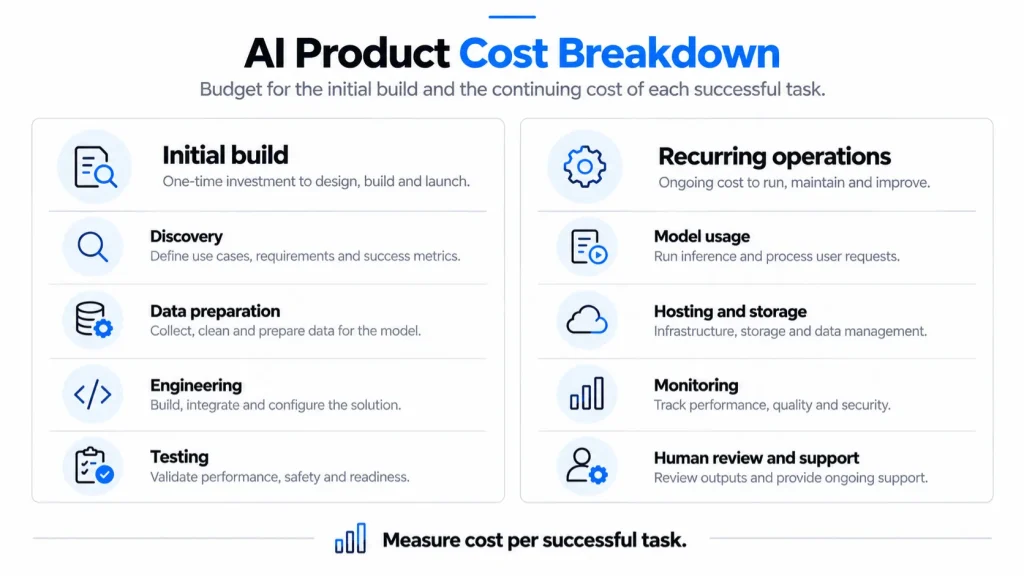
Estimate discovery, design, development, security testing and deployment separately. Then add recurring model charges, hosting, storage, monitoring and support.
For illustration, 400 hours at an assumed ₹2,000 per hour equals ₹8 lakh in labour. This is a calculation example, not a market estimate or Teleglobal quote. Taxes, licences and operations are additional.
Use current Amazon Bedrock pricing to estimate model charges for the chosen service and region. Include input text, generated output, retries and extra calls.
Measure cost per successfully completed task. A low-cost answer that needs frequent correction may be expensive overall.
Build a budget around scope and usage
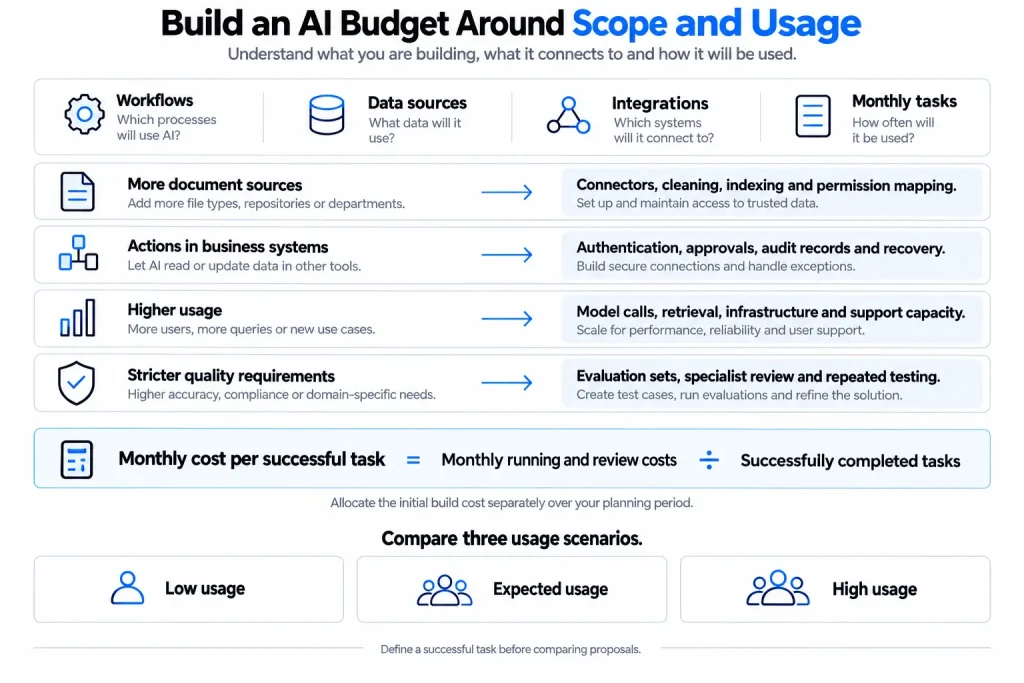
Ask for an estimate that states the number of workflows, data sources, integrations and expected monthly tasks. Define what counts as a successful task before comparing proposals.
For a monthly operating estimate, divide total running and review costs by successfully completed tasks. Separately spread the initial build cost over your chosen planning period. Use low, expected and high usage scenarios so leadership can see how adoption changes the budget.
Manage AI product security and reliability
Language models can produce incorrect answers or follow malicious instructions hidden in input. The OWASP list of LLM risks includes prompt injection and sensitive information disclosure.
Enforce permissions outside the model, limit tool access and require approval for consequential actions. Define when the product should decline to answer. Our responsible AI guide explains governance and ownership.
When is an AI product pilot ready to scale?
A pilot is ready for broader use when it meets agreed business, quality and operating requirements on representative tasks. A polished demonstration alone does not establish this.
Before expanding, ask:
- Value: Does the workflow improve the chosen business measure against its baseline?
- Quality: Are errors within agreed limits, including difficult cases?
- Control: Do permission checks, escalation and fallback routes work?
- Economics: Is cost per successful task acceptable at expected usage?
- Ownership: Is a named team responsible for monitoring, support and rollback?
Document the decision and unresolved issues. If one requirement fails, improve that part of the workflow and repeat the relevant evaluation before increasing access.
Plan AI for product development with Teleglobal
Teleglobal offers AI integration and custom application development. Share your target workflow, data sources and success measure through our AI integration services page to discuss a focused pilot and its technical requirements.
Frequently Asked Questions
1. How does AI help product development teams?
AI helps product teams organise research, draft requirements, suggest code and analyse feedback. Its value depends on the task and the review required. Measure completed work, quality and customer outcomes against a baseline before assuming that faster drafts will reduce overall development time.
2. What is the difference between AI-assisted and AI-powered product development?
AI-assisted development changes how a team builds software, such as using a coding assistant. AI-powered product development can also involve features customers use, such as intelligent search. The latter requires runtime data access, monitoring and ongoing usage budgets, alongside ordinary application engineering and support.
3. Which AI model should a product team choose?
An AI model should match the task, data controls, response-time requirements and budget. Compare candidate models on representative examples, including difficult cases. Select the lowest-cost option that meets the agreed quality threshold, and repeat the evaluation when models, prompts or business requirements change.
4. Can AI integration in a product work with existing software?
AI integration in a product can work through APIs and connectors without replacing the entire application. Feasibility depends on data access, authentication and system performance. Start with one feature, preserve the existing workflow as a fallback, and test permissions before opening access to customers.
5. Does the AI product development lifecycle require custom training?
The AI product development lifecycle does not always require custom model training. Existing models, carefully written instructions and retrieval may meet the need. Consider additional training only when evaluation reveals a specific gap and the available training data, budget and maintenance capacity justify it.
6. Can AI reduce product development costs?
AI can reduce product development costs when the value of time saved or quality improved exceeds software, infrastructure and review costs. Include rework, integration and support in the calculation. Staff time released becomes a financial benefit only when the business uses that capacity productively.
7. How long does an AI product pilot take?
An AI product pilot’s duration depends on data readiness, integration scope and evaluation requirements. Estimate these activities separately before agreeing a delivery date. A working demonstration is not proof of production readiness; security checks, user testing and support arrangements must also fit the schedule.
8. Can AI replace product managers and developers?
AI can automate or assist specific product management and development tasks, but product decisions still need accountable owners. People must validate customer needs, set priorities, review architecture and accept releases. The appropriate level of automation depends on how reliably outputs can be checked and corrected.