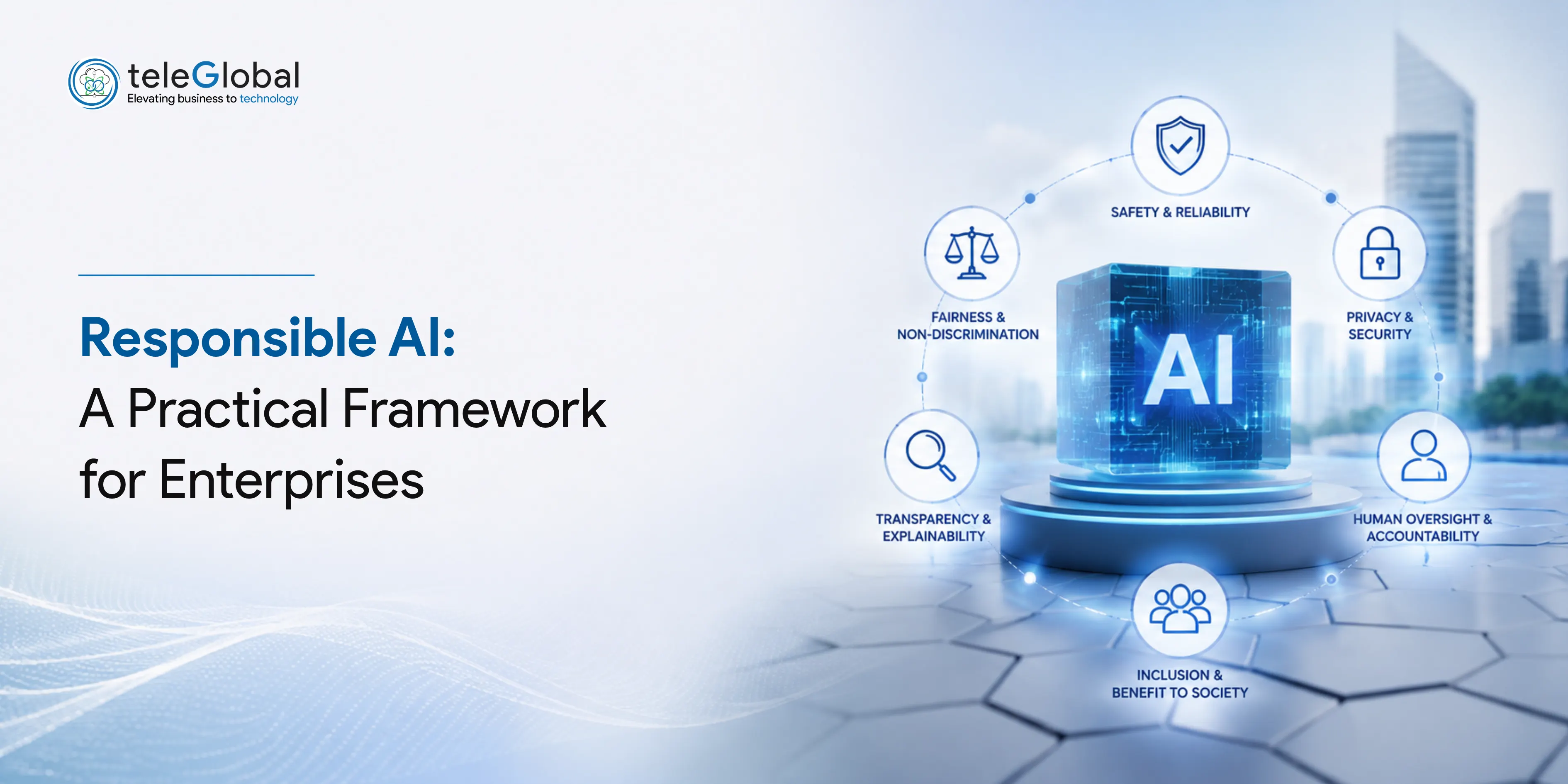
This guide explains what responsible AI means in practice, why governance is now the main brake on AI value, and how to put it in place without stalling delivery. Written for CIOs, CTOs, risk leads and architects deploying AI in regulated or customer-facing settings. You will finish with a definition, the rules, a seven step rollout and a scorecard.
| Author: Ashish Kumar | Published Date: 25-August-2026 |
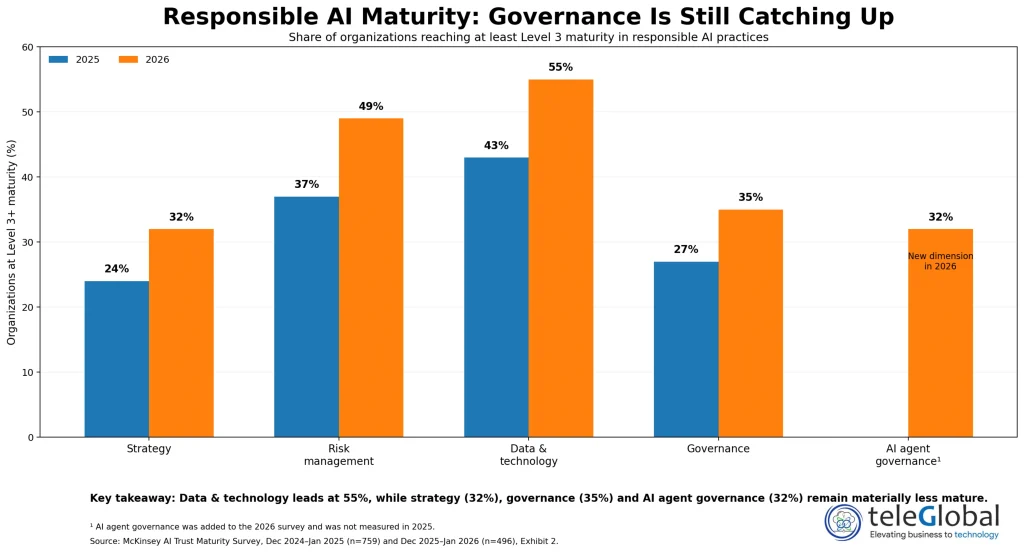
Responsible AI is the practice of building and running AI systems that are fair, explainable, secure and accountable to a named owner. Responsible artificial intelligence (AI) has moved from an ethics statement to an operating requirement because autonomous systems now take actions rather than only suggest them. McKinsey’s 2026 AI Trust Maturity Survey found only about 30 percent of organisations reach a mature level in strategy, governance and agentic AI controls.
What is Responsible AI?
Responsible AI is the set of principles, controls and review processes that keep an AI system fair, transparent, secure and accountable throughout its life. These Responsible AI principles cover how a model is trained, how its decisions are explained, who is answerable when it fails, and how it is monitored after launch.
Responsible AI also connects closely with AI ethics and Ethical AI, but it goes further by turning cvalues into practical controls and repeatable Responsible AI practices.
The word carrying most weight there is monitored. A model that passed its fairness checks at launch can drift months later as the data changes. Responsible AI is a running process, not a certificate earned once.
That continuous oversight is central to the responsible use of AI in real-world business environments.
If you are working out where your systems sit, our machine learning team builds bias checks and drift monitoring into every model as standard.
Why Responsible AI Is Critical in 2026
Three forces turned this from a values discussion into a budget item: regulation arrived, autonomy raised the stakes, and evidence now shows a gap between what organisations know and what they control.
Strong AI Governance helps organisations turn Responsible AI principles into operational controls, accountability and evidence.
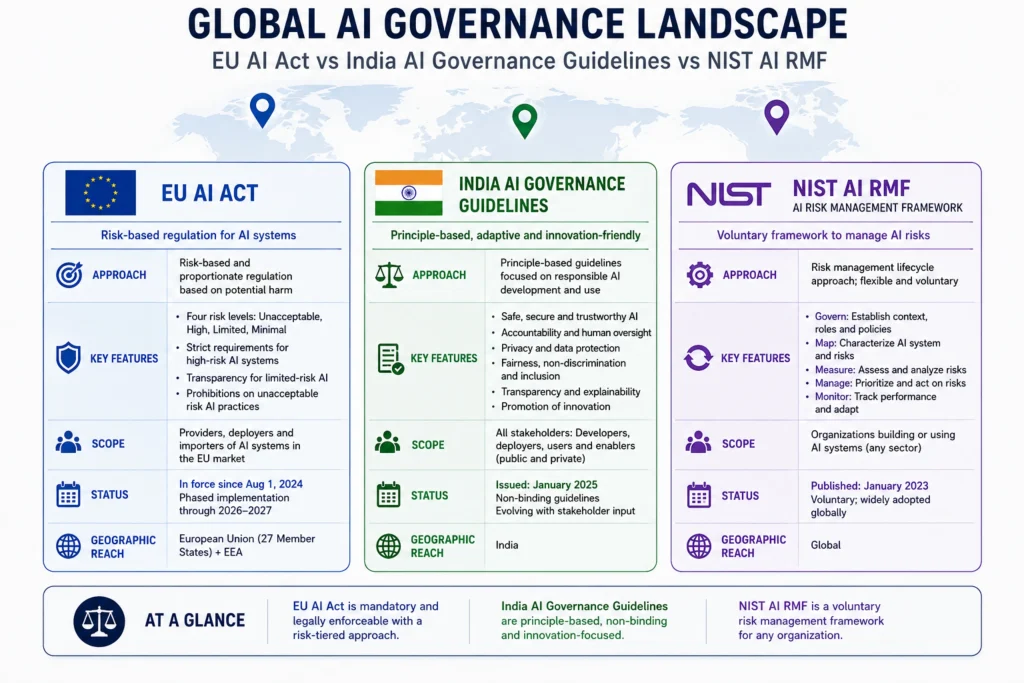
The regulatory picture is no longer theoretical. On 2 August 2026 the remainder of the EU AI Act began to apply. Fines reach 35 million euros or 7 percent of worldwide turnover for prohibited practices, and 15 million euros or 3 percent for breaches of provider, deployer and transparency duties.
India took a different route. The India AI Governance Guidelines, published by MeitY in November 2025, set out seven sutras: Trust is the Foundation, People First, Innovation over Restraint, Fairness and Equity, Accountability, Understandable by Design, and Safety, Resilience and Sustainability. They work through existing laws and sectoral regulators rather than a separate AI act.
These principles support Ethical AI and the responsible use of AI while allowing organisations to build governance around existing legal and regulatory structures.
Table 1. The three frameworks that shape responsible AI in 2026
| Framework | Where it applies | What it requires | Status |
| EU AI Act | Companies placing AI on the EU market, or whose outputs are used there | Risk classification, transparency, human oversight, conformity checks for high risk | Remainder applied 2 Aug 2026, Article 6(1) from 2 Aug 2027 |
| India AI Governance Guidelines | Indian organisations, via existing sectoral regulators | Seven sutras, voluntary commitments, transparency reports, grievance redressal | Published November 2025 |
| NIST AI Risk Management Framework | Voluntary, used globally as reference | Govern, map, measure and manage across the AI lifecycle | Released Jan 2023, revision under way |
Where responsible AI programmes break down
The failures are consistent, and organisational rather than technical. McKinsey’s survey of around 500 organisations, taken between December 2025 and January 2026, points to four. Inaccuracy and cybersecurity top the risk list, at 74 and 72 percent.
- Awareness outpaces action. Across nearly every risk category, more organisations rate a risk as relevant than actively mitigate it, most visibly on privacy and intellectual property.
- Nobody owns it. Organisations with clear accountability score 2.6 on maturity. Those without a named owner score 1.8.
- Teams lack the skills. Almost 60 percent name knowledge and training gaps as the leading barrier, up from around 50 percent a year before.
- Response capability is slipping. Incidents hold steady at roughly 8 percent of organisations, but almost 60 percent of those hit rate their own response as satisfactory or worse.
These failures are why responsible AI governance practices matter. Policies alone are not enough unless they are supported by clear ownership, monitoring, controls and incident processes.
How to implement responsible AI in seven steps
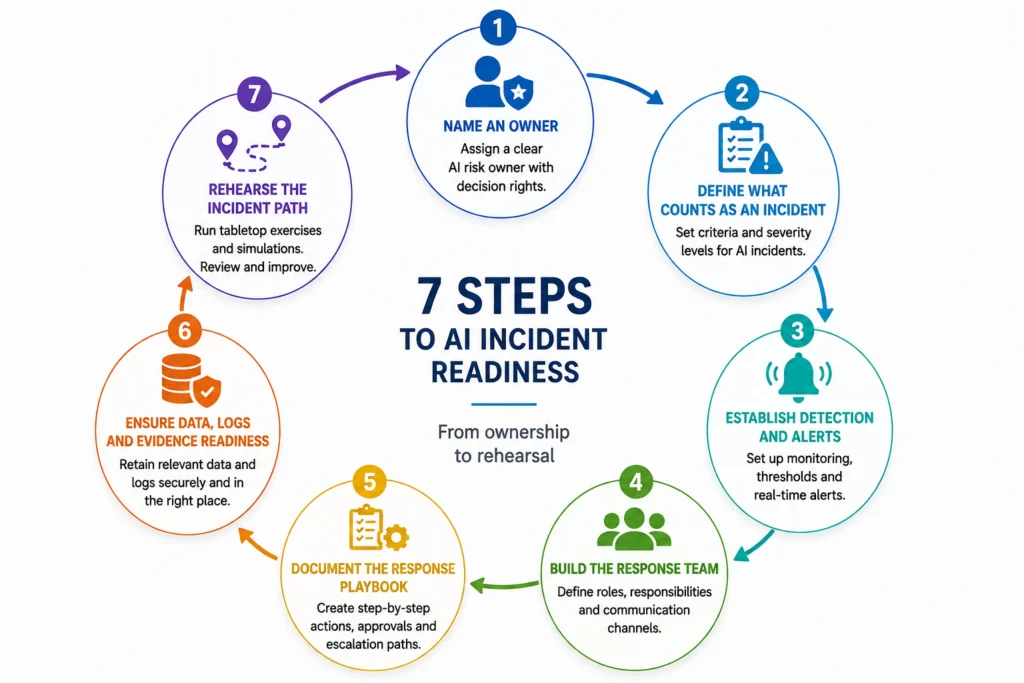
- Name an owner before you write a policy. An executive with decision rights is the change most associated with higher maturity. A committee without authority is not ownership. Clear ownership is one of the foundations of effective AI Governance.
- Inventory every AI system in use, including those inside bought software. Most organisations underestimate the count, and you cannot govern what you have not listed.
- Classify each system by consequence, not sophistication. A simple model approving credit needs tighter control than an advanced one drafting internal summaries. This supports the responsible use of AI by applying stricter controls where the consequences are greater.
- Set controls to match each tier: human review, explainability, bias testing, logging and rollback. Write down which apply where, so teams stop negotiating each case. These are practical Responsible AI practices that turn policy into action.
- Keep data inside your own boundary where the use case is sensitive. Routing customer conversations through an external API is an AI Governance decision, not only architecture.
- Instrument everything. Audit logs, performance monitoring and drift detection turn policy into something you can evidence to a regulator or client. These controls also help put AI ethics into practice by making accountability and transparency measurable.
- Rehearse the incident path. Decide now who is called, who can pause a model, and what customers are told. Most organisations find the gaps during the incident.
Table 2. Responsible AI readiness scorecard
| Question to answer | Weak position | Strong position |
| Who owns responsible AI? | A committee with no decision rights | A named executive who can pause a system |
| Do you know every AI system running? | Partial list, shadow tools unknown | Full inventory, including AI inside bought software |
| How are systems classified? | By technical sophistication | By consequence if the system is wrong |
| Where does data go at inference? | Through an external API by default | Inside your own cloud boundary when sensitive |
| Can you evidence what a model did? | Logs kept inconsistently | Full audit trail, drift monitoring |
| What happens in an incident? | Worked out on the day | A rehearsed path, named roles |
What responsible AI looks like in production
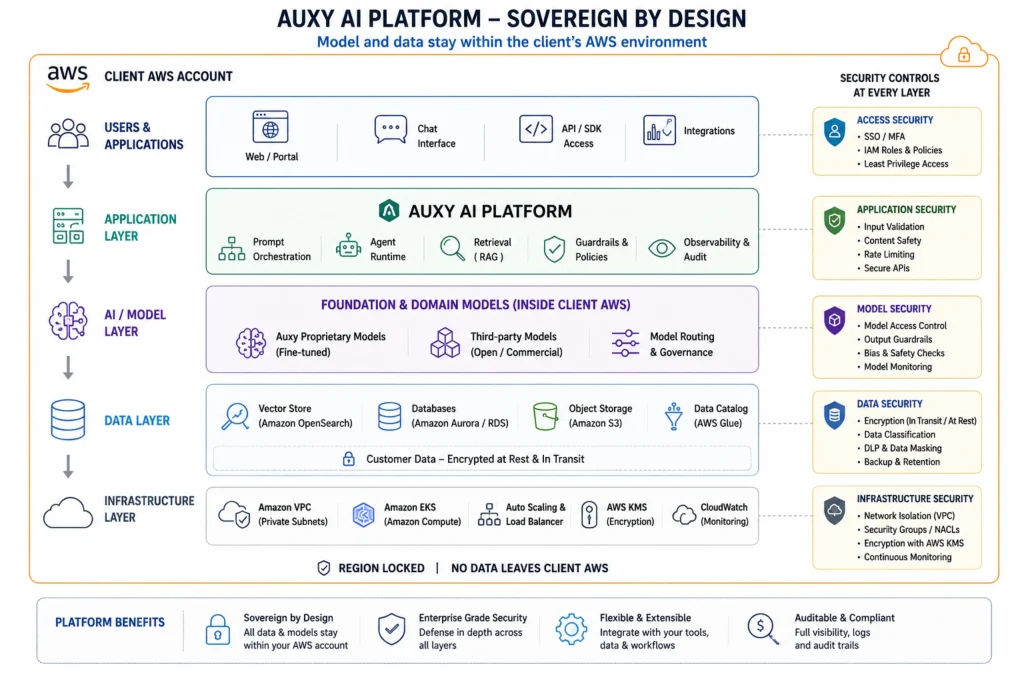
A recent Teleglobal engagement shows how these decisions play out. Building an agentic AI voice platform for Auxy AI, the team evaluated three models and rejected GPT-4o because call data would route through an external provider, which enterprise clients would not accept.
The selected option was a fine-tuned model on Amazon SageMaker inside the client’s own AWS environment, so conversation data never left the boundary. Security controls went live from day one rather than retrofitted: encryption, threat detection, least-privilege access and full API logging for the audit trail enterprise buyers expect. That is the practical shape of responsible AI.
Why businesses choose Teleglobal
Teleglobal International has worked in cloud and IT transformation since 2016 and supports more than 900 clients across BFSI, healthcare, manufacturing and logistics, with delivery from Pune and offices in Mumbai and Gurugram.
Teleglobal embeds Responsible AI practices across the AI lifecycle, from model development and deployment to monitoring and governance. Bias and fairness checks, drift detection and automated retraining are standard in the build process, not optional extras.
These controls help organisations move from broad Responsible AI principles and AI ethics commitments to practical implementation.
If you are deploying AI into a regulated or customer-facing process, talk to our team for a governance review of what you run today.
Frequently Asked Questions
1. What is Responsible AI?
Responsible artificial intelligence (AI) is the approach of designing, deploying and operating AI systems in a way that supports fairness, transparency, security and accountability throughout their lifecycle.
2. What are the main principles of responsible AI?
Most frameworks share five core Responsible AI principles: fairness, transparency, accountability, privacy and security, and reliability. India’s AI Governance Guidelines list seven sutras including Trust is the Foundation, People First and Understandable by Design. The labels vary, but the underlying obligations are broadly consistent across jurisdictions.
3. What are Responsible AI practices?
Responsible AI practices are the controls and processes used to apply Responsible AI principles in real-world systems. They can include bias testing, human review, explainability, monitoring, logging, risk classification and incident response.
4. Why is responsible AI important for business?
Autonomous systems now take actions rather than only make suggestions, so failures carry direct cost. Regulatory penalties reach 35 million euros under the EU AI Act. Beyond compliance, McKinsey found organisations investing seriously in responsible AI report higher maturity and stronger business results.
5. What is the difference between responsible AI and AI governance?
Responsible AI describes the outcome, meaning systems that are fair, safe and accountable. AI governance is the machinery that delivers it: ownership, policies, approval gates, controls and monitoring. Governance is how an organisation makes responsible AI repeatable instead of dependent on individual judgement.
6. Does India have an AI law?
Not a dedicated one. The India AI Governance Guidelines, published in November 2025, apply existing laws through sectoral regulators rather than creating separate AI legislation. The framework sets out seven guiding principles and recommends voluntary measures backed by technical standards during this stage of development.
7. When does the EU AI Act apply to my company?
The remainder of the Act started to apply on 2 August 2026, with obligations for high risk systems under Article 6 following on 2 August 2027. It reaches companies outside the EU whose AI systems are placed on the EU market or whose outputs are used there.
8. How do you measure responsible AI maturity?
Common frameworks assess strategy, risk management, data and technology, governance, and controls for autonomous systems. McKinsey scores these on a four level scale, where the 2026 average sat at 2.3. NIST’s AI Risk Management Framework offers a widely used alternative structured around govern, map, measure and manage.
9. What is the first step to implementing responsible AI?
Assign clear ownership to a named executive with authority to pause or approve systems. Organisations with explicit accountability score 2.6 on maturity against 1.8 for those without. Building an inventory of AI systems already running is the natural second step.