| Author: Kamlesh Kumar | Updated on: 25-August-2026 |
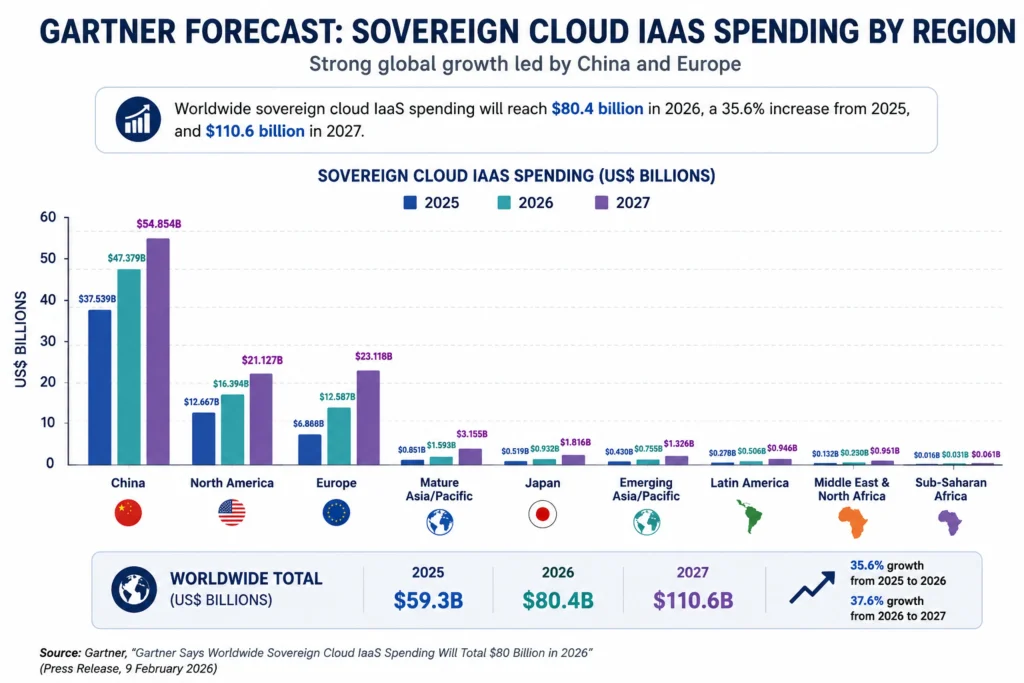
Sovereign cloud is cloud computing where your data, and the systems and people that control it, stay inside one country’s legal borders. In India that shifted from debate to budget line during 2026. Gartner forecasts worldwide sovereign cloud IaaS spending will reach 80 billion dollars in 2026, a 35.6 percent rise on the previous year. Below is what the model gives you, which Indian rules apply, and how to check a provider’s claims.
What is sovereign cloud?
Sovereign cloud is a cloud environment where data storage, processing, operations and legal control all sit within a single country’s jurisdiction. Your data is not only hosted locally. It is governed only by that country’s laws, and no foreign government can compel access to it. This model is built around a sovereign cloud architecture that considers not only where data is stored, but also where control, identity, operations and access are managed.
The distinction that matters is between data residency and data sovereignty. Residency answers where the servers sit. Sovereignty answers whose law applies and who can be ordered to hand data over. A Mumbai data centre run by a foreign owned entity gives the first without the second, and that gap is where compliance surprises start.
If you are mapping which workloads fall into this category, our cloud consulting team runs that assessment first can help evaluate the sovereign cloud capabilities required for each workload.
Why sovereign cloud matters in India in 2026
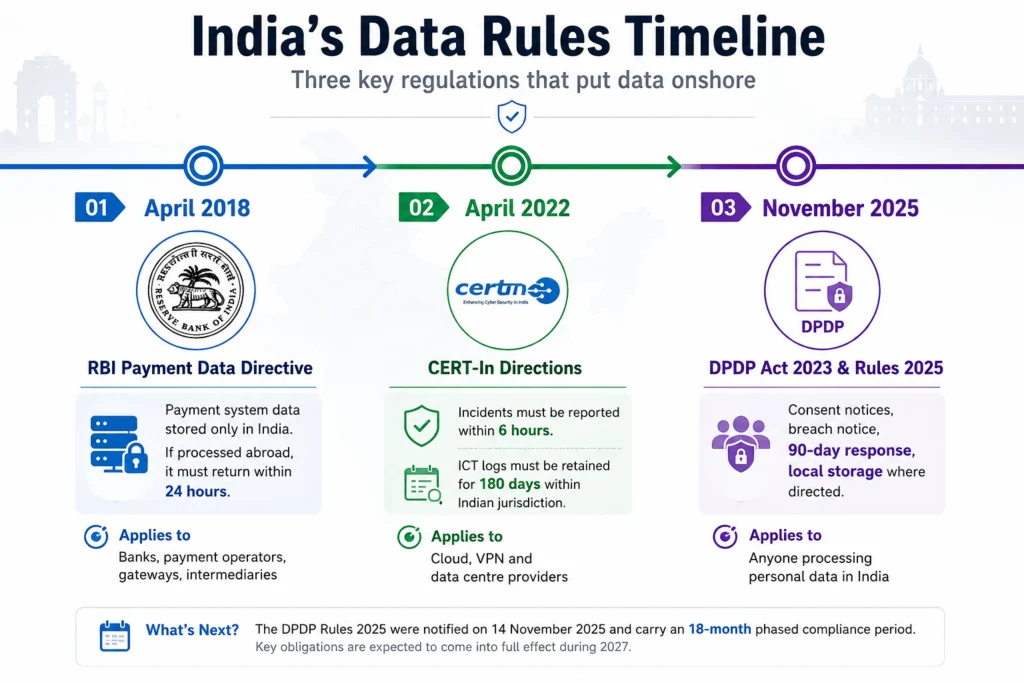
India’s data rules now reach almost every regulated workload, and three push data onshore. The Digital Personal Data Protection Rules 2025 were notified on 14 November 2025, giving full effect to the DPDP Act 2023 and opening an 18 month phased compliance window. Organisations classed as Significant Data Fiduciaries can be directed to keep specified data inside India. Penalties reach 250 crore rupees for weak security safeguards.
Banking and payments have faced stricter rules for longer. The Reserve Bank of India’s directive of 6 April 2018 requires the entire payment system data to be stored only in India, and data processed abroad must return within 24 hours. CERT-In added an operational layer in April 2022: incidents reported within six hours, and 180 days of logs held inside Indian jurisdiction.
On 15 August 2026, Island Computing opened a fully managed sovereign cloud in India, keeping data centres, control planes, identity systems and audit logs under Indian law. It estimates India’s cloud spending will reach 26.4 billion dollars in 2026, with around 80 percent going to foreign providers, a vendor estimate rather than an audited figure.
Table 1. The Indian rules that push data onshore
| Rule | Applies to | Key requirement | In force |
| DPDP Act 2023 and Rules 2025 | Anyone processing personal data in India | Consent notices, breach notice, 90 day response, local storage where directed | 14 November 2025 |
| RBI payment data directive | Banks, payment operators, gateways, intermediaries | Payment system data stored only in India, 24 hour return if processed abroad | 6 April 2018 |
| CERT-In directions | Cloud, VPN and data centre providers | Six hour incident reporting, 180 days of logs inside Indian jurisdiction | 28 April 2022 |
Sovereign cloud is not the same as a local region
A local cloud region and a sovereign cloud solve different problems. Every major hyperscaler runs Indian regions, and for most workloads that is enough. The difference appears when a foreign parent can be served a legal order for data held by its Indian subsidiary. If no foreign jurisdiction may reach your data, a region alone does not close the gap.
Depending on the workload and regulatory requirement, organisations may consider different sovereign cloud configurations, including a Sovereign Public Cloud or a Sovereign Private Cloud. The right model depends on the level of control, isolation and regulatory assurance required.
How to evaluate a sovereign cloud provider in six steps
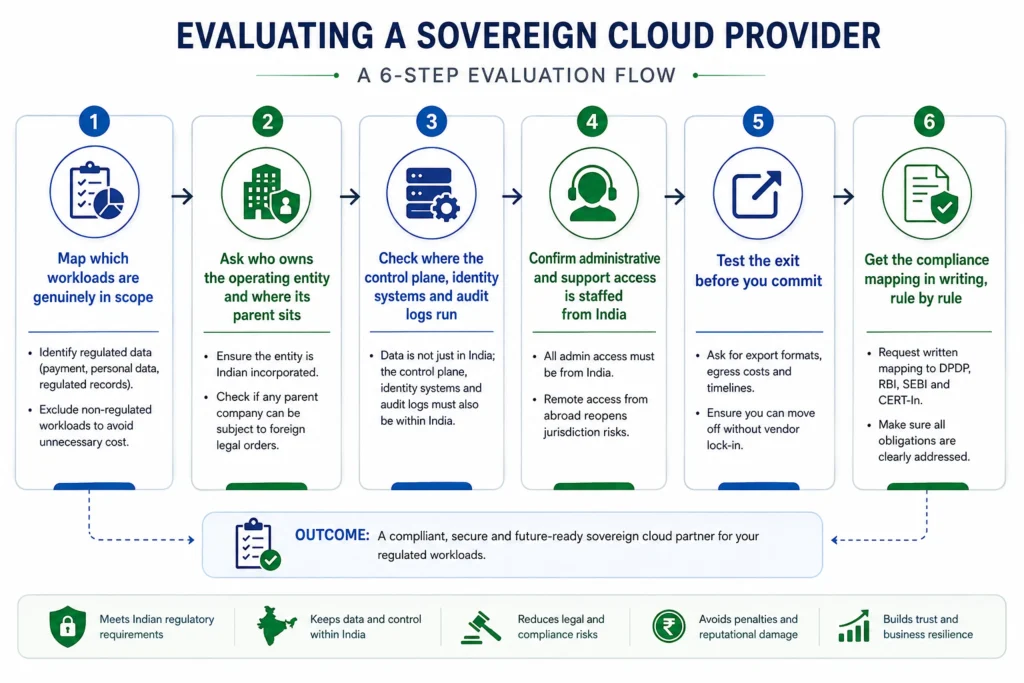
- Map which workloads are genuinely in scope. Payment data, personal data of Indian users and regulated records carry the obligation. Marketing sites and internal wikis do not, and treating everything as sovereign inflates cost for no gain.
- Ask who owns the operating entity and where its parent sits. A foreign parent can face foreign disclosure orders even when every server is in Pune.
- Check where the control plane, identity systems and audit logs run, not only where storage sits. Control follows the control plane, and vendors are least specific here. This is a core consideration when evaluating sovereign cloud architecture and provider controls.
- Confirm administrative and support access is staffed from India. Remote admin access from abroad reopens the jurisdiction question you just paid to close.
- Test the exit before you commit. Ask for export formats, egress costs and a timeline to move off. Sovereignty without portability is lock-in with a flag on it.
- Get the compliance mapping in writing, rule by rule, against DPDP, RBI, SEBI and CERT-In. A documented Sovereign Cloud strategy should connect these regulatory requirements to specific technical and operational controls
Table 2. Scoring framework for a sovereign cloud shortlist
| Criterion | What a strong answer looks like | Weight |
| Jurisdiction of operating entity | Indian incorporated, no parent facing foreign orders | High |
| Control plane and identity | Fully inside India, documented | High |
| Admin and support access | Indian staff, every access logged | High |
| Regulatory mapping | Written mapping to DPDP, RBI and CERT-In duties | High |
| Exit and portability | Standard formats, published egress cost, tested restore | Medium |
| Cost benchmark | Compared per workload, not on list price | Medium |
| Local data and AI services | Analytics without cross-border transfer | Medium |
What sovereign cloud costs, and what it saves
Sovereign cloud is not automatically the expensive option. Gartner expects the shift to move 20 percent of current workloads from global to local providers, with the remaining 80 percent of sovereign spend coming from new projects or legacy systems already waiting to migrate. The real comparison is moving one workload against a compliance failure on it.
That second figure is measurable. A single failure to maintain reasonable security safeguards under the DPDP Act carries a penalty of up to 250 crore rupees. Relocating a workload is usually the smaller number.
The cost comparison should also consider the level of sovereign cloud solutions required, including infrastructure, operations, compliance controls, support and portability rather than comparing infrastructure prices alone.
Whatever platform you choose, the controls still need building and monitoring, which is where cloud security and analytics work continues.
Why businesses choose Teleglobal
Teleglobal International has worked in cloud and IT transformation since 2016 and supports more than 900 clients across BFSI, healthcare, manufacturing and logistics. Delivery runs from Pune, with offices in Mumbai and Gurugram and a presence in the US, Europe and the Middle East, so Indian workloads are assessed by people under the same rules.
Our teams map workloads against the rules for your sector, then design around what has to stay onshore rather than moving everything by default. This approach supports practical sovereign cloud implementations instead of applying the same architecture to every workload. Our sovereign cloud services in India can also help organisations assess requirements, design the target environment and plan migration.
Frequently Asked Questions
1. What is sovereign cloud?
Sovereign cloud is a cloud environment where data storage, processing, operations and legal control all sit inside one country’s jurisdiction. It goes further than local hosting. The operating entity, the control systems and the staff with access are governed by that country’s laws alone.
2. What is the difference between sovereign cloud and data residency?
Data residency means the servers holding your data sit in a specific country. Data sovereignty means the data is also governed only by that country’s laws. A local data centre owned by a foreign company delivers residency but not sovereignty, because the parent may face foreign orders.
3. Does India require data to be stored in India?
For some categories, yes. The Reserve Bank of India requires the entire payment system data to be stored only in India. CERT-In requires 180 days of ICT logs held within Indian jurisdiction. Significant Data Fiduciaries can be directed to keep specified data onshore.
4. Which laws govern cloud data in India?
Four matter most. The DPDP Act 2023 with the DPDP Rules 2025 covers personal data. RBI directives cover payment system data. CERT-In directions cover incident reporting and log retention. SEBI advisories apply to regulated market participants. Sector rules sit above general ones. These requirements form the regulatory foundation for many sovereign cloud frameworks used by organisations in regulated sectors.
5. Is sovereign cloud more expensive than public cloud?
Not always. Pricing depends on the provider and the workload, and some Indian platforms benchmark below hyperscaler regions. The more useful comparison is relocating one regulated workload against the penalty exposure of leaving it non-compliant, which reaches 250 crore rupees.
6. Who needs a sovereign cloud in India?
Organisations handling payment data, government workloads, healthcare records, or large volumes of personal data of Indian users. Banks, insurers, public sector bodies and regulated SaaS platforms have the clearest case. Businesses without regulated data usually meet obligations with a standard Indian region.
7.Can I use AWS or Azure and still meet Indian rules?
In most cases, yes. Indian regions from major providers satisfy residency requirements for many workloads. The gap appears when a contract, regulator or board requires that no foreign jurisdiction can reach the data. That points to a sovereign platform rather than a local region.
8.How long do I have to comply with the DPDP Rules?
The DPDP Rules 2025 were notified on 14 November 2025 and carry an 18 month phased compliance period, so the main obligations land during 2027. Organisations likely to be classed as Significant Data Fiduciaries should begin their data mapping now rather than waiting.