Executive Summary
A technology startup building AI-powered products needed production-grade AWS infrastructure for generative AI and machine learning workloads. The company had no cloud environment in place. Everything needed to be built from scratch: compute for training open-source ML models, integration with foundation model APIs, a recommendation engine, secure networking, database management, and operational monitoring.
Teleglobal designed and deployed a complete AWS machine learning infrastructure covering Amazon SageMaker for model training, Amazon Bedrock for generative AI capabilities, Amazon Personalize for real-time recommendations, and a full production stack with EC2, RDS for PostgreSQL, VPC, ELB, WAF, and CloudWatch. This engagement is part of Teleglobal’s Expert AWS Solutions practice.
Background
The client is a startup developing AI-powered products that combine machine learning, generative AI, and personalized recommendations to deliver intelligent experiences to end users.
The team needed to go from zero infrastructure to a fully operational AWS cloud platform for AI workloads. This was not a basic hosting setup. The requirements included dedicated compute for open-source model training, access to foundation models through Amazon Bedrock, a PostgreSQL database in a high-availability configuration, load balancing, web application firewall protection, and VPN-based remote access for developers.
Without a proper cloud foundation, the company could not train models at scale, serve AI inference in production, or meet the security expectations of enterprise customers evaluating the platform.
The Challenge
The startup faced four infrastructure problems that needed to be solved before the product could go live.
No Cloud Infrastructure for AI Workloads
There was no AWS infrastructure in place. The company needed compute, networking, databases, security, monitoring, and a full AI/ML stack built from scratch. Getting the architecture right the first time was critical because reworking a production AI environment is expensive and disruptive.
ML Training and Generative AI Requirements
The platform needed dedicated EC2 instances for training open-source ML models and a production-ready setup for Amazon SageMaker and Amazon Bedrock. Both services required proper IAM configuration, network isolation, and monitoring to function correctly and securely in a production environment.
Security from Day One
AI workloads process sensitive data. The company could not launch with open ports, public-facing servers, or basic access controls. They needed private subnets, VPN-only access, WAF protection, least-privilege IAM, and encryption, all configured before the first model was trained.
No Operational Visibility
Without monitoring, the team would have no way to track infrastructure health, detect performance issues, or respond to incidents. Production AI workloads need real-time observability, not just logging after something breaks.
The Solution
Teleglobal built a complete, production-ready AWS infrastructure for AI covering compute, networking, database, security, monitoring, and the full ML/AI service stack. This project was delivered as part of Teleglobal’s cloud managed services.
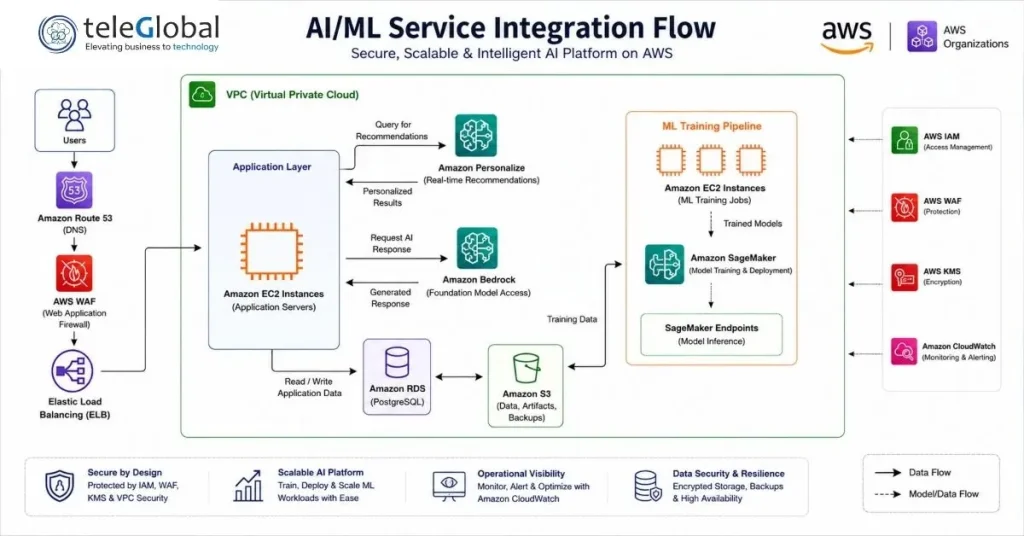
Amazon SageMaker Setup for ML Model Training
Amazon SageMaker was configured for the full ML model lifecycle: building, training, and deploying models. EC2 instances in private subnets were provisioned specifically for open-source model training, running in a secure and isolated environment with NAT Gateway and VPN access. IAM roles, networking rules, and CloudWatch monitoring were set up to give the team visibility into training jobs, resource usage, and model performance.
Amazon Bedrock Deployment for Generative AI
Amazon Bedrock was integrated to give the platform access to foundation models for generative AI on AWS. The configuration included IAM permissions, VPC networking integration, and monitoring. This allowed the company to add generative AI capabilities to their product without managing the underlying model infrastructure.
Amazon Personalize for Recommendations
Amazon Personalize was deployed to deliver real-time personalized recommendations. This added a layer of intelligent content delivery that adapts to user behavior, improving engagement and retention across the platform.
Compute, Database, and Load Balancing
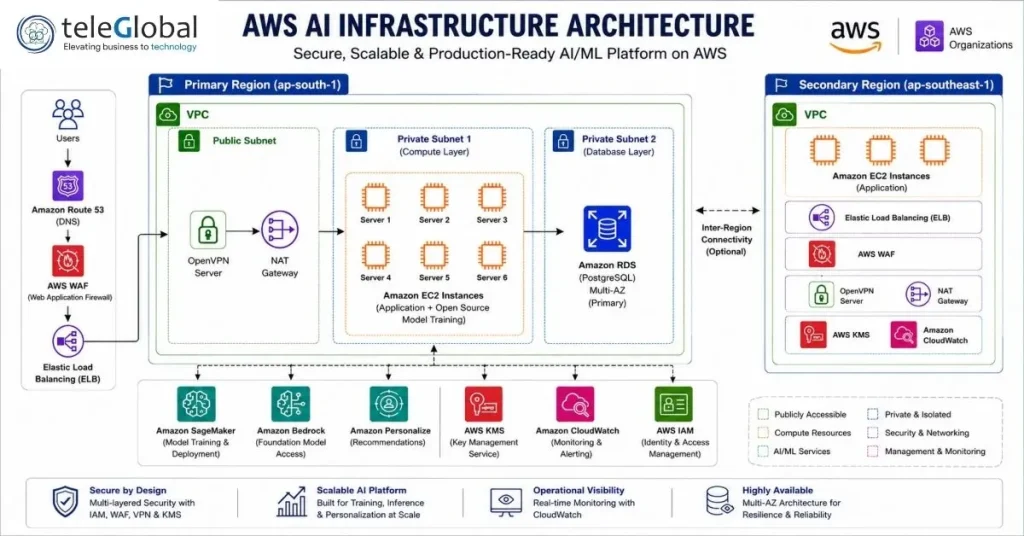
Amazon EC2 instances were deployed in private subnets for both application workloads and ML model training. Amazon RDS for PostgreSQL was configured in a private subnet for high availability and fault tolerance. Elastic Load Balancing (ELB) distributes incoming traffic across EC2 instances. S3 buckets were set up for data storage, backups, and static content.
Secure AWS Architecture for AI Workloads
A multi-layered security approach was implemented following AWS cloud security best practices:
- AWS WAF deployed with custom and managed rules to filter malicious traffic and protect the application from common web exploits
- AWS IAM configured with least-privilege policies, user groups, and service-specific roles for controlled access across all services
- Amazon VPC provisioned with private and public subnets, NAT Gateway, route tables, and Security Groups with least-privilege rules
- OpenVPN server providing secure remote access to private subnets, keeping all production workloads off the public internet
- AWS KMS for encryption key management across services
Monitoring and Operational Visibility
Amazon CloudWatch was configured across all deployed services for infrastructure monitoring, performance tracking, anomaly detection, and proactive alerting. The operations team now has dashboards and alarms covering EC2, RDS, ELB, WAF, and networking, giving them the ability to catch issues before they affect users.
AWS Services Used
| Category | AWS Services |
|---|---|
| AI & Machine Learning | Amazon SageMaker, Amazon Bedrock, Amazon Personalize |
| Compute | Amazon EC2 (application and open-source model training) |
| Database | Amazon RDS for PostgreSQL |
| Networking | Amazon VPC, NAT Gateway, OpenVPN, Security Groups, Route Tables |
| Load Balancing | Elastic Load Balancing (ELB) |
| Security | AWS WAF, AWS IAM, AWS KMS |
| Monitoring | Amazon CloudWatch |
| Storage | Amazon S3 |
| Governance | AWS Organizations |
Results
| Area | Before | After |
|---|---|---|
| Cloud Infrastructure | No production environment | Full AWS infrastructure built from scratch |
| ML Model Training | No ML training capability | SageMaker configured with dedicated EC2 for open-source model training |
| Generative AI | No generative AI integration | Amazon Bedrock deployed for foundation model access |
| Personalization | No recommendation engine | Amazon Personalize delivering real-time personalized experiences |
| Network Security | No VPC, no isolation | VPC with private subnets, WAF, VPN, IAM least privilege |
| Database | No managed database | RDS PostgreSQL in private subnet with high availability |
| Monitoring | No operational visibility | CloudWatch dashboards, alarms, and proactive alerting |
What’s Next
- Scale ML training with additional GPU-optimized instances as model complexity grows
- Implement Terraform-based Infrastructure as Code for repeatable deployments
- Add CI/CD pipelines with security controls built into the deployment workflow
- Expand Amazon Bedrock usage to support new generative AI use cases
- Set up AWS cost monitoring with Cost Explorer and Budgets
- Build operational runbooks and incident response procedures
About Teleglobal International
Teleglobal International is an IT consulting company that helps AI startups and technology companies build production-grade AWS infrastructure for machine learning and generative AI. From Amazon SageMaker and Bedrock deployment to cloud security and cloud managed services, Teleglobal builds cloud platforms that are secure, scalable, and ready for AI-powered growth.