
| Author: Ashish Kumar | Published: 11-Sept-2025 |
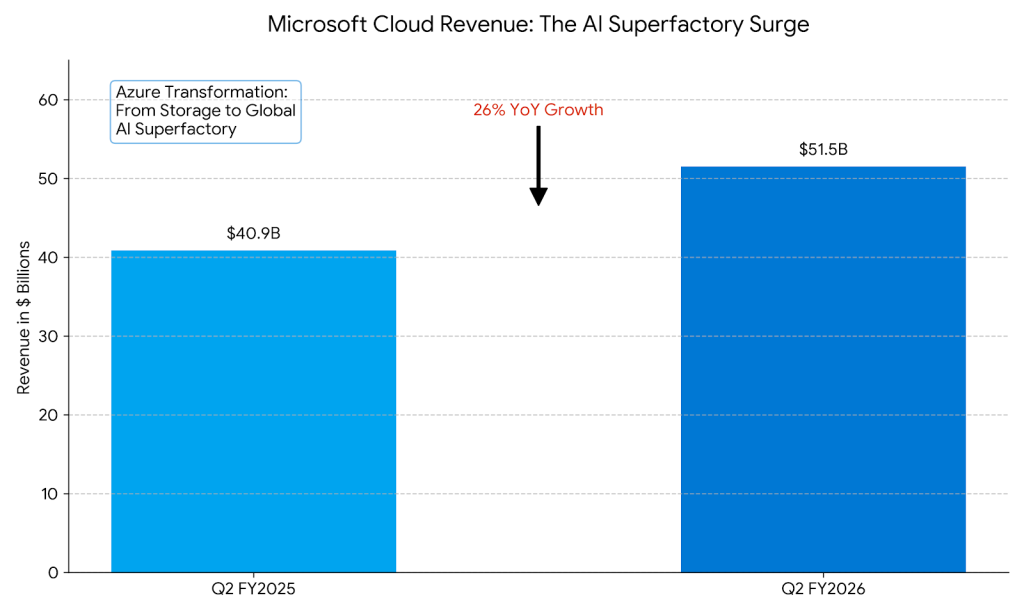
In 2026, business growth is no longer just about ‘uptime’, it’s about Intelligence Velocity. As per Teleglobal research, Microsoft Cloud revenue hit $51.5 billion in Q2 FY2026, and Azure has moved from a storage platform to a global AI Superfactory.
Microsoft Azure cloud platform provides both. It powers global apps, protects critical data, and adapts to changing needs. That’s why 95% of Fortune 500 companies trust it.
This guide explores why Azure is the foundational layer for the next generation of autonomous AI agents and secure infrastructure.
What is Microsoft Azure?
Microsoft Azure is a cloud platform with services for computing, storage, networking, databases, and AI. It helps businesses move away from costly physical servers.
It includes tools like:
- Microsoft Azure SQL Database for managed databases.
- Microsoft Azure DevOps for managing code pipelines.
- Microsoft Azure storage explorer for easy storage management.
- Microsoft Azure AI for natural language, vision, and machine learning.
- Microsoft Azure security for layered protection.
Azure works worldwide. It operates in more than 70 regions and over 400 data centers.
Why Scalability Matters for Business
Business demand shifts quickly. Companies cannot risk downtime when traffic spikes.
Azure offers elastic resources. With autoscaling, apps can grow or shrink instantly. You only pay for what you use, keeping Microsoft Azure pricing under control.
Global scale also means faster response. Customers connect to the closest Azure region for lower latency.
This flexibility makes Azure ideal for startups, global firms, and governments.
Why Security is Essential
Every company faces rising cyber threats. Data leaks cost millions and damage trust.
Microsoft Azure security provides multi-layer protection. It includes:
- Encrypted servers with custom hardware chips.
- Identity protection with multi-factor authentication.
- Continuous monitoring through Security Center.
- Threat detection with Sentinel.
- Compliance with ISO, HIPAA, GDPR, and more.
Numbers show the impact. Accounts protected by MFA cut breach risk by over 99%.
In 2026 threats like AI-powered threats require Phishing-Resistant Authentication. Azure Entra now supports 1 billion monthly active users, utilizing FIDO2 and Windows Hello for Business to eliminate session-token theft, which bypassed legacy MFA in 70% of targeted 2025 attacks.
Is Your Infrastructure Ready for 2026?
Don’t let legacy setups slow down your AI growth. Get a Free 20-Minute Azure Resiliency & Cost Audit with our experts to identify hidden leaks and security gaps in your current cloud stack.
Schedule My Free Cloud Audit →*Includes a custom 2026 Cost-Savings Roadmap for your specific industry.
Microsoft Azure vs AWS
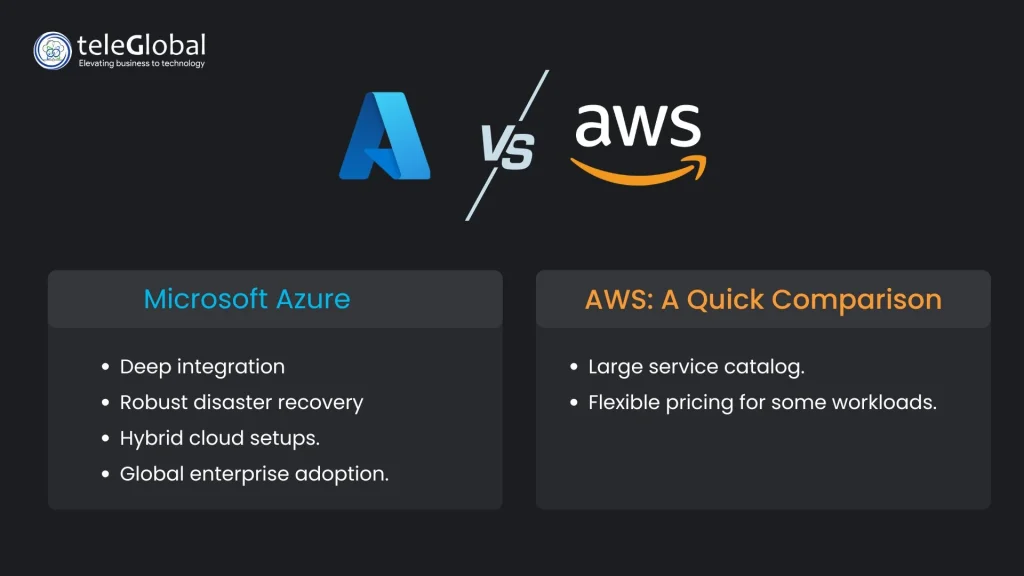
When comparing Microsoft Azure vs AWS, both are strong. As per our research, Linux-heavy startups hold Approx 31% market share. However, Azure (~25% share) is the undisputed winner for Enterprise IT and Hybrid Cloud.
- AWS strengths: large service catalog, flexible pricing for some workloads.
- Azure strengths: deep integration with Microsoft tools, global enterprise adoption.
Companies using Windows, SQL, or Office benefit most from Azure. It reduces complexity and supports hybrid cloud.
Azure also offers strong disaster recovery and backup options. AWS may need extra steps for hybrid setups.
Key Microsoft Azure Services
Microsoft Azure SQL Database
A managed database that removes the need for physical servers. It scales automatically and includes built-in security.
Microsoft Azure DevOps
Tools to plan, build, and deploy software. It shortens release cycles and improves quality.
Microsoft Azure AI
Pre-built and custom AI models. Supports image recognition, speech, translation, and advanced analytics.
Microsoft Azure storage explorer
Simplifies storage management. Developers and IT teams can handle files, containers, and backups with ease.
Microsoft Azure security
Protects data and apps with encryption, monitoring, and identity controls.
Real Numbers That Prove Azure’s Power
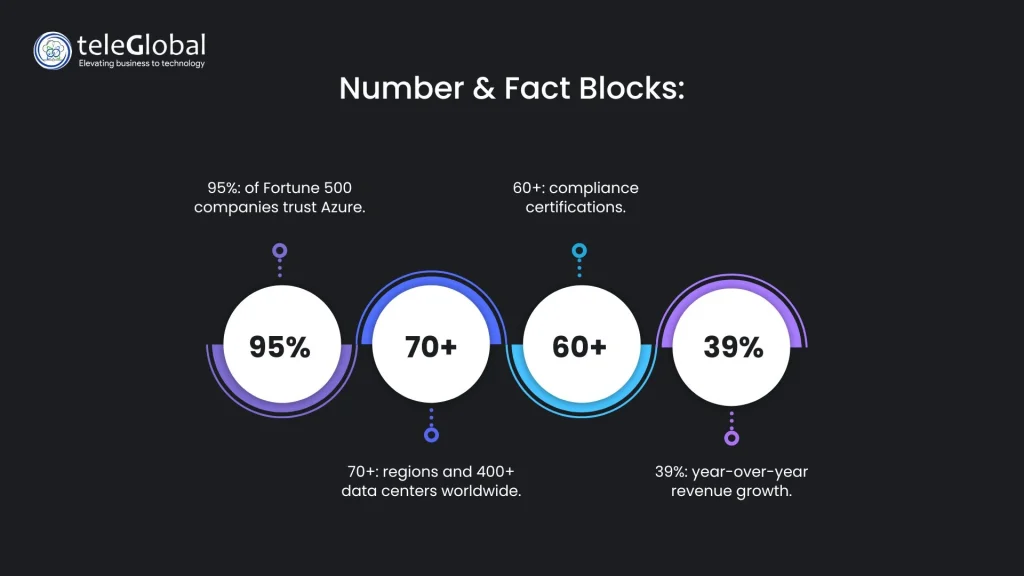
- Used by 95% of Fortune 500 companies.
- Runs in 70+ regions and 400+ data centers.
- Supports 60+ compliance certifications worldwide.
- Azure revenue grew 39% year-over-year.
These numbers confirm Azure’s strength and trust worldwide.
What is Microsoft Azure Used For?
Azure is used for many needs:
- Hosting apps with high uptime.
- Running cloud databases.
- Managing pipelines with DevOps.
- Building AI features.
- Managing storage and backups.
- Protecting data with layered security.
| Feature | Business Impact (2026) |
| Foundry IQ | Centralized data plane for grounding AI models. |
| Azure Arc | Manage AWS, Google Cloud, and On-prem from one Azure portal. |
| Elastic SAN | First-ever cloud-native storage for agentic-scale concurrency. |
| Sovereign Cloud | Digital sovereignty capabilities now covering 33+ countries. |
Industry Use Cases of Microsoft Azure
Healthcare
Hospitals use Azure for secure records and patient apps. Microsoft Azure security ensures compliance with HIPAA.
Finance
Banks rely on Azure for fraud detection using Microsoft Azure AI. It also supports secure transactions and risk analysis.
Retail
Retailers use Azure for inventory, customer apps, and analytics. Scaling handles shopping spikes during holidays.
Government
Agencies trust Azure for secure citizen data. Strong compliance helps meet national standards.
Startups
Startups use Azure for flexible pricing and fast scaling. It avoids upfront hardware costs and speeds up growth.
Microsoft Azure Pricing and Cost Control
Azure pricing is flexible. Options include pay-as-you-go, reserved instances, and spot pricing.
Cost control tools include:
- Cost analysis dashboards.
- Budgets and alerts.
- Recommendations for unused resources.
This ensures companies get value while avoiding waste.
Business Continuity with Azure
Disasters can hit at any time. Azure helps businesses stay online.
Azure Backup and Site Recovery protect apps and data. If a region fails, workloads shift to another.
Companies avoid long outages and lost revenue.
Microsoft Azure Certifications and Skills
Building skill in Azure matters. Teams can start with Microsoft Azure fundamentals.
Advanced certifications include:
- Azure Administrator.
- Azure Security Engineer.
- Azure Solutions Architect.
These certifications prepare staff to design and secure cloud systems.
Addressing Microsoft Azure Outage Concerns
Like any cloud, Azure can face outages. But redundancy reduces impact.
Global regions and backup systems keep businesses online. Companies can design failover plans for extra safety.
Why Azure Cloud Computing is the Future
Microsoft Azure cloud computing delivers speed, safety, and global access. Businesses no longer need heavy hardware.
It reduces costs, boosts speed, and ensures protection. That is why adoption keeps growing.
Conclusion
The Microsoft Azure cloud platform is built for growth and safety. It combines scale, security, and trusted services.
It supports industries from healthcare to finance to retail. It lowers cost, improves speed, and protects data.
At TeleGlobal International, we help businesses move to Azure with confidence. We design systems that scale, stay secure, and deliver real results.
Frequently Asked Questions
1. What is Microsoft Azure?
A cloud platform offering compute, storage, databases, AI, and security.
2. What is Microsoft Azure used for?
Hosting apps, managing databases, DevOps pipelines, AI, and storage.
3. How secure is Microsoft Azure?
It offers encryption, MFA, monitoring, and global compliance.
4. How does Microsoft Azure pricing work
Flexible pricing includes pay-as-you-go, reserved, and spot options.
5. How does Microsoft Azure compare to AWS?
Both are strong. Azure suits enterprises using Microsoft systems.
6. What is Microsoft Azure storage explorer?
A tool to manage cloud storage and backups.
7. What is Microsoft Azure SQL Database?
A managed, scalable database with built-in security.
8. What are Microsoft Azure certifications?
Training paths that build skills in cloud administration and security.
9. What happens during a Microsoft Azure outage?
Failover systems shift workloads to keep apps running.