| Author: Ashish Kumar | Published: 18-Feb-2026 |
Cyber attacks are no longer a risk reserved for large corporations. In 2026, businesses of every size are targets. A single breach can cost millions, damage your reputation, and shut down operations for days. The question is no longer if you will be attacked. It is whether you are ready when it happens.
The global average cost of a data breach was $4.44 million in 2025. This guide covers the biggest cyber threats businesses face right now and the practical steps you can take to stay protected.
The Biggest Cyber Threats Businesses Face in 2026
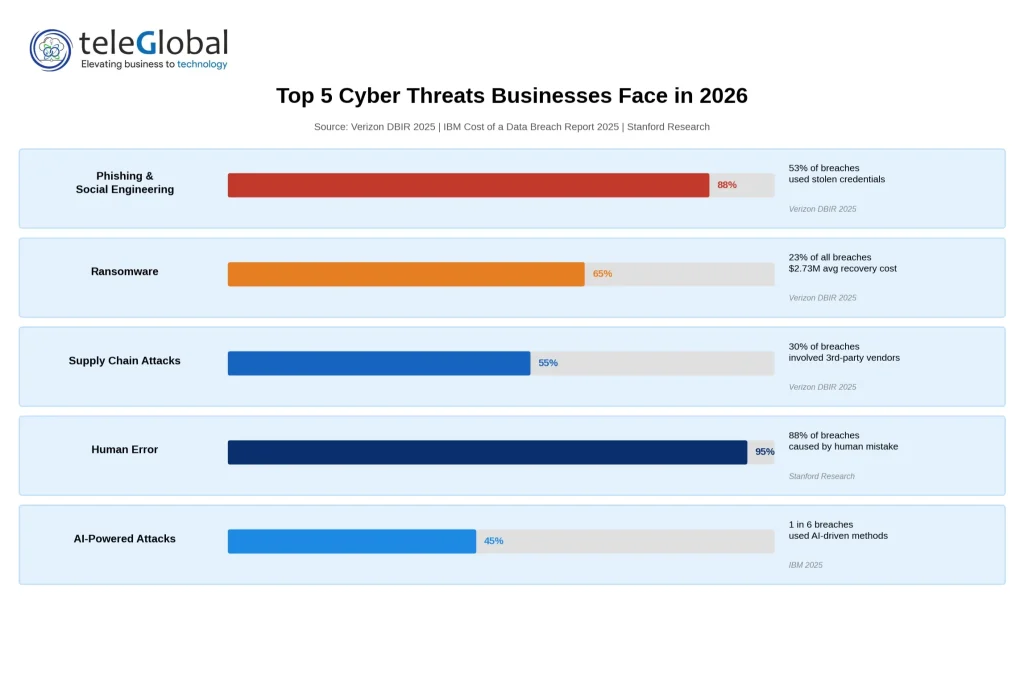
- Phishing and Social Engineering: Stolen credentials were used in 53% of all data breaches in 2025, according to Verizon’s Data Breach Investigations Report. Attackers now use AI to write convincing phishing emails with perfect grammar and personalised details, making them far harder to spot than before.
- Ransomware: Ransomware appeared in 23% of all breaches in 2025. The average cost of recovering from a ransomware attack has risen to $2.73 million, nearly $1 million more than in 2023. Attacks are faster, more automated, and increasingly targeted at critical sectors like healthcare and manufacturing.
- Third-Party and Supply Chain Attacks: 30% of breaches in 2025 involved third-party vendors, double the rate from the previous year. If your suppliers or software partners are not secure, attackers use them as a backdoor into your systems.
- Human Error: 88% of all cybersecurity breaches are caused by human error, according to Stanford research. Clicking a bad link, using a weak password, or misconfiguring a cloud setting are all it takes.
- AI-Powered Attacks: 1 in 6 data breaches in 2025 involved AI-driven attacks. Cybercriminals are using AI to find vulnerabilities faster, generate deepfakes, and automate attacks at a scale that was not possible two years ago.
Don’t wait for a $4.44M alert.
In 2026, the gap between a “minor incident” and a “business-ending breach” is exactly 51 days. That is the time AI-powered security saves you in containment.
7 Practical Steps to Protect Your Business Right Now
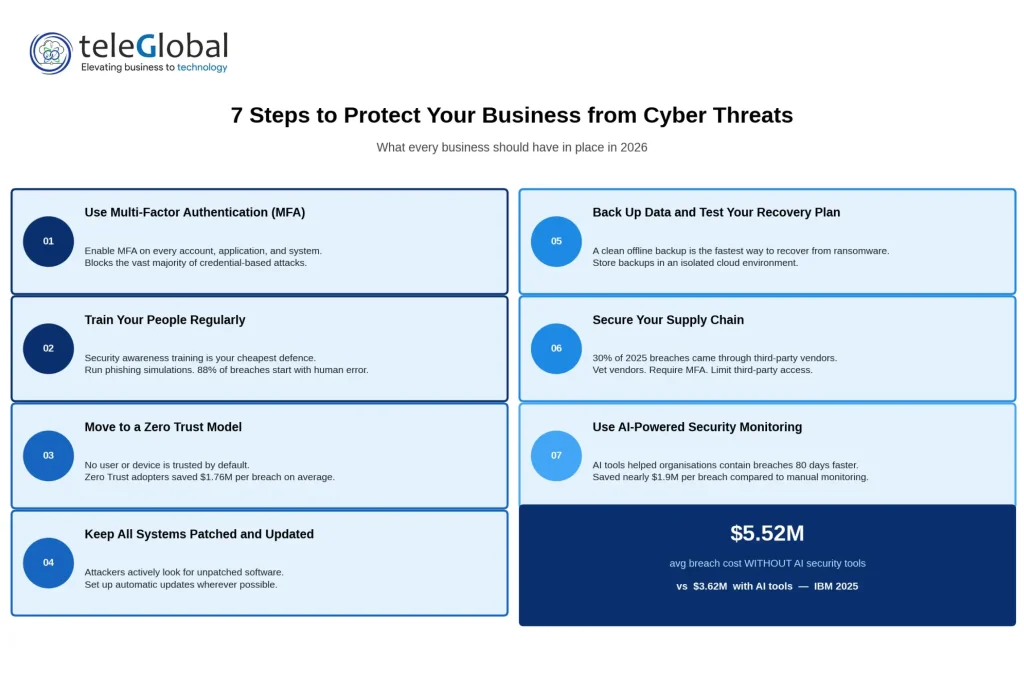
Here is what every business should have in place in 2026:
- Use Multi-Factor Authentication (MFA) everywhere. MFA blocks the vast majority of credential-based attacks. Enable it on every account, application, and system your team accesses.
- Train your people regularly. Since 88% of breaches start with human error, security awareness training is your cheapest and most effective defence. Run phishing simulations. Keep staff informed about new tactics.
- Move to a Zero Trust model. Zero Trust means no user or device is trusted by default, even inside your network. Every access request is verified. Organisations using Zero Trust saved an average of $1.76 million per breach compared to those that did not.
- Keep all systems patched and updated. Attackers actively look for unpatched software. Set up automatic updates wherever possible.
- Back up your data and test your recovery plan. A clean, tested backup is the fastest way to recover from ransomware without paying. Store backups offline or in an isolated cloud environment.
- Secure your supply chain. Vet your vendors’ security practices. Require MFA and signed contracts with security obligations. Limit the access third parties have to your systems.
- Use AI-powered security monitoring. Organisations that used security AI and automation identified and contained breaches 80 days faster and saved nearly $1.9 million compared to those that did not. Real-time monitoring catches threats before they spread.
Organisations without AI security tools paid an average of $5.52M per breach vs $3.62M for those using them extensively. — IBM, 2025
Why 2026 Is the Year to Get Serious About Cybersecurity
Cybercrime is growing at 15% annually and is on track to cost $1 trillion per month globally by 2031. Attackers have more tools, more automation, and more entry points into your business than ever before.
But the data also shows that businesses that invest in the right defences see real results. Faster detection. Lower breach costs. Faster recovery. Cybersecurity is not an IT expense. It is business continuity.
At Teleglobal International, our cybersecurity and managed IT services are built around this reality. We help businesses assess their current security posture, plug the gaps, and put the right monitoring and response systems in place before a breach happens, not after.
The Bottom Line
No business is too small to be attacked, and no business is too complex to be protected. The right steps, taken consistently, make a measurable difference. Start with the basics, train your team, and work with the right partners.
The cost of prevention is always less than the cost of a breach.
Frequently Asked Questions
Q1. What is the most common cause of a cyber breach in 2026?
Human error remains the leading cause, responsible for 88% of all breaches according to Stanford research. Phishing, weak passwords, and misconfigured systems are the top culprits.
Q2. How much does a data breach cost a business on average?
The global average cost of a data breach in 2025 was $4.44 million, according to IBM. In the United States, that figure climbed to an all-time high of $10.22 million per breach.
Q3. How can small businesses protect themselves from cyber attacks?
Start with the essentials: enable MFA on all accounts, keep software updated, train employees on phishing, back up data regularly, and limit who has access to sensitive systems. These steps alone eliminate a large portion of common attack vectors.
Q4. What is ransomware and how does it affect businesses?
Ransomware is a type of malware that locks your files or systems and demands payment to restore access. It appeared in 23% of all data breaches in 2025. The average recovery cost has risen to $2.73 million. Regular offline backups and patched systems are the best defences.
Q5. Is cloud infrastructure more or less secure than on-premises?
Breaches in hybrid cloud environments averaged $5.05 million in 2025, higher than on-premises incidents. Cloud security depends heavily on configuration and access controls. Working with a managed IT partner ensures your cloud setup follows best practices from day one.
Q6. How does AI help in cybersecurity?
AI-powered security tools continuously monitor network activity, detect unusual behaviour, and alert teams to potential threats in real time. Organisations using them identified and contained breaches 80 days faster and saved nearly $1.9 million on average compared to those without AI security tools.