| Author: Ashish Kumar | Published: 10-March-2026 |
Generative AI is advancing fast, and 2026 is the year it moves from being an early experiment to a core part of how businesses operate. As Generative AI Models grow more capable and accessible, companies that understand the trends shaping this space right now will be better placed to make faster decisions, reduce operational costs, and build a competitive edge that lasts.1
This article covers the six most important Generative AI for Business Leaders trends in 2026, backed by real data, with guidance on what each one means for business leaders. Whether you lead a team, a function, or an entire enterprise, this guide is designed to help you decide where to act and how.
The Generative AI Market in 2026: What the Numbers Tell Us
The generative AI market is valued at approximately $161 billion in 2026 and is forecast to reach $1,260 billion by 2034, growing at nearly 40% per year. This level of growth reflects a fundamental shift in how organizations view AI, not as a technology investment, but as a business advantage. Generative Ai with Large Language Models is at the core of this transformation, enabling machines to understand, generate, and reason across text, data, and more.
According to McKinsey’s latest global AI report, 78% of organizations now use AI in at least one business function, compared to 55% a year ago. Workers who use generative AI tools save an average of 5.4% of their working hours each week. And yet, only 39% of companies report a meaningful positive impact on their bottom line.
Explore how Teleglobal International’s AI Solutions help enterprises move from exploration to real-world AI outcomes.
Trend 1: Agentic AI Is Becoming Central to Enterprise Operations
AI agents are systems that can plan tasks, make decisions, and carry out multi-step actions without needing input at every stage. Unlike a basic AI assistant that responds to a prompt, an agent can take a task from start to finish on its own.
By the end of 2026, Gartner predicts that 40% of enterprise applications will embed AI agents, up from less than 5% in 2025. Organizations that are leading in AI adoption are three times more likely to be scaling agents across the business compared to those that are just getting started.
For business leaders, the real shift here is not about adding agents to existing processes. It is about rethinking how those processes are designed. High-value, repetitive workflows with clear inputs and outputs are the best candidates for early agentic AI deployment.
Start by identifying two or three processes where automation could deliver immediate results. Measure outcomes before expanding, and build governance rules around what agents are and are not permitted to do.
Trend 2: Multimodal AI Is Expanding What Enterprise AI Can Do
Multimodal AI processes more than just text. It works with images, audio, and video as well, all within a single model. This opens up a much wider range of business use cases, from quality control in manufacturing to customer service, medical imaging, and content review.
According to IBM’s 2026 AI trends analysis, multimodal models are expected to bridge language, vision, and action in ways that bring AI closer to how humans understand the world. In practice, this means an AI system can listen to a customer call, read the account details, and analyze a product image all at the same time to deliver a precise response.
Customer-facing teams, operations teams, and healthcare organizations stand to benefit the most from this capability. The key is evaluating which of your existing workflows involve multiple data types and could be streamlined by a model that handles all of them together.
Trend 3: Moving AI from Pilot Stages to Full Production Scale
Most organizations have run AI pilots. Far fewer have moved them into full production. This gap is one of the most important challenges businesses face in 2026. Leveraging the right Generative AI Services is what seperates organizations that experiment from those that scale.
A 2026 benchmark report by the Data and AI Leadership Exchange found that 39% of companies have now implemented AI in production at scale, up from 24% the year before. The organizations making this transition share one thing in common: they have built a centralized AI infrastructure rather than relying on disconnected tools across departments.
MIT Sloan Management Review describes this as an AI factory model, where a shared foundation of tools, data, and processes allows every team to build on the same platform. Without this kind of unified infrastructure, scaling AI across a business becomes slow, expensive, and inconsistent.
Teleglobal International’s Cloud Migration and Modernization Services help organizations build the infrastructure foundation needed to take AI from pilot to full production.
Microsoft Azure Security and Cost
Strong security is not optional. Many think tighter security means higher cost. But in Azure, smart security can also cut spend.
Examples:
- Turn off unused accounts and access rights
- Use managed identity instead of custom keys
- Monitor with Microsoft Azure security center
Good security reduces risk of outages and wasted resources. This supports both cost and performance.
Trend 4: Industry-Specific AI Models Are Delivering Better Results
General-purpose AI tools are widely accessible, but they are not always the most effective option for specialized business functions. In 2026, companies in healthcare, finance, legal services, and manufacturing are finding that Generative AI models trained on domain-specific data consistently outperform broader tools on accuracy and reliability.
In healthcare, up to 80% of initial diagnoses are expected to involve AI analysis by 2026. In financial services, specialized models are handling credit assessments and fraud detection with greater precision than standard tools. In retail and consumer goods, McKinsey estimates that generative AI could contribute between $400 billion and $660 billion in annual value globally.
For leaders in regulated industries, accuracy and compliance are non-negotiable. A domain-specific model trained on relevant, clean data will consistently deliver better outcomes than a general model trying to serve every use case at once.
Trend 5: AI Governance and Security Are No Longer Optional
As AI becomes more deeply embedded in business operations, the risks that come with it grow as well. Data privacy, regulatory compliance, and AI-specific security vulnerabilities are now among the top concerns for enterprise technology leaders. This is where Generative AI Guardrails become essential – structured policies and automated checks that keep AI outputs safe, accurate, and compliant.
A recent industry survey found that 44% of companies have already experienced at least one negative outcome from generative AI, ranging from inaccurate outputs to security incidents. Separately, 70% of organizations report that weak data governance is actively slowing down their ability to scale AI safely.
Governance agents, which are AI systems specifically designed to monitor other AI for policy violations, are now being built into enterprise-level deployments as a standard layer of protection. This reflects a broader shift: security and compliance need to be part of the AI design process, not added later.
Trend 6: Cloud Infrastructure Is the Foundation Every AI Strategy Needs
Every generative AI capability discussed in this article depends on cloud infrastructure to function at scale. Companies that invest in a strong, well-managed cloud environment are able to deploy AI faster, control costs better, and adapt to new developments more effectively. Best-in-class Generative AI Services are only as powerful as the cloud foundation they run on.
Technology providers are forecasted to spend $401 billion on AI infrastructure in 2026 alone, with 17% of total AI spending going directly toward the compute and storage capacity needed to run these models. The fastest-growing organizations are not simply spending more on cloud. They are using multi-cloud strategies across AWS, Azure, and Google Cloud to optimize performance and control costs.
Teleglobal International’s Cloud Managed Services and Multi-Cloud Pricing Calculator help businesses plan and manage cloud spend as their AI workloads grow.
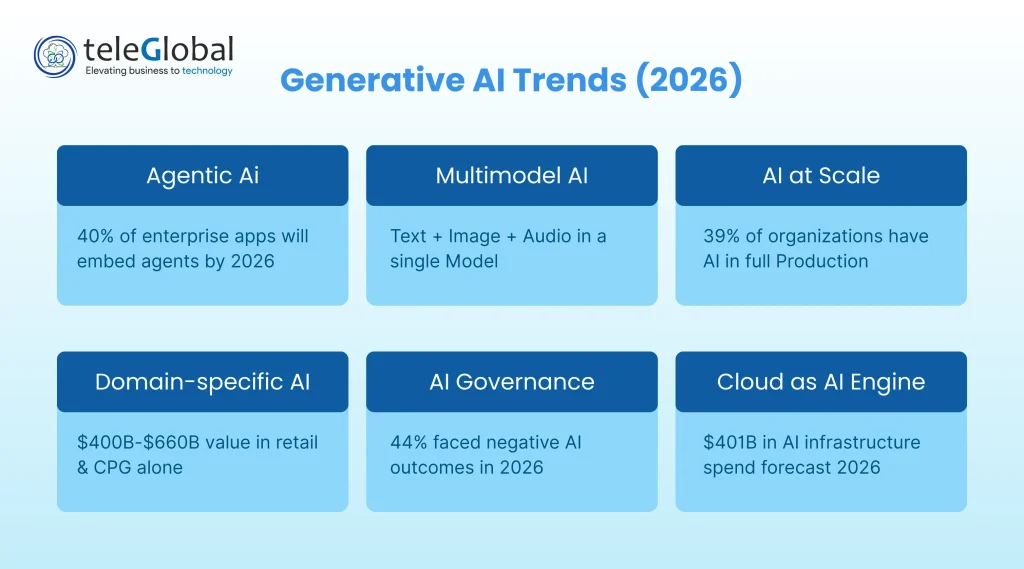
2026 Generative AI Trends: What Each One Means for Your Business
| Trend | What It Means for Your Business |
| Agentic AI | AI that completes end-to-end tasks on its own. Redesign key workflows around agents to unlock real efficiency gains. |
| Multimodal AI | AI that handles text, image, and audio together. Opens new use cases across customer service, operations, and diagnostics. |
| AI at Production Scale | 39% of organizations have now scaled AI to production. A centralized AI infrastructure is the key differentiator. |
| Domain-Specific Models | Specialized models outperform general AI in regulated industries. Match your model choice to your compliance and accuracy needs. |
| AI Governance | 44% of companies have already faced AI-related incidents. Security and governance must be built in from the start. |
| Cloud Infrastructure | $401B in AI infrastructure spending in 2026. A strong cloud foundation is what makes everything else possible. |
What Business Leaders Should Prioritize in 2026
Translating these trends into action requires focus. Here are six steps that every leadership team should consider:
- Review where AI is already in use across your organization. Identify what is delivering value and what is not.
- Select one or two high-impact workflows for an agentic AI pilot. Define success metrics before you start.
- Invest in a centralized AI infrastructure. Teams working on separate tools with separate data will not be able to scale.
- Assess your cloud environment. If it is not ready to support AI workloads, this is the right time to modernize.
- Build governance before you scale. Define clear policies around data access, model outputs, and risk thresholds.
- Prepare your workforce. 92% of technology leaders are already using AI-assisted tools. Your teams need to understand how to work alongside AI, not just use it.
Teleglobal International works with enterprise teams across industries to build AI-ready cloud strategies and put scalable AI solutions into production. Speak with our team today.
Frequently Asked Questions
1. What is the most important generative AI trend for enterprise leaders in 2026?
Agentic AI is the most significant development this year. These are AI systems that can plan and execute multi-step tasks without requiring manual input at each stage. Gartner predicts that 40% of enterprise applications will include AI agents by the end of 2026, up from less than 5% in 2025.
2. How large is the generative AI market in 2026?
The global generative AI market is valued at approximately $161 billion in 2026. It is forecast to grow to over $1,260 billion by 2034 at a compound annual growth rate of around 40%, according to Fortune Business Insights.
3. What is multimodal AI and why does it matter for businesses?
Multimodal AI processes text, images, audio, and video together within a single model. For businesses, this expands what AI tools can do, especially in customer service, manufacturing quality control, and healthcare diagnostics, where multiple types of data need to be understood at the same time.
4. Why are many companies not seeing strong returns from generative AI?
Most organizations have explored AI tools without building the shared infrastructure needed to deploy them at scale. Only 39% report a meaningful positive impact on earnings. The companies getting the most value are treating AI as a centralized capability rather than a collection of individual tools.
5.How can Teleglobal International support our AI and cloud strategy?
Teleglobal International provides Generative AI for Business Leaders-focused AI solutions, cloud consulting, cloud migration, managed cloud services, and IT infrastructure management for enterprises. Their teams help businesses build the technical foundation required to deploy and scale AI in production. You can connect with tour team at teleglobals.com.