
| Author: Kamlesh Kumar | Published: 21-Jan-2026 |
Many enterprises move to the cloud too quickly. The result is higher bills, security risks, and projects that take longer than expected. Working with a cloud consulting partner that has experience in the US, Europe, India, and the UAE can make the process smoother.
In 2026, we have moved into the era of Cloud 3.0. This phase is defined by Sovereign Cloud constraints, where data must live within specific national borders, and the urgent need for AI-Native Architectures.
Modern cloud investments are no longer just IT expenses; they are the engines for autonomous AI agents and real-time data intelligence. Choosing a partner who only understands “lifting and shifting” VMs is no longer enough. You need a strategist who can engineer reliability and regulatory compliance into your operating model from day one.
This blog will guide you through the essentials of cloud consulting services, the types of cloud services available, and how to choose the partner that aligns with your goals.
What Are Cloud Consulting Services?
A cloud consultant is more than a technical advisor. They help shape strategy, manage risks, and drive value from cloud investments.
Cloud consulting services include:
- Cloud migration strategy – Moving workloads to the cloud with minimal disruption.
- Cloud cost optimization – Reducing waste and improving efficiency.
- Cloud security consulting – Protecting data and meeting compliance requirements.
- Cloud governance – Creating policies for long-term stability.
- Cloud integration services – Ensuring apps and platforms work together seamlessly.
- AI Readiness & Orchestration: A consultant helps you transition from AI- enabled to AI-Native. This includes setting up Vector Databases, managing high-cost GPUaaS resources, and implementing AI Governance.
The right cloud consulting partner tailors these services to your specific needs, whether you’re a startup moving to google cloud services or an enterprise scaling on azure cloud services or aws cloud services.
Types of Cloud Services Explained
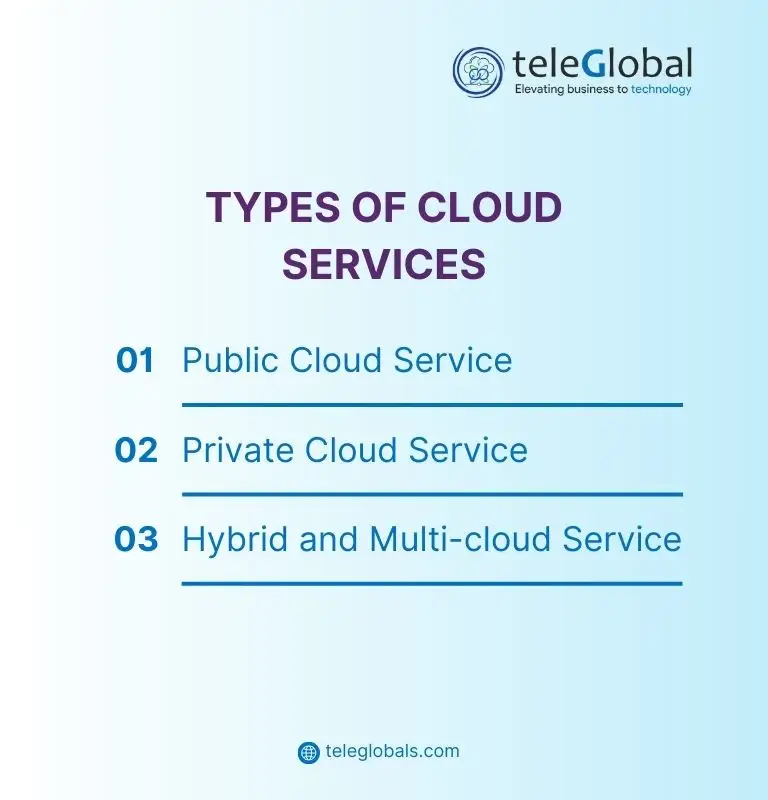
Before choosing a cloud consulting partner, it’s important to understand what is cloud services and how they’re delivered.
Cloud services generally fall into three categories:
- Public Cloud Services
- Delivered by providers like Amazon Web Services (AWS), Microsoft Azure Cloud, and Google Cloud Platform.
- Benefits: Scalability, global reach, and rapid deployment.
- Ideal for: Businesses that want speed and cost efficiency.
- Private Cloud Services
- Dedicated infrastructure, often hosted on-premises or through managed providers.
- Benefits: Greater control, security, and compliance.
- Ideal for: Finance, healthcare, and industries with strict regulations.
- Hybrid and Multi-Cloud Services
- Hybrid cloud consulting combines private and public environments for flexibility.
- Multi-cloud consulting utilises two or more public providers to reduce vendor lock-in.
- Benefits: Balance between control and innovation.
- Ideal for: Enterprises with diverse workloads and global operations.
Cloud Storage Services and Beyond
Most people think of cloud storage services as just a place to save files. In reality, today’s storage solutions power disaster recovery, big data analytics, and collaboration tools.
Along with storage, types of cloud services include:
- IaaS (Infrastructure as a Service): Servers, networks, and storage.
- PaaS (Platform as a Service): Development frameworks and databases.
- SaaS (Software as a Service): Applications like Office 365 or Google Workspace.
A strong cloud consulting partner helps you identify the right mix for your needs. For example, enterprise cloud consulting may focus on global scalability, while small business cloud consulting emphasizes cost savings.
Benefits of Cloud Consulting Services
Cloud adoption sounds simple, subscribe, migrate, and run. In reality, it’s far more complex. Businesses often struggle with rising costs, compliance risks, and integration issues. That’s where cloud consulting services deliver real value.
Here are the top benefits:
- Sovereignty & Regional Compliance
In 2026, geopolitical shifts have made Data Sovereignty a non-negotiable factor. The regions like the UAE (for Digital Dubai standards), Europe (for updated GDPR/EU AI Act compliance), and India (for DPDP Act alignment).
2. Clear Cloud Migration Strategy
A skilled cloud consultant helps design a tailored cloud migration strategy. Instead of lifting everything at once, workloads are moved in phases. This reduces downtime and avoids unnecessary costs.
3. FinOps & Unit Economics
With global cloud spending projected to top $900 billion in 2026, simple cost-cutting has evolved into FinOps. A modern partner focuses on AI Unit Economics, measuring the marginal cost of every AI inference or customer acquisition. By using standardized schemas like FOCUS 1.3, they normalize billing across AWS, Azure, and GCP, transforming cloud spend from a “black box” into a predictable, value-driven metric for your CFO.
4. Stronger Security and Compliance
From healthcare regulations to financial data protection, compliance is non-negotiable. Cloud security consulting ensures that policies are aligned with GDPR, HIPAA, or industry standards.
5. Disaster Recovery and Business Continuity
Cloud consultants set up disaster recovery in cloud and business continuity in cloud frameworks. That means your systems keep running even during outages.
6. Vendor-Neutral Advice
One of the biggest risks is vendor lock-in. A good partner guides you on whether to stick with one provider or adopt a multi-cloud consulting approach.
7. Faster Digital Transformation
Beyond tech, cloud adoption transforms how teams work. With expert guidance, companies unlock collaboration tools, analytics, and automation that fuel growth.
Ready for Cloud 3.0?
Don’t just migrate—modernize. In 2026, 70% of cloud success depends on AI-readiness and FinOps governance. Let TeleGlobal design your future-proof roadmap today.
Top Cloud Service Providers & Platforms
Choosing the right platform is central to success. While many cloud service providers exist, three dominate the global market: Amazon Web Services (AWS), Microsoft Azure Cloud, and Google Cloud Platform (GCP).
| Cloud Provider | Market Share (2026) | Primary Growth Driver | Best For |
|---|---|---|---|
| Amazon Web Services (AWS) | Infrastructure Scale & Bedrock AI | Global Stability & Legacy Apps | |
| Microsoft Azure | OpenAI Partnership & Ecosystem | Enterprise AI & Hybrid Cloud | |
| Google Cloud (GCP) | Gemini 3 & Advanced Analytics | AI Startups & Big Data | |
| Others | Sovereign Clouds & GPUaaS | Local Compliance & Niche Tech |
Amazon Web Services (AWS)
- The market leader, offering a broad portfolio.
- Best known for IaaS and scalable cloud storage services.
- Popular with enterprises needing global infrastructure.
- Example: Netflix relies on AWS cloud services for streaming at scale.
Microsoft Azure Cloud
- Strong presence in hybrid deployments.
- Ideal for enterprises already using Microsoft tools like Office 365.
- Offers azure cloud services for computing, AI, and analytics.
- Known for deep cloud integration services.
Google Cloud Platform (GCP)
- Specializes in analytics, AI, and Kubernetes.
- Offers google cloud services and advanced cloud storage services.
- Ideal for data-heavy businesses and startups.
- Example: Spotify leverages google cloud platform for scalability.
Why Consultants Matter in Choosing Providers
Each platform has strengths. AWS leads in scale, Azure excels in enterprise integration, and GCP shines in innovation. But choosing one or a mix depends on your goals.
That’s where cloud consulting services step in. Consultants compare providers, assess workload fit, and design the right architecture. For example:
- A bank may need private cloud consulting with Azure for compliance.
- A startup might prefer google cloud services for analytics.
- A global retailer could choose multi-cloud consulting across AWS and Azure to avoid downtime.
In short, a strong cloud consulting partner makes sure you’re not just picking a provider, you’re picking the provider that fuels your growth.
The Role of Cloud Consultants in Cloud Strategy
A cloud consultant does more than migrate workloads. They act as advisors who align technology with business goals. Their role includes:
- Cloud strategy consulting – Designing a roadmap that supports growth and digital transformation.
- Cloud adoption strategy – Ensuring adoption is smooth, with minimal disruption to teams.
- Cloud cost optimization – Tracking usage, avoiding waste, and balancing costs.
- Cloud governance – Setting policies for operations, compliance, and security.
- Cloud digital transformation – Helping businesses use cloud tools for collaboration, analytics, and innovation.
In short, a strong partner turns cloud adoption into a growth driver. They don’t just solve IT challenges, they solve business challenges with cloud technology.
Best Practices When Working With a Cloud Consulting Partner
Getting the most from cloud consulting services depends on how you work with your partner. Here are proven practices:
1. Define Clear Goals
Before starting, outline your priorities. Is the focus on cloud migration strategy, cost optimization, or cloud security consulting? A clear scope avoids confusion later.
2. Involve Business and IT Leaders
Cloud isn’t just a technology decision. Bring in finance, compliance, and operations teams. Their input ensures that cloud strategy consulting supports the entire business.
3. Start Small, Scale Fast
Pilot projects reduce risks. For example, migrate one workload to azure cloud services or test google cloud platform for analytics. Once validated, expand further.
4. Focus on Knowledge Transfer
Great partners don’t just deliver, they teach. Insist on training and documentation so your team grows stronger in cloud operations and cloud governance.
5. Monitor and Optimize Continuously
Cloud is never a “set it and forget it” model. Use cloud cost management, cloud monitoring, and performance reviews to track progress and improve.
The Cost of Hiring Cloud Consultant
Choosing a partner is as much about the financial framework as it is about technical expertise. In 2026, cloud pricing has evolved to be more flexible, but also more complex. Here are the four dominant models you will encounter:
2026 Cloud Consulting Pricing Models
| Model | Typical Structure | Best For… |
|---|---|---|
| Project-Based | One-time Fixed Fee | Cloud Migrations & App Modernization |
| Managed Services | Monthly Subscription | 24/7 Security & FinOps Governance |
| Retainer Model | Pre-paid Block of Hours | Strategic Advisory & Burst Development |
| Outcome-Based | KPI-Driven / Success Fees | Cost Optimization & Efficiency Gains |
Future of Cloud Consulting (2026 and Beyond)
The future of cloud is about complexity and simplification. Here’s what’s ahead:
- Hybrid and Multi-Cloud Growth – More companies will adopt hybrid cloud consulting and multi-cloud consulting to balance flexibility and compliance.
- AI in Cloud Management – AI-driven tools will help with cloud cost optimization, workload distribution, and compliance automation.
- Security First – With rising cyber threats, demand for cloud security consulting will surge.
- Industry-Specific Cloud Solutions – Consultants will tailor services to niches like healthcare, banking, and manufacturing.
- Sustainability in Cloud – Energy-efficient cloud service providers will become a top priority for enterprises.
Conclusion
Choosing the right cloud consulting partner is one of the most important IT decisions in 2026.
- Select a partner with proven expertise in cloud migration strategy, security, and multi-cloud consulting.
- Watch for red flags like lack of certifications or vendor bias.
- Remember, a strong partner doesn’t just move workloads, they transform your business with the cloud.
At TeleGlobal International, we specialize in guiding enterprises through this journey. From cloud consulting services to hybrid and multi-cloud strategies, our experts ensure your business gets the most from AWS cloud services, azure cloud services, and google cloud services. With our focus on security, governance, and cost optimization, we help enterprises build a future-ready cloud foundation.
Frequently Asked Questions
1. What is cloud services and why do businesses need them?
Cloud services provide computing, storage, and software over the internet. Businesses use them for scalability, cost savings, and flexibility.
2. How do I choose the right cloud consulting partner?
Look for proven experience in cloud consulting services, security, and multi-provider expertise. Avoid vendors who push only one provider.
3. What are the types of cloud services?
The main types of cloud services are IaaS, PaaS, and SaaS. Consultants help select the right mix.
4. Which are the top cloud service providers in 2026?
The top cloud service providers include Amazon Web Services (AWS), Microsoft Azure Cloud, and Google Cloud Platform.
5. What are the benefits of cloud consulting services?
Benefits include cloud cost optimization, stronger security, smooth migration, and tailored enterprise cloud consulting strategies.
6. How do cloud consultants help with cloud migration strategy?
They assess workloads, design a phased plan, and ensure minimal downtime during migration.
7. Is hybrid cloud consulting better than multi-cloud consulting?
It depends. Hybrid cloud consulting suits compliance-driven industries. Multi-cloud consulting fits businesses needing flexibility and vendor independence.