| Author: Ashish Kumar | Published: 18-Feb-2026 |
Artificial Neural Networks, or ANN, are behind almost every smart technology you use today. From the voice assistant on your phone to fraud alerts from your bank, ANN makes machines intelligent. In 2026, this technology is no longer an experiment. It is core infrastructure for businesses, hospitals, governments, and developers worldwide.
If you have been searching for a simple understanding of what ANN is, how it works, and where it is used, this is the guide for you.
What Is an Artificial Neural Network (ANN)?
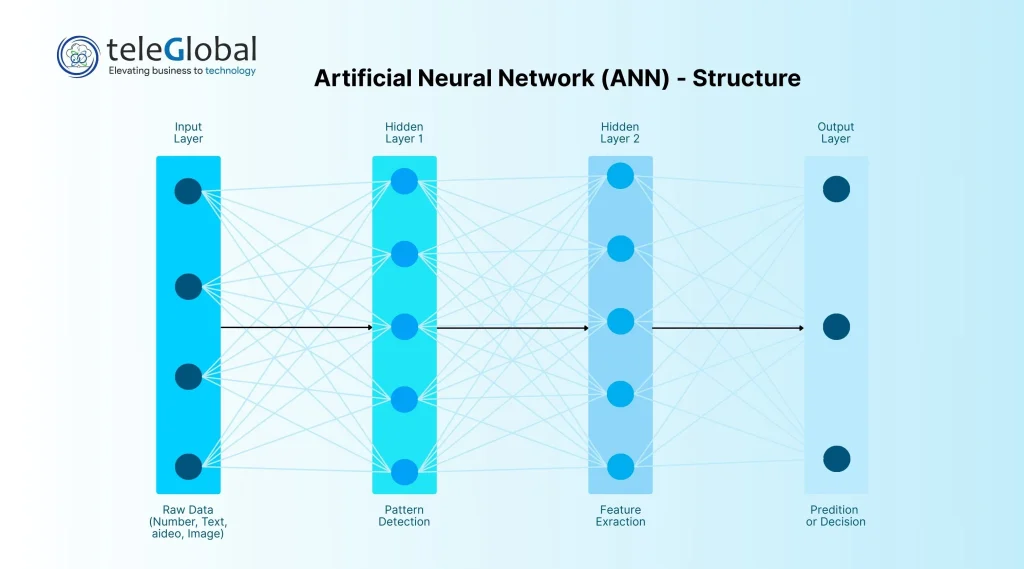
An Artificial Neural Network is a computer system that learns the way the human brain does. It is built from layers of connected nodes, called artificial neurons, that work together to receive data, find patterns, and produce an answer.
Every ANN has three types of layers:
- Input Layer: Where data enters, whether it is text, numbers, images, or audio.
- Hidden Layers: Where the actual learning happens. These layers find patterns and connections in the data.
- Output Layer: Where the final result appears, such as a prediction, a decision, or a label.
When a neural network has many hidden layers, it is called a deep neural network. This is where the term deep learning comes from. The more layers, the more complex the patterns a model can understand.
How Does ANN Work?
Think of ANN like teaching a child to recognise a cat. You show thousands of images of cats and non-cats. Over time, the child learns what features define a cat. ANN works the same way.
During training, the network is shown labelled data. It makes a guess, checks if it was right, adjusts its internal weights to reduce the error, and tries again. This process repeats millions of times. The adjustment process is called backpropagation. The measurement of how wrong the guess was is called the loss function.
After enough training, the network can make accurate predictions on data it has never seen before. This is what makes ANN so powerful.
The 2026 Evolution: From Neural Networks to “Agentic AI”
While traditional ANNs were designed to simply classify data or make predictions, 2026 marks the rise of Agentic AI.
Traditional networks act like “Brains in a Jar”; you give them data, and they give you an answer. Agentic systems, powered by advanced Transformer and RNN architectures, act like “Digital Workers.” They can:
- Reason: Break down a complex goal into smaller steps.
- Use Tools: Access your CRM, send emails, or run code to solve a problem.
- Collaborate: Talk to other specialized neural networks to complete a workflow.
ANN vs Machine Learning vs Deep Learning: What Is the Difference?
These three terms are often confused. Here is a simple breakdown:
- Machine Learning is a broad field where computers learn from data. It includes many techniques.
- Artificial Neural Network is one specific technique within machine learning, inspired by how the brain works.
- Deep Learning is a type of ANN that uses many layers. It is especially useful for complex tasks like recognising speech, images, and language.
In short: deep learning is a type of ANN, and ANN is a type of machine learning. All deep learning is ANN, but not all ANN is deep learning.
| Feature | Traditional ANN | Generative AI (2026) |
|---|---|---|
| Core Purpose | Pattern recognition & Prediction | Content creation & Action |
| Data Input | Structured (Numbers/Labels) | Unstructured (Text/Video/Code) |
| Best Business Use | Fraud detection, Forecasting | Customer support, Coding, Design |
| 2026 Trend | Edge deployment (On-device) | Agentic workflows (Autonomous) |
Real-World Applications of Artificial Neural Networks in 2026
ANN is active across every major industry. Here are the most important applications:
1. Healthcare and Medical Diagnosis
Hospitals use CNN-based neural networks to analyse CT scans, MRIs, and X-rays and detect conditions like cancer and heart disease early. AI-powered medical imaging tools now match or exceed human radiologist accuracy in several studies. This saves lives through faster, more reliable diagnosis.
2. Fraud Detection and Finance
Banks and payment platforms use ANN to monitor millions of transactions per second. Mastercard’s AI fraud detection improved detection rates by an average of 20%, reaching up to 300% improvement in specific case categories. The U.S. Treasury used AI in FY2024 to prevent or recover USD 4 billion in fraud, up from USD 652.7 million the year before.
3. Natural Language Processing and Chatbots
Every AI chatbot, translation tool, and voice assistant runs on a neural network. In 2025, 74% of companies used AI chatbots in customer service operations, and AI reduced customer service costs by 30% on average.
4. Facial Recognition and Security
ANN powers biometric systems at airports, banks, and mobile devices. Convolutional Neural Networks process facial images and match them against databases in milliseconds. Banks also use ANN for handwriting and signature verification.
5. Weather Forecasting
ANN models combining MLP, RNN, and CNN can now forecast weather up to 15 days in advance with measurable accuracy improvements over older statistical methods. Governments and disaster management agencies depend on these predictions.
6. Autonomous Vehicles
Self-driving cars process camera, radar, and lidar data in real time using neural networks to detect objects, read road conditions, and make driving decisions. ANN is the backbone of every autonomous vehicle system on the road today.
Types of Neural Networks You Should Know
- CNN (Convolutional Neural Network): Best for image and video analysis. Used in medical imaging, facial recognition, and self-driving cars.
- RNN (Recurrent Neural Network): Designed for sequential data. Used in speech recognition, text prediction, and language translation.
- MLP (Multilayer Perceptron): A basic feedforward network used in financial modelling, social media analytics, and general classification tasks.
- GAN (Generative Adversarial Network): Creates realistic synthetic data, images, and content. Used in design, simulation, and training datasets.
- Transformer Networks: Power modern large language models like GPT. Used in advanced NLP, code generation, and document summarisation.
Final Thoughts
Artificial Neural Networks are not the future. They are the present. They are running in your pocket, guarding your money, and helping doctors save lives right now. Understanding what ANN is and how it works is no longer just useful for engineers. It is knowledge every business leader, student, and curious person should have in 2026.
Whether you are looking to adopt AI solutions, build on cloud infrastructure, or simply stay informed about where technology is heading, ANN is the foundation to understand first.
At Teleglobal International, we help businesses put AI, cloud, and IT infrastructure to work in ways that are practical, secure, and built for growth.
Frequently Asked Questions
Q1. What is an Artificial Neural Network?
An Artificial Neural Network is a computer system that learns from data the way a human brain learns from experience. It uses connected layers of nodes to find patterns and make predictions.
Q2. What is the difference between ANN and deep learning?
Deep learning is a type of ANN that uses many hidden layers. All deep learning systems are neural networks, but not every neural network qualifies as deep learning. Deep learning handles more complex problems like image recognition and language understanding.
Q3. What is ANN used for in real life?
ANN is used in medical diagnosis, fraud detection, weather forecasting, facial recognition, self-driving cars, chatbots, product recommendations, and stock market analysis, among many other areas.
Q4. Is ANN the same as machine learning?
ANN is a subset of machine learning. Machine learning covers a wide range of techniques, and ANN is one of those techniques. It is particularly powerful because of its ability to handle unstructured data like images, audio, and text.
Q5. How does an ANN learn?
An ANN learns by processing labelled training data, making predictions, measuring how wrong those predictions are, and adjusting its internal weights through a process called backpropagation. It repeats this process until it becomes accurate enough.
Q6. What industries use ANN the most?
Healthcare, banking and finance, retail, automotive, cybersecurity, agriculture, and entertainment are the top sectors using ANN.