| Author: Ashish Kumar | Published: 11-Sept-2025 |
As more organisations move from simple bots to full action systems, agentic AI is reshaping how work gets done. Across many fields, ai agents are not just experiments. They deliver real value. According to a January 2025 Gartner poll of 3,412 webinar attendees, 19% said their organization had made significant investments in agentic AI, 42% had made conservative investments, 8% no investments, with the remaining 31% taking a wait and see approach or are unsure.
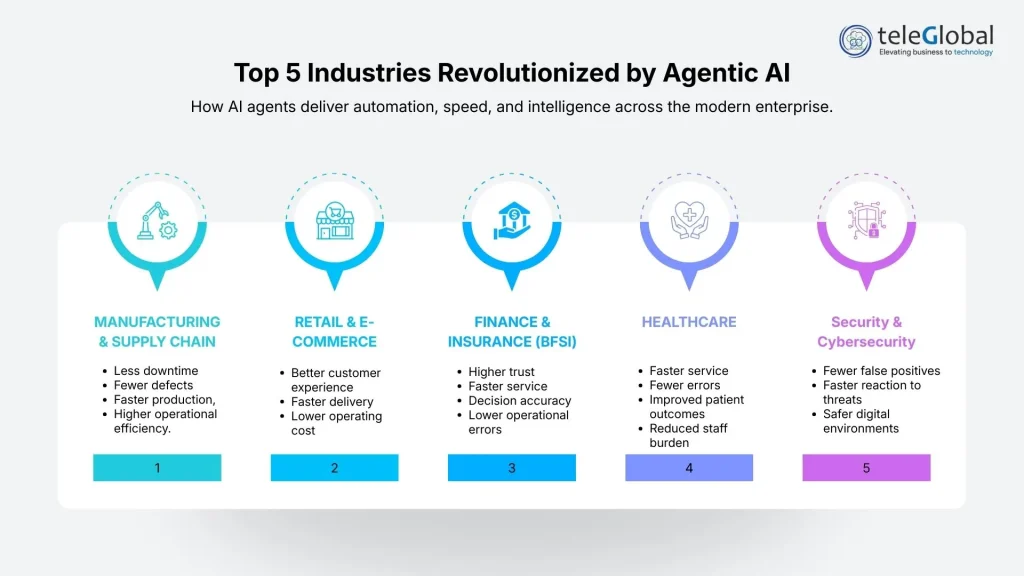
Below are five industries that are changing fastest, what is happening, and why it matters.
1. Manufacturing & Supply Chain
Ai Automation In manufacturing, companies deploy AI agents for predictive maintenance, quality checks, and supply chain coordination.
One global manufacturer reduced downtime by nearly 40% using agents that monitor sensor data and alert teams before machines fail.
At another firm, an agentic AI system now handles over 60% of purchase orders without human involvement.
Why this works:
- Agents integrate with machines, data, and scheduling systems.
- Memory and context help when inputs change, as supply issues arise.
- Real time tool integration ensures the agent can adjust.
Agentic AI benefits here include less downtime, cost savings, greater throughput, and fewer defects.
2. Retail & E Commerce
Retailers now use AI powered business solutions to manage inventory, personalise customer service, and automate order tracking.
Some major retailers are rolling out ai agents that manage order fulfilment, customer support, and dynamic pricing. Investments in these systems have jumped by more than 70% in the past year.
What makes retailer use strong:
- Agents that connect front end (customer) with back end (inventory, logistics) tools.
- Persistent memory: showing past purchases and preferences.
- Automation of repetitive tasks such as follow ups and returns.
Agentic AI for businesses in retail gives better customer experience, faster delivery, and lower cost.
Several global retailers report that agent-driven customer service flows reduce handling time by up to 42% and increase repeat purchase likelihood by 16%. Inventory-driven agents also cut stockouts by approximately 20%.
3. Finance & Insurance
In finance, agents perform risk modelling, compliance checks, fraud detection, and more.
Banks and insurance firms are deploying AI agents that can process claims, validate transactions, and run background compliance checks.
Executives report that their agentic AI use cases 2025 projects deliver measurable value, including lower error rates, faster processing, and cost savings.
Insurance firms are also using agents to automate fraud detection. These agents extract data, check rules, and escalate when human judgment is needed.
- AI-driven fraud detection reduces false positives by up to 50% in major banks.
- Automated claims processing cuts cycle times by 30–50%
- Compliance-checking agents improve accuracy by up to 92%, reducing audit overhead significantly.
Agentic AI benefits in finance include higher trust, speed, and improved compliance.
Banks piloting agentic systems for transaction reviews report processing time reductions of 50–70%. Insurance firms using AI-driven claims analysis have reduced manual workload by nearly 35%.
4. Healthcare
Healthcare faces resource constraints, regulatory demands, and fast data growth. Agentic AI helps in diagnostics, patient monitoring, and operational tasks.
Agents now monitor patient data such as vitals and lab results, flag anomalies, and schedule follow ups. They also assist staff with paperwork, freeing them to focus on patient care.
Regulatory compliance is another area where agents add value. They can check medical guidelines, summarise research, and suggest treatment options while keeping safety in mind.
AI business automation in healthcare means fewer errors, faster service, and better outcomes.
- Hospitals using AI triage tools report up to 25% faster patient assessment.
- AI-enabled scheduling and workflow agents reduce administrative burden by 30–40%.
- Clinical decision support agents improve diagnostic consistency by 12–18% across departments.
5. Security & Cybersecurity
Security teams face rising threats and a flood of alerts. AI agents help by triaging alerts, automating responses, and detecting threats.
Some companies now use agentic AI systems that can act on alerts, prioritise risks, and cut response times drastically.
Agents are also used for fraud detection, identity verification, and phishing defence. These tasks need speed, real time data, memory of past incidents, and integration with monitoring tools.
Examples of agentic AI in security show time saved, fewer false positives, and faster reaction to attacks.
Security teams using agent-based triage report a 52% reduction in false positives and a 32% faster mean time to respond (MTTR) in incident handling.
Common Features That Make Agentic AI Work
Unlike traditional rule-based automation, agentic AI systems can reason, plan, and take action autonomously using real-time context. They do not rely on fixed workflows but instead adjust decisions dynamically. This difference allows organizations to move from linear automation to adaptive, outcome-based execution where agents can coordinate complex, multi-step tasks across tools and departments.
Across industries, the following factors make agent adoption successful:
- Strong context and memory so agents learn and adapt.
- Tight integration with business tools (ERP, CRM, security, health records).
- Feedback loops and oversight so mistakes get caught.
- Modular design so agent parts can update independently.
- Clear goals and metrics like downtime saved, cost cut, or customer satisfaction.
Risks & Best Practices
These industries also show risks:
- Projects without clear goals often stall.
- Poor data quality causes wrong outcomes.
- Security or privacy issues hurt trust.
- Over automation without human checks leads to errors.
Best practices include pilot testing, involving domain experts, building governance, and designing agents to escalate when unsure.
According to Capgemini research, 68% of failed AI initiatives cite data quality as the primary reason for breakdown. Gartner also notes that by 2026, nearly 60% of enterprise AI incidents will be caused by poor governance or lack of oversight rather than model weaknesses.
Looking Ahead: Enterprise AI 2025 & Beyond
- More multi agent systems will emerge, with agents from different functions working together.
- Vertical specific agentic AI for businesses will grow in law, education, and agriculture.
- Investments in trust, explainability, and safety will increase.
- AI agent builder platforms will improve, lowering barriers to adoption.
- The enterprise AI market size was estimated at USD 23.95 billion in 2024 to approximately 1,55,210.3 million by 2030, growing at a CAGR of 37.6% from 2025 to 2030, showing strong demand.
Conclusion
These five industries showcase what is possible when agentic AI moves from pilot projects to core operations. When done well, ai agents bring value such as speed, accuracy, cost savings, and better service.
At Teleglobal International helps through deep expertise in secure AI deployment, cross-industry integrations, and multi-cloud optimization. Our teams have delivered solutions that reduce operational costs by up to 30% while accelerating deployment timelines through reusable agent components, scalable architectures, and industry-specific blueprints. This unique combination helps enterprises translate AI investments into measurable business outcomes.
Let’s discuss your AI strategy → Contact us today.
Frequently Asked Questions
1. What is an agent in AI?
An agent is a system that senses, decides, acts, and adapts over time. It handles repetitive tasks and complex decisions.
2. What are examples of agentic AI?
Examples include agents that monitor machines in factories, optimise inventory for retailers, manage financial risk, support patient care, or respond to cyber threats.
3. What are agentic AI benefits for businesses?
Benefits include lowering cost, saving time, reducing error, scaling operations, improving service, and freeing staff for critical work.
4. What is enterprise AI 2025 outlook?
In 2025, enterprise AI is moving from pilot projects to full deployments. Most industries will use agentic AI for businesses in deeper ways.
5.What are agentic AI use cases 2025?
Use cases include supply chain automation, financial risk modelling, customer support, security alert triage, and healthcare monitoring.
6. How to choose an AI agent builder?
Pick one that supports context and memory, integrates with your tools, ensures oversight, handles compliance, scales, and delivers measurable results.